

 News
News  Coin Information
  About us
  Customer Service


 Add as a preferred source on Google

Ripple’s token XRP is hovering around the $1.41 level as traders weigh a rare combination of catalysts: a major consumer-facing integration in Japan via Rakuten Wallet and a sharp pickup in institutional inflows. The setup highlights a potential shift from purely speculative activity toward more durable, ‘real-world demand’—even as regulatory uncertainty and bearish technical signals continue to cloud the near-term outlook.
As of Wednesday U.S. Eastern Time (ET), XRP was trading at $1.4099. The token’s 24-hour trading volume surged to roughly $3.34 billion, up 29.5% from the prior day, while market capitalization stood near $86.8 billion. XRP has gained 5.67% over the past week but is down 6.63% over the last 30 days, reflecting a short-term bounce within a broader corrective phase.
The broader drawdown remains notable. After nearing a local high around $3.10 in October 2025, XRP entered a steep decline. It is down about 26.7% year-to-date and approximately 35.3% from a year ago, with a 90-day return of -31.6%—figures that continue to weigh on longer-horizon holders.
A key narrative driver this week has been Rakuten Wallet’s formal launch of XRP integration on April 15 ET, described by market participants as one of the year’s most consequential single adoption events for the asset. The rollout connects XRP to Rakuten Pay’s reported 44 million monthly active users in Japan, enabling users to buy, convert, and spend XRP across a network of more than 5 million merchants.
Analysts point to Rakuten’s points ecosystem as a particularly important demand lever. With an estimated $23 billion-equivalent pool of Rakuten Points potentially convertible into XRP, the integration could generate ongoing transactional demand that is less sensitive to market sentiment than typical exchange-driven flows. In practical terms, XRP’s presence in routine consumer payments represents an attempt to embed the token into everyday commerce—an adoption pathway the market often views as more structurally supportive than short-lived trading spikes.
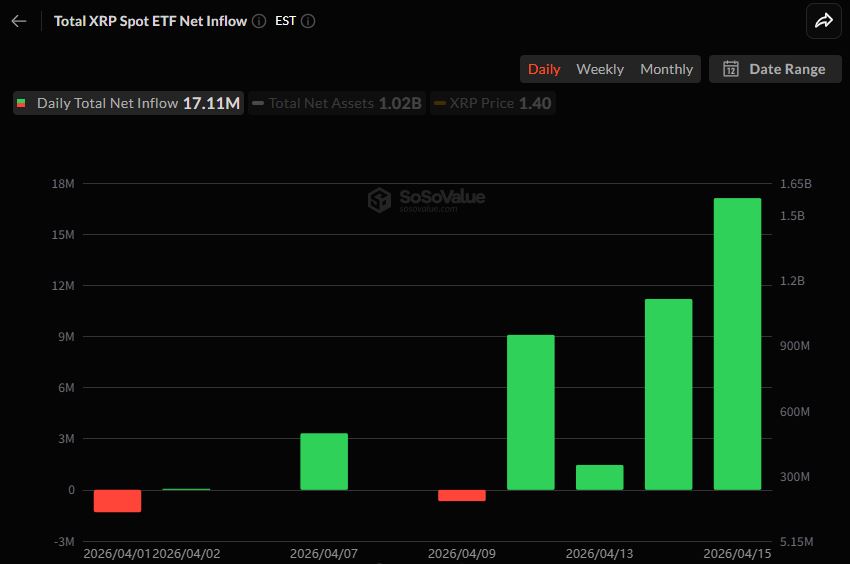
At the same time, institutional positioning has shown renewed momentum. XRP-focused investment products recorded net inflows of $119.6 million for the week ending April 4 ET, the largest weekly addition since mid-December 2025. The figure also represented roughly 53% of total global crypto fund inflows for that week, underscoring the extent to which capital was concentrated in XRP-linked exposure.
While such inflows are often interpreted as a signal of improving ‘institutional demand’, market observers caution that fund flows do not always translate into immediate price appreciation. In particular, allocators may be building positions ahead of policy or market catalysts, meaning the persistence of inflows—and whether they broaden beyond a few vehicles—will be closely watched.
Regulation remains a central swing factor. The U.S. Securities and Exchange Commission (SEC) is scheduled to hold a digital asset roundtable on April 16 ET, while the U.S. Senate is expected to take up review later this month of the ‘CLARITY Act’, a proposal aimed at clarifying how digital assets are categorized and regulated. Both events are seen as potential volatility triggers for large-cap tokens, including XRP, especially as Ripple’s long-running SEC dispute moves through its late-stage dynamics and the market looks for signals on how the next U.S. framework could be structured.
Technical indicators, however, continue to argue for caution. CoinCodex’s algorithmic outlook projects an April trading range of roughly $1.29 to $1.49 for XRP, and as of April 13 ET, 27 out of 29 tracked indicators were flashing bearish signals, according to the model. Traders are monitoring a near-term resistance zone around $1.60 and support near $1.15 as reference levels for risk sentiment.
Longer-range forecasts are more divided. CoinPedia’s 2026 outlook places XRP in a broad $3 to $6 range under conditions that include a recovery in overall crypto market momentum and continued expansion in Ripple’s banking and payments partnerships. Separately, some institutional analysts have cited year-end targets around $2.80, though such projections are highly sensitive to both macro liquidity and regulatory clarity.
With Rakuten’s user base now connected to XRP, institutional inflows accelerating, and U.S. policy discussions heating up, the token is entering a consequential window. Over the coming months, the market will be testing whether this combination can translate into sustained ‘structural demand’—or whether bearish technical pressure and regulatory overhangs keep XRP constrained despite high-profile adoption headlines.
🔎 Market Interpretation
- Price/flow snapshot: XRP trades near $1.41 with 24h volume +29.5% to ~$3.34B; weekly gain (+5.67%) contrasts with a -6.63% 30-day decline, signaling a bounce inside a broader corrective trend.
- From speculation to usage narrative: The Rakuten Wallet integration links XRP to large-scale consumer payments, introducing a potential demand source tied to commerce rather than exchange-only trading.
- Institutional interest is rising, but not decisive: XRP investment products saw $119.6M weekly inflows (largest since mid-Dec 2025), yet the article notes flows can be positioning ahead of catalysts and may not immediately lift spot price.
- Regulatory catalysts = volatility risk: The SEC digital asset roundtable (Apr 16 ET) and Senate review of the CLARITY Act later this month are framed as near-term swing factors, especially given Ripple’s ongoing SEC dynamics.
- Technicals remain cautious: Algorithmic signals are predominantly bearish (27/29 indicators), with an April model range of $1.29–$1.49; key levels highlighted are resistance ~$1.60 and support ~$1.15.
💡 Strategic Points
- Watch for “structural demand” evidence: Track whether Rakuten Pay usage converts into sustained on-chain/payment activity and repeat purchasing—more meaningful than one-time listing hype.
- Monitor Rakuten Points conversion dynamics: The cited $23B-equivalent points pool is a potential demand lever; key is actual conversion rates and ongoing redemption cycles, not just theoretical capacity.
- Validate institutional inflow quality: Observe whether inflows persist for multiple weeks, diversify across issuers/vehicles, and coincide with tighter spreads and improved spot market depth.
- Risk framework around policy dates: Expect headline-driven gaps around the SEC roundtable and CLARITY Act developments; consider scenario planning for outcomes that improve vs. worsen classification clarity.
- Level-based market structure: Bulls typically need a clean reclaim/hold above $1.60 to challenge bearish structure; a break below $1.15 would reinforce downside risk consistent with the bearish indicator set.
- Separate timelines: Near-term is driven by regulation/technicals; longer-term upside cases (e.g., $3–$6 2026 ranges cited) are contingent on broader market recovery and continued payment/banking partnership expansion.
📘 Glossary
- Institutional inflows: Net new capital entering professionally managed products (e.g., ETPs/funds) that provide XRP exposure.
- Structural (real-world) demand: Ongoing demand created by payments/utilities (spending, settlement) rather than short-lived speculative trading.
- Rakuten Pay / Rakuten Wallet integration: Adding XRP buy/convert/spend functionality within Rakuten’s consumer ecosystem, potentially expanding everyday usage.
- Support / Resistance: Price zones where buying (support) or selling (resistance) historically strengthens; used for risk levels and trade planning.
- Bearish technical indicators: Model/indicator readings (momentum, trend, moving averages, etc.) implying higher probability of continued downside or weak upside follow-through.
- CLARITY Act: A referenced U.S. legislative proposal intended to clarify digital asset regulatory categorization—an important factor for compliance and market confidence.














Comment 0