

 News
News  Coin Information
  About us
  Customer Service


 Add as a preferred source on Google

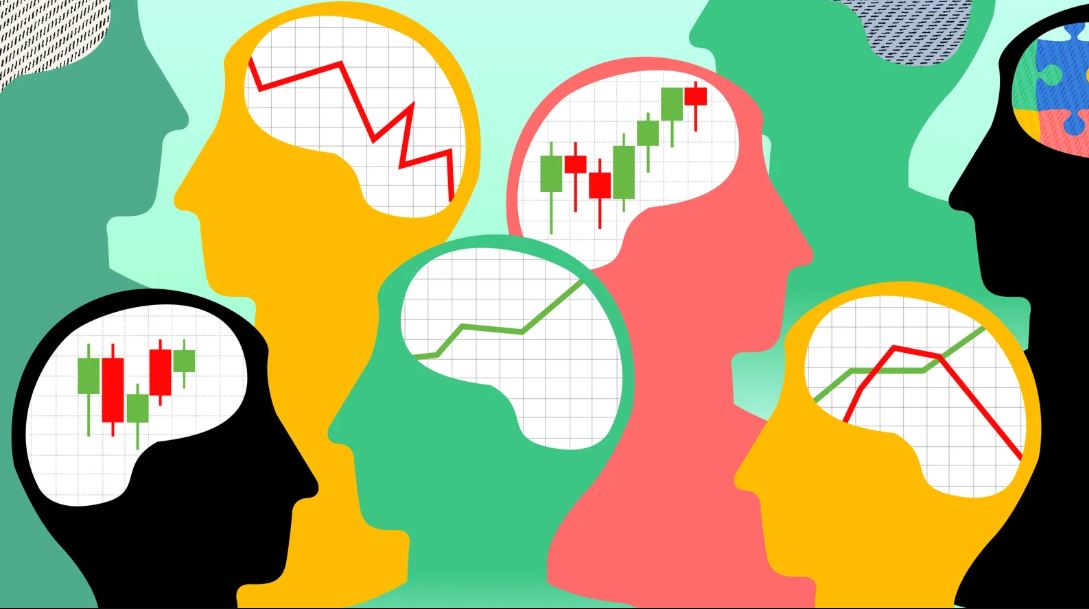
Behavioral finance meets personality testing in platform that maps investor psychology to 16 archetypes — and then prescribes exactly what to do about it.
The question sounds deceptively simple: why do intelligent people with access to the same market data keep repeating the same costly mistakes?
They buy near the top during euphoria. They sell near the bottom in panic. They pledge to diversify and then concentrate everything into a single bet. They set a stop-loss and then quietly move it. The information was available. The strategy existed. Something else went wrong.
The team behind CRTX — a new crypto investor diagnostic platform — believes the answer has little to do with data and everything to do with the structure of how individual traders make decisions under pressure.
"Most tools analyze your portfolio. We analyze your judgment. The portfolio is just the output. We want to understand the input."
THE FRAMEWORK
CRTX — short for Crypto Trader DNA — classifies investors into one of 16 psychological archetypes using a 30-question diagnostic scored on a seven-point Likert scale. The architecture is deliberately familiar: four binary axes, two poles each, producing 2⁴ = 16 possible combinations. The influence of Myers-Briggs is intentional, and the team does not shy away from the comparison.
"MBTI tells you who you are as a person," the team said. "CRTX tells you how you behave as an investor when markets move against you. Those are very different questions."
The four axes function as follows.
Signal measures whether a trader's decisions are driven by quantitative data — on-chain metrics, financial fundamentals, technical indicators — or by qualitative signals: community sentiment, influencer calls, narrative momentum. The poles are Data (D) and Vibe (V).
Horizon measures time preference. Does the investor plan around multi-year market cycles, or does short-term price action dominate their decision-making? The poles are Hold (H) and Trade (T).
Process measures execution discipline. Does the trader operate from a fixed ruleset — pre-defined entries, stop-losses, position sizing formulas — or does real-time intuition override the plan? The poles are Rules (R) and Intuition (I).
Exposure measures risk concentration philosophy. When conviction is high, does the trader concentrate or diversify? The poles are Big Bet (B) and Portfolio (P).
A trader who scores Data, Hold, Rules, and Big Bet receives the code DHRB. One who scores Vibe, Trade, Intuition, and Portfolio is VTIP. Each of the 16 combinations carries a distinct archetype name, a description, and — critically — a customized prescription for how that investor type should trade.
THE ARCHETYPES
The platform's 16 archetypes span the full behavioral spectrum of crypto investing, from the most methodical to the most speculative.
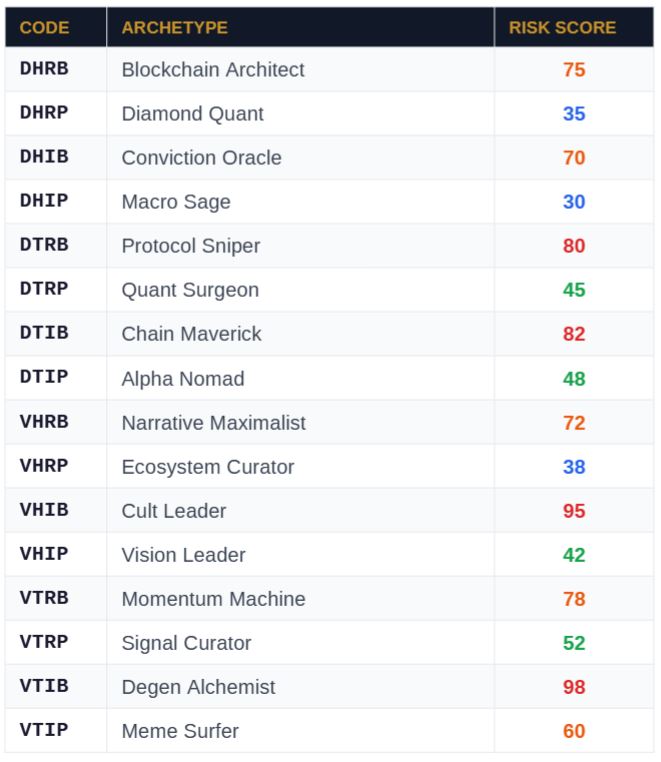
The highest Risk Score belongs to VTIB — the Degen Alchemist, at 98 — driven by vibe-based signals, short-term thinking, intuitive execution, and concentrated positioning. The lowest belongs to DHIP — the Macro Sage, at 30 — a data-driven, long-term, rules-based, diversified investor.
The team notes that two investors can share the same four-letter code while receiving meaningfully different guidance. A borderline B and an extreme B on the Exposure axis are both classified as DHRB, but the prescription adjusts for that difference in intensity.
BEYOND THE LABEL: THE PRESCRIPTION
What distinguishes CRTX from a conventional personality quiz is what comes after the classification. Each result unlocks a detailed prescription — actionable guidance built specifically for that archetype's psychological strengths and blind spots.
The prescription includes a recommended portfolio allocation by asset class, five trading rules the investor should always follow, five behaviors they should never engage in, a position sizing formula, and a single-sentence investment philosophy the team calls a mantra.
The prescription for VTIB — the most aggressive archetype in the system — gives a sense of the approach:
"Under no circumstances touch the 10% stablecoin floor. If a position reaches 3x, take 50% off the table immediately. Once a stop-loss is set, do not remove it. Never trade while in an emotionally elevated state."
"The prescription is not the appendix to the result," the team said. "It is the result. Knowing your type without knowing what to do differently is just an interesting fact about yourself."
The framing deliberately inverts the way personality tests are typically consumed. Where MBTI has become cultural shorthand for explaining — and excusing — fixed behavioral patterns, CRTX positions the classification as the beginning of a behavioral change process, not the end of one.
THE RISK NUMBER
Alongside the four-letter code, CRTX generates a Risk Number: a single composite score from 1 to 100 representing the psychological aggressiveness of the investor's decision-making patterns — not their portfolio size, not their returns, but the underlying behavioral tendencies that produce those returns.
The calculation is axis-weighted. Exposure carries the heaviest weighting at 35%, reflecting the team's view that position sizing is the single largest determinant of portfolio outcomes. Signal and Horizon each contribute 25%. Process carries 15%.
"Risk Numbers go up in bull markets," the team said. "They come down after people live through a 70% drawdown. Seeing that pattern in your own history, tracked across multiple cycles, is more instructive than any single result."
A Risk Number above 80 triggers additional guardrails in the prescription: mandatory stablecoin floor requirements, hard caps on maximum position concentration, and tighter stop-loss guidelines.
THE METHODOLOGY
The 30-question test is designed to surface actual trading behavior rather than stated preferences — a distinction the team treats as the most important variable in diagnostic accuracy. Questions are interleaved across the four axes so that users do not answer eight consecutive Signal questions before moving to Horizon. The design prevents response fatigue and reduces the likelihood of pattern-matching answers.
Several questions are reverse-scored. A question that reads "community vibe and narrative matter more than the numbers" registers as a Vibe indicator when agreed with — and a Data indicator when disagreed with. This prevents respondents from gaming the test by anchoring to one end of the scale throughout.
The team is direct about the diagnostic's limitations. CRTX draws on established behavioral finance frameworks — including Kahneman's System 1 and System 2 thinking, confirmation bias research, and prospect theory — but has not been independently peer-reviewed. It is positioned as a practitioner's self-awareness tool, not a clinical instrument.
"The most common reason for a surprising result is answering aspirationally. We recommend answering based on your worst trading period, not your best."
THE TIMING
The platform launches as a new Bitcoin market cycle appears to be gaining momentum, with institutional inflows through spot ETFs accelerating and the April 2024 halving behind it. The timing is not incidental. Bull markets are precisely when the behavioral patterns CRTX is designed to identify tend to manifest most destructively.
Confirmation bias intensifies when prices are rising. FOMO accelerates entry timing toward cycle peaks. Concentration risk compounds as winning positions grow. Risk Numbers inflate as investors unconsciously revise their own risk tolerance upward to match the market's momentum.
The information advantage available to retail crypto investors has never been greater. On-chain analytics are publicly accessible. Research is abundant. Yet the outcomes of the previous cycle — mass liquidations, panic selling at cycle lows, concentrated losses in collapsed projects — suggest that information alone is not the binding constraint.
"Your biggest risk is not the market," the team said. "It is yourself. CRTX was built around that premise."
CRTX is available at crtxapp.com The diagnostic is free. Full prescription access is unlocked upon email registration.
Disclaimer: This article is not investment advice. CRTX is a behavioral self-awareness tool and does not guarantee investment outcomes. All investment decisions remain the sole responsibility of the individual investor.


















Comment 0