
Solana Put-Call Ratio Tops 2 as Traders Hedge Downside While XRP Stays Call-Led
Deribit data shows Solana traders ramping up downside protection while XRP maintains call-driven upside positioning amid broader market weakness.




Put option activity in Solana (SOL) has surged to more than double call volume over the past 24 hours, signaling a sharper rise in near-term downside hedging, while XRP (XRP) has continued to show comparatively firmer upside appetite through call-led flow. The divergence matters because options positioning often reveals how sophisticated traders are framing risk around key support levels after a broad market pullback.
Data from Deribit, the largest cryptocurrency options exchange, showed that options open interest in contracts expiring March 27 stood at roughly 1,029,176 contracts for Ethereum (ETH) (about $2.13 billion), 328,299 contracts for Solana (about $284.5 million), and 35,378 contracts for XRP (about $48.2 million), based on figures published Thursday UTC.
By open interest put/call ratio—a common proxy for how much bearish protection is outstanding versus bullish exposure—Ethereum printed 0.57, indicating a clear tilt toward calls and a still-resilient 'upside' structure despite the day’s price weakness. Solana and XRP sat closer to neutral at 0.85 and 0.87, respectively, suggesting more balanced positioning in outstanding contracts even as short-dated trading flows diverged.
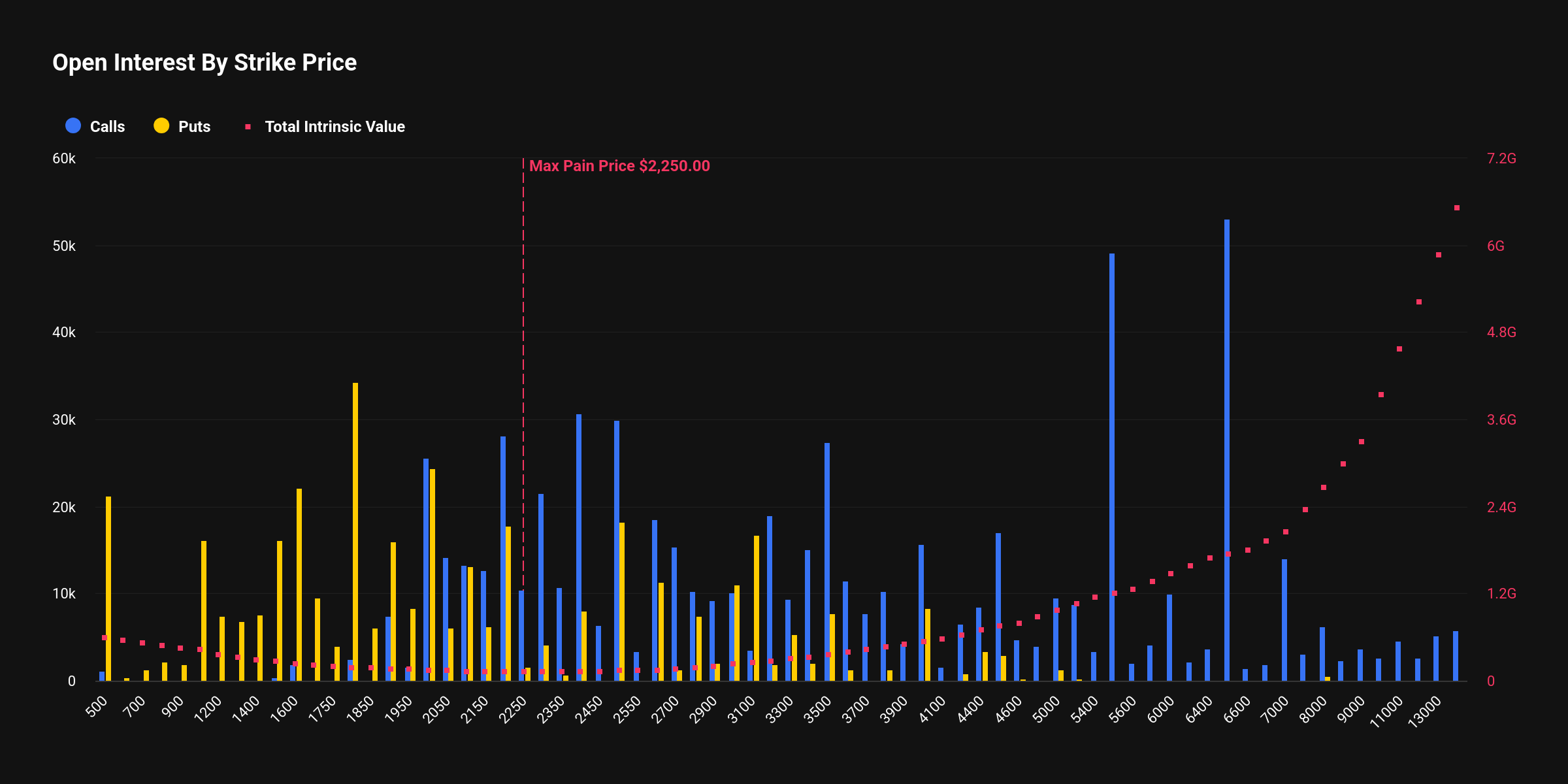
Deribit’s 'max pain' estimate—the price level at which option buyers would experience the greatest aggregate losses at expiry—was pegged at $2,250 for Ethereum, $100 for Solana, and $1.50 for XRP. While max pain is not a forecast, it is frequently monitored as a potential gravitational level near expiration, particularly when liquidity conditions are thin.
Strike-level positioning underscored how traders are expressing their views. In Ethereum, large call open interest was concentrated at high strikes such as $6,500 and $5,500, pointing to lingering demand for longer-tail bullish exposure. At the same time, notable open interest in $1,800 puts suggests that downside insurance remains in place—an indication that market participants are keeping 'risk management' on even while holding optimistic longer-run bets.
Solana’s open interest was clustered at the $80 strike on both calls and puts, highlighting a clear near-term pivot zone. Interest was also visible at the $300 call strike, a pattern more consistent with positioning for 'volatility expansion'—for example, via convex upside exposure—rather than a purely directional bet. The distribution suggests traders are bracing for larger moves while still treating the $80–$100 region as a key battle line.
For XRP, positioning centered tightly around $1.40 with both calls and puts stacked at that level, alongside additional put concentration around $1.50. The shape implies the market is prioritizing defense of the current range rather than aggressively chasing higher levels, reflecting a more cautious stance even as calls have dominated recent trading volume.
That caution is clearer in the latest 24-hour flow. Total options trading volume over the period was reported at 161,468 contracts for Ethereum, 61,440 for Solana, and 2,813,000 for XRP. The 24-hour put/call ratio came in at 1.04 for Ethereum, 2.08 for Solana, and 0.67 for XRP—meaning Ethereum flow leaned slightly toward puts, Solana saw a pronounced put-heavy skew, and XRP remained call-led.
In practice, a put/call ratio above 1 in short-dated volume often reflects either increased demand for downside protection or speculative downside positioning. Solana’s reading above 2 suggests traders are paying up for protection or positioning for additional drawdowns—an interpretation consistent with the token’s sharper daily decline. XRP’s sub-1 ratio, meanwhile, indicates relatively stronger interest in upside exposure despite falling spot prices.
Among the most actively traded contracts, Ethereum volume was concentrated in strikes including the $2,000 put (March 27 expiry) and calls around $2,100–$2,300 across late March and early April expirations, with longer-dated interest also appearing in higher-strike calls such as $3,200 for late September. Solana’s heaviest activity clustered around early April expiries, featuring puts at $80, $84, and $60 alongside calls around $88 and $90. In XRP, notable flow included the $0.90 put and $1.55 call (both April 10), plus a higher-strike $2.20 call for April 24, reflecting a mix of protection and upside optionality.
Spot markets were broadly weaker during the session. As of 10:55 a.m. in Seoul (1:55 a.m. UTC) on Thursday, Ethereum traded at $2,068, down 4.50% on the day. Solana fell 5.61% to $86.72, while XRP slid 3.49% to $1.364, according to TokenPost Market data.
The combined picture suggests traders are increasingly distinguishing between assets on a relative-risk basis: Ethereum retains a call-heavy outstanding structure despite near-term hedging, Solana is seeing a decisive rush into downside protection, and XRP is holding a comparatively constructive flow profile even as open interest remains balanced. With multiple key expiries approaching, the next leg in price action may be shaped as much by 'positioning unwind' and hedging dynamics as by spot-driven sentiment.