
Retail Bitcoin Activity Rises but Lags Institutional Market Influence
CryptoQuant analysis shows rising retail Bitcoin activity but limited market influence as larger institutional flows continue to drive price trends.


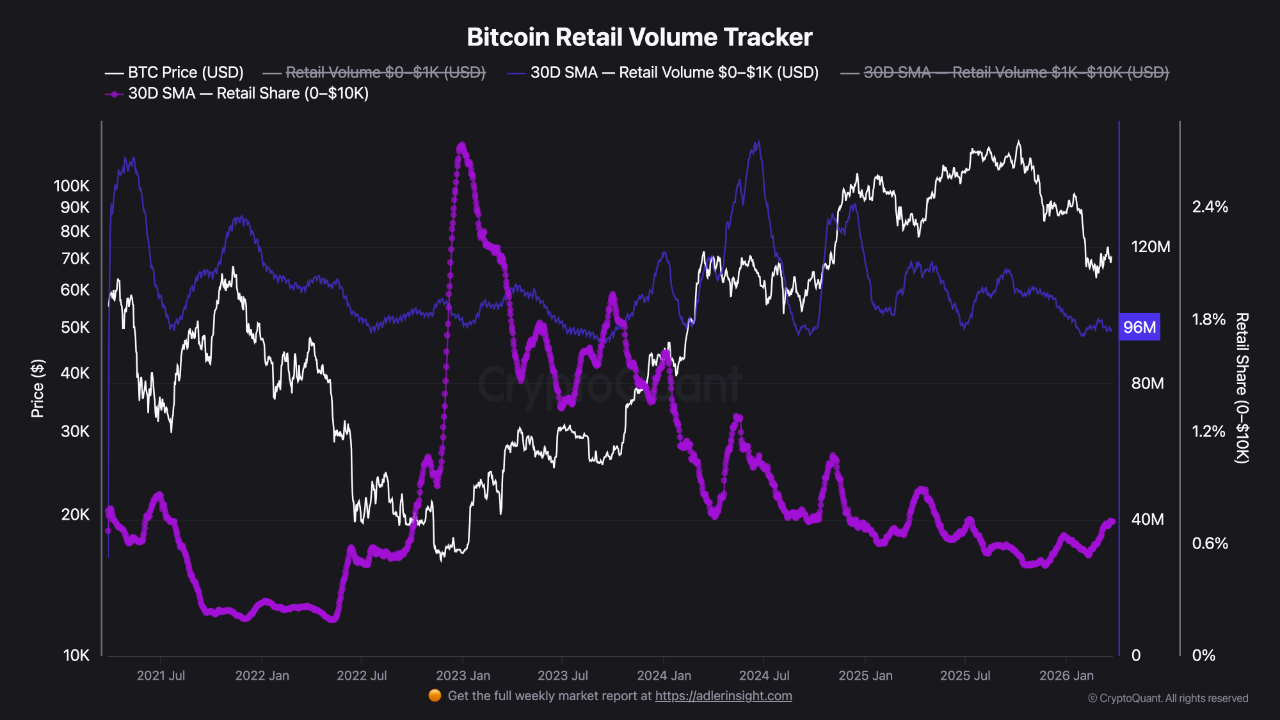
Retail Bitcoin (BTC) traders are becoming more active on-chain, but their ability to shape broader market direction remains limited—suggesting that much of the individual flow is still 'following money' rather than leading it.
In a note published Wednesday UTC on CryptoQuant, on-chain analyst “JizCrypto” said small investors have been participating more aggressively during periods of price movement, yet their relative footprint in the Bitcoin network has not expanded. “Retail investors are reacting to price fluctuations and joining trading activity, but their influence in the market is not increasing,” the analyst wrote.
CryptoQuant data cited in the report shows that very small transactions—defined as transfers worth $0 to $1,000—have continued to rise in repeated bursts. The 30-day moving average for this band has held near $95 million, indicating that when Bitcoin climbs or volatility increases, individual traders tend to rush in for short-term positioning.
However, activity does not necessarily translate into market power. The share of transactions in the $0 to $10,000 range climbed from mid-2022 through early 2023, but has trended downward since then. It is now hovering at roughly 0.7% of total network activity, suggesting that retail participation is not keeping pace with the growth in overall on-chain flows.
“Retail investors are trading actively, but their share of the market is no longer increasing,” JizCrypto noted, adding that current retail funds display a strong tendency to 'chase price moves' rather than set them. In practical terms, that points to a market where the marginal driver is more likely to be larger holders and institutional-sized flows—entities capable of moving liquidity and sustaining trend formation.
The takeaway is that while small investors remain visible in transaction volume—especially during high-volatility stretches—the structure of the current Bitcoin cycle appears less like a retail-led rally and more like one shaped by bigger capital. If that dynamic persists, near-term price action may continue to be dictated by shifts in larger positioning, with retail activity reacting after the fact.
Article Summary by TokenPost.ai
🔎 Market Interpretation
Retail on-chain activity is rising, but impact is not: Small BTC holders are transacting more during price swings, yet their share of total network activity is not expanding—implying they are participating without meaningfully steering the market.
Behavior is reactive (“following money”): The data suggests retail tends to enter after volatility or upward price movement begins, positioning for short-term moves rather than initiating trends.
Market direction likely set by larger capital: With retail influence hovering near ~0.7% of network activity (for $0–$10K transactions), marginal price direction is more plausibly driven by whales/institutions that can move liquidity and sustain trends.
Cycle structure looks institution/whale-shaped: The current phase resembles a bigger-capital-led cycle where retail is visible mainly as a volatility amplifier, not as the primary trend engine.
💡 Strategic Points
Don’t confuse activity spikes with leadership: Bursts in $0–$1K transfers (30D MA near ~$95M) may reflect crowd participation, but not necessarily a durable bullish signal if retail share is flat/down.
Watch concentration and large-flow indicators: If larger holders are the main drivers, tracking whale exchange flows, large UTXO activity, and institutional inflow proxies may be more informative than retail transaction counts alone.
Volatility can attract late retail entries: When BTC rallies or becomes choppy, retail tends to “rush in,” which can increase short-term noise and whipsaws—risk management (position sizing, stops, time horizon) becomes more important.
Use retail share as a cycle context metric: A sustained rise in the percentage of small transactions (not just absolute volume) could indicate broader grassroots participation; continued weakness suggests trend sustainability depends on big players.
Near-term price sensitivity: If the market is large-flow-led, abrupt reversals may occur when bigger positioning shifts—retail may only respond after the move, increasing gap risk around key levels.
📘 Glossary
On-chain activity: Transactions and behaviors observed directly on the blockchain (e.g., transfers between addresses), used to infer market participation and flows.
Retail investors/traders: Individual, small-size market participants (here approximated by smaller transaction value bands like $0–$1K and $0–$10K).
30-day moving average (30D MA): A smoothing method that averages a metric over the past 30 days to reduce day-to-day volatility and reveal trends.
Transaction share: The proportion of total network activity attributable to a given transaction-size band; useful for measuring relative influence versus absolute volume.
Chasing price moves: Entering trades after a price move is already underway (momentum-following behavior), often linked with late-cycle participation or reactive positioning.
Liquidity: The market’s ability to absorb buying/selling without large price changes; larger participants can meaningfully impact liquidity conditions.
Whales / institutional flows: Large holders or professional entities capable of transacting at sizes that can influence market trends and direction.