
 Add as a preferred source on Google
$553 Million Crypto Liquidations Hit as Short Positions Dominate Market Squeeze
Over $553 million in crypto derivatives positions were liquidated in 24 hours, led by short bets as Bitcoin and Ethereum saw heavy market pressure.




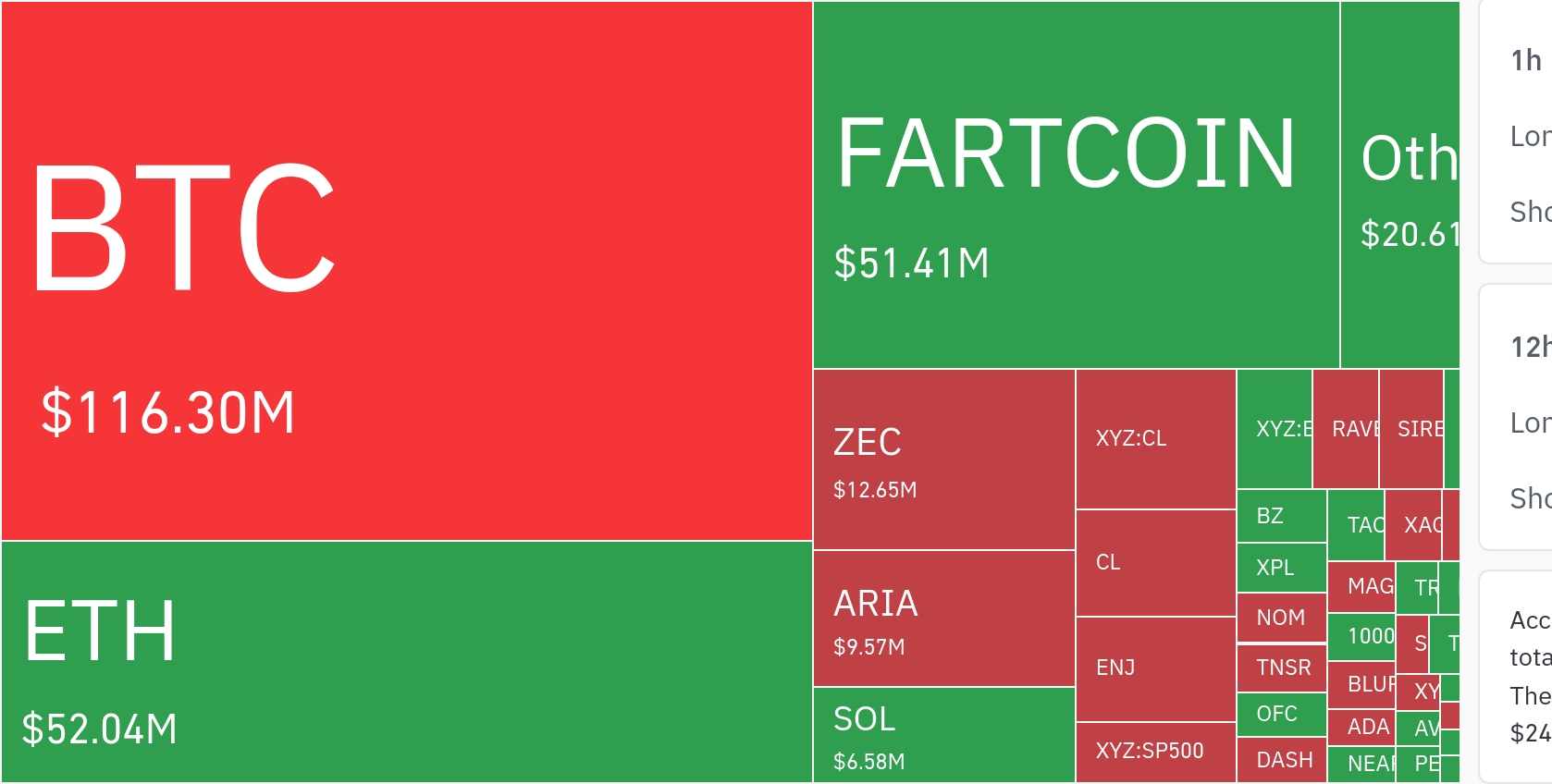
Cryptocurrency derivatives traders faced a sharp wave of forced liquidations over the past day, with more than $553.2 million in leveraged positions wiped out as market volatility accelerated. The imbalance skewed heavily toward bearish bets, underscoring how quickly sentiment can flip when prices move against crowded positioning.
Data aggregated over the 24-hour window showed liquidations were dominated by shorts, which accounted for 68.45% of the total. In crypto markets, a 'liquidation' occurs when a leveraged trader can no longer meet margin requirements and an exchange forcibly closes the position—often amplifying price swings as cascading orders hit the market.
On a shorter time horizon, CoinGlass exchange-level data for the most recent four hours pointed to Binance as the largest source of liquidations, with roughly $16.05 million closed out in that period. Shorts made up 57.71% of Binance’s liquidations, suggesting many traders were positioned for downside that failed to materialize—or were caught by a fast rebound.
Hyperliquid recorded the second-highest liquidation volume over the same four-hour stretch at about $12.74 million, with shorts representing 71.69%. OKX followed with around $7.59 million in liquidations, 65.43% of which were short positions.
One notable outlier was BitMEX, where liquidations were overwhelmingly concentrated in long positions. Longs represented 99.97% of BitMEX liquidations during the referenced period, indicating that positioning on that venue was exposed to downside moves or abrupt intraday drawdowns even as broader market liquidations favored shorts.
By asset, Bitcoin (BTC) absorbed the largest share of liquidation pressure, with approximately $116.3 million in BTC-linked positions liquidated over 24 hours. Ethereum (ETH) followed at about $52.04 million. Several smaller or more speculative tokens also saw significant flush-outs, including FARTCOIN with roughly $51.41 million and Zcash (ZEC) at about $12.65 million.
Dogecoin (DOGE) also experienced substantial liquidations—around $67.3 million—despite a modest 0.52% price increase over the period, a pattern often associated with overleveraged derivatives positioning where even small moves can trigger margin calls.
The scale and composition of the liquidations point to a market environment where leverage remains elevated and price action is sensitive to momentum shocks. With shorts making up the majority of forced closures, the data suggests that downside conviction had become crowded across multiple venues—leaving traders vulnerable to squeeze-like moves when prices stabilized or bounced.
While liquidation data does not, on its own, determine direction, it serves as a real-time barometer of 'liquidity stress' in the derivatives market. The latest flush highlights how quickly volatility can return across cryptocurrencies, particularly when derivatives positioning becomes one-sided.
Article Summary by TokenPost.ai
🔎 Market Interpretation
Liquidation shock: Roughly $553.2M in leveraged crypto derivatives positions were forcibly closed in 24 hours, signaling a volatility spike and high leverage sensitivity.
Shorts were crowded and punished: 68.45% of liquidations were short positions, consistent with a squeeze-like dynamic where stabilization or a rebound forces short covering.
Exchange dispersion matters: In the latest 4 hours, liquidations concentrated on major venues—Binance ($16.05M), Hyperliquid ($12.74M), OKX ($7.59M)—with shorts still the majority on each, implying broadly similar positioning across platforms.
Venue-specific positioning divergence: BitMEX was a notable outlier with 99.97% long liquidations, indicating its user base was positioned differently (or faced sharper intraday downside) versus the wider market.
Asset-level stress hotspots: BTC led liquidation value ($116.3M), followed by ETH ($52.04M). Elevated liquidation in smaller/high-beta names (e.g., FARTCOIN $51.41M, ZEC $12.65M) suggests risk-on leverage extended beyond majors.
Small price move, big damage: DOGE saw about $67.3M liquidated despite only a 0.52% price increase, highlighting how thin margin buffers and high leverage can trigger cascading closures even on modest moves.
💡 Strategic Points
Watch for squeeze risk after one-sided positioning: When liquidations skew heavily toward shorts, remaining shorts may reduce exposure, potentially adding upward pressure via forced buying.
Use liquidation mix as a stress indicator, not a compass: The data reflects positioning fragility and liquidity stress, but does not guarantee the next directional move.
Cross-exchange signals: If multiple venues show short-heavy liquidations simultaneously, it suggests a market-wide crowded trade; if one venue diverges (e.g., BitMEX long-heavy), it may hint at different client flows or instrument mix.
Risk control implication: High liquidation totals often coincide with wider spreads and slippage; traders may consider reducing leverage, widening stop buffers, or scaling entries to avoid forced exits during volatility bursts.
Token selection matters in stress: Large liquidations in speculative tokens can amplify volatility and spill over into majors as traders deleverage portfolios.
📘 Glossary
Liquidation: An exchange forcibly closes a leveraged position when margin falls below required levels, typically during adverse price moves.
Leverage: Borrowed exposure that magnifies gains and losses; higher leverage increases liquidation risk.
Margin: Collateral posted to support a leveraged trade; insufficient margin triggers liquidation.
Short position (short): A bet that price will fall; liquidated if price rises enough against the trader.
Long position (long): A bet that price will rise; liquidated if price falls enough against the trader.
Short squeeze: Rapid price rise that forces shorts to buy back to close, accelerating the move upward.
Cascading liquidations: A chain reaction where liquidations push price further, triggering more liquidations.
Liquidity stress: Market conditions where order flow and forced unwinds cause exaggerated price swings and reduced execution quality.