

 News
News  Coin Information
  About us
  Customer Service


 Add as a preferred source on Google

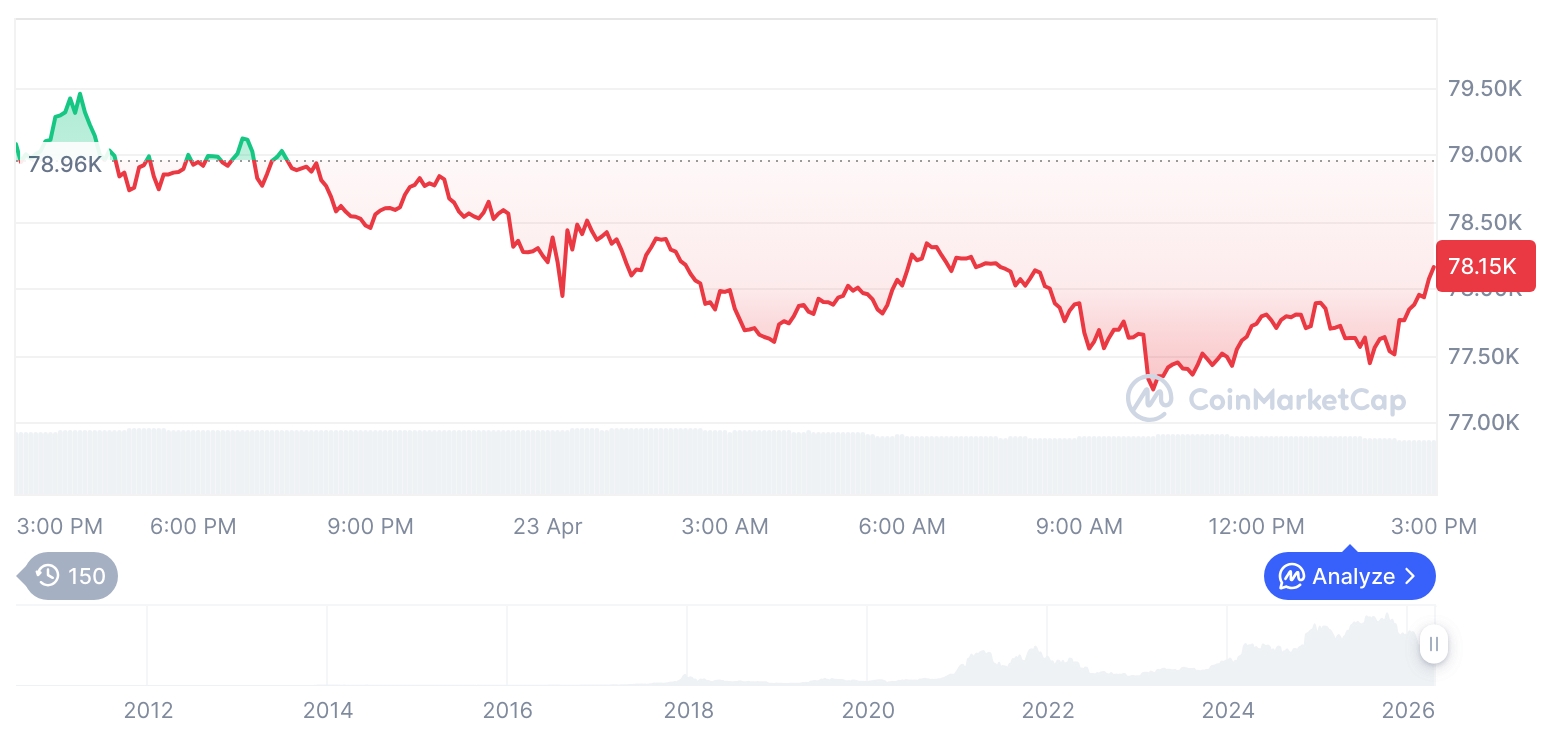
Crypto traders on Telegram are increasingly framing Bitcoin’s next move as a ‘risk-management’ question rather than a directional bet, with a widely circulated warning that a break below $75,000 could accelerate downside pressure. The shift in tone comes as spot Bitcoin hovers in the high-$70,000 range and sentiment gauges are described as oscillating between ‘neutral’ and ‘fear’.
The discussion was highlighted by the latest KOL Index, a community-trend series compiled using Telegram message analysis from TokenPost and DataMaxiPlus. Rather than price predictions, the most shared posts focused on ‘positioning signals’—options-market gamma zones, improving spot Bitcoin ETF flows, and stablecoin liquidity movements—alongside practical campaign and airdrop updates.
Options ‘gamma’ map becomes the day’s key reference point
A recurring framework in community posts centered on Bitcoin options dealer positioning. According to the shared interpretation, the $79,000–$90,000 band is viewed as a ‘long gamma’ zone, where dealer hedging can dampen volatility and potentially cap rapid upside moves. By contrast, commentary suggested that below roughly $75,000 the market may shift into ‘short gamma,’ where hedging dynamics can amplify spot selling and speed up declines.
“There may still be room to grind higher, but if 75K breaks, the response has to change,” became a common, action-oriented refrain—reflecting a broader preference for defining levels that would alter risk exposure.
Spot Bitcoin ETF flows turn broadly positive, BlackRock’s IBIT in focus
Another major theme was a rebound in spot Bitcoin ETF demand. Community channels widely cited Bloomberg ETF analyst Eric Balchunas, who said flows across issuers had flipped back to net inflows. Particular attention fell on BlackRock’s iShares Bitcoin Trust ($IBIT), described in circulated posts as posting inflows in the top 1% of the ETF product set.
Even so, the tone was more cautious than celebratory. Many messages paired the inflow headlines with reminders that total cumulative inflows remain below prior peaks, framing the latest data as a ‘confirmation signal’ to be monitored rather than a definitive trend reversal.
Stablecoin liquidity sends mixed signals: exchange inflows vs DeFi outflows
On-chain summaries also gained traction after claims that centralized exchanges recorded approximately $1.7 billion in net stablecoin inflows over the past week, while decentralized finance (DeFi) saw around $5.4 billion in net outflows over the same period.
Traders debated whether a string of security incidents and hacking headlines has pushed users toward perceived safety—either holding stablecoins on major venues or sitting in cash-like positions—while simultaneously pulling liquidity out of DeFi protocols. Several posts characterized the data as a ‘mixed signal’: potential dry powder accumulating on exchanges at the same time as risk appetite appears to be receding elsewhere.
USD1 listing on Bybit sparks attention with WLFI reward campaign
Beyond market structure and flows, practical “how-to” content ranked highly—especially a breakdown of a USD1 listing on Bybit and an associated reward campaign totaling 10 million WLFI. Shared summaries outlined three main parts:
- Spot trading rewards for USD1 pairs totaling 6 million WLFI (April 22 to May 6)
- Mantle-based Alpha rewards totaling 1 million WLFI during the same period (often cited with a $500 participation condition)
- A “Puzzle Hunt” segment totaling 3 million WLFI (May 6 to May 22), tied to attendance-style engagement, trading, and referrals
Posts also pointed to upcoming fee promotions beginning May 6, including 0% fees for USDC/USD1 and USD1/USDT, with traders describing the structure as a two-stage playbook: early trading/alpha participation followed by the later puzzle campaign.
Tether freeze tied to enforcement action and ‘pig butchering’ scams
Community feeds also circulated Tether’s statement regarding the freezing of $344 million worth of USDT, describing coordination with U.S. law enforcement and the Office of Foreign Assets Control (OFAC). The freeze was widely framed as part of efforts targeting ‘pig butchering’ scams—long-horizon fraud schemes that combine social engineering with investment deception.
Notably, traders appeared more interested in the underlying criminal typology than the freeze headline itself, with broader discussion touching on how enforcement actions and compliance expectations can shape ‘stablecoin’ market risk.
Airdrop and TGE chatter continues: Pharos and MegaETH
Airdrop-related posts remained a high-engagement category. Pharos registration criteria—such as testnet participation, Discord roles, and an OKX Wallet campaign—were frequently shared alongside claim links and user comparisons of allocation size and deposit requirements. The most debated points centered on whitelist status and how allocation changes by deposit amount.
Meanwhile, brief, viral updates suggested MegaETH’s token generation event (TGE) may be approaching within roughly a week, driving renewed demand for schedule confirmations.
Overall, the day’s most-shared community narratives emphasized ‘risk and liquidity signals’—options gamma levels, ETF inflows, and stablecoin movement—while campaign logistics and airdrop checklists provided the practical backdrop. The KOL Index analysis is based on Telegram messages collected through DataMaxiPlus’ community analytics tools.


















Comment 0