
Ethereum Sees $47 Million Outflows as Capital Shifts to USDT and USD
Ethereum recorded $47.27 million in outflows as traders moved funds into USDT and USD, signaling a defensive market shift toward liquidity.








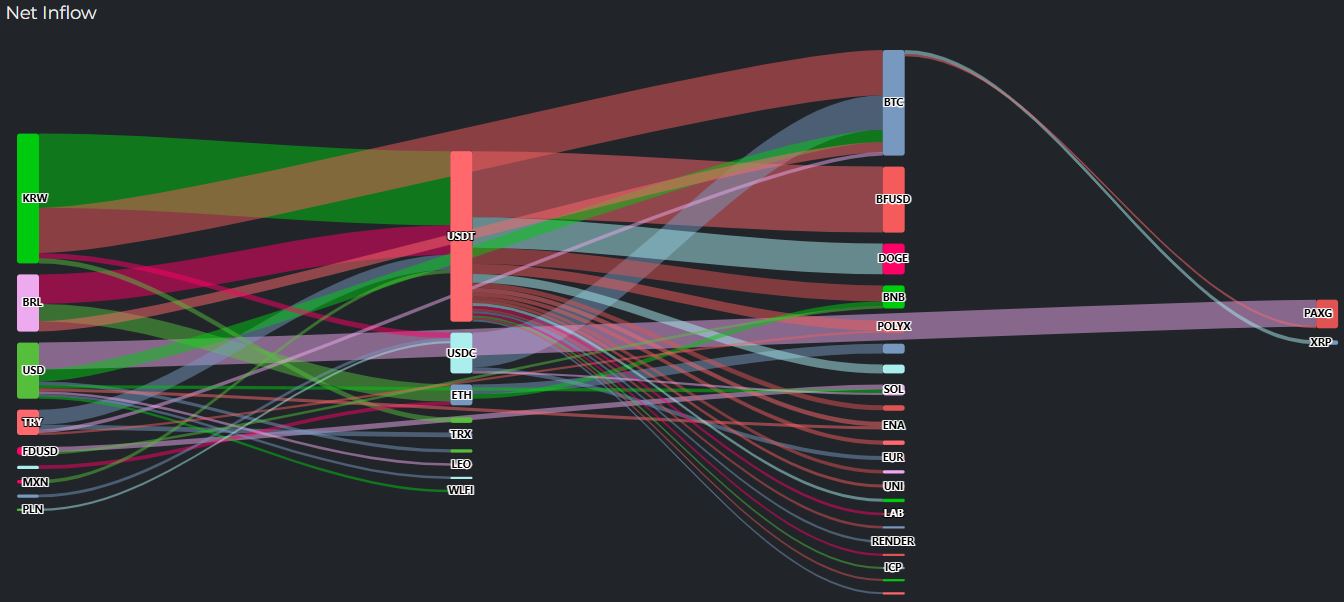
Ethereum (ETH) saw a sharp short-term capital outflow of roughly $47.27 million, while the broader market’s资金 appeared to rotate toward 'stablecoin liquidity'—particularly Tether (USDT)—and into U.S. dollars, underscoring a more defensive positioning by traders.
According to Cryptometer data referenced at 2:55 a.m. ET on May 15 (with flows measured over the previous five hours), fresh fiat inflows into the crypto market were led by the South Korean won (KRW) at $6.36 million, followed by the Brazilian real (BRL) at $2.80 million, the U.S. dollar (USD) at $2.76 million, and the Turkish lira (TRY) at $1.26 million.
Stablecoin flows also showed dispersion across multiple assets. Over the same window, about $8.34 million in USDT and $1.99 million in USD Coin (USDC) were distributed across various cryptocurrencies. The largest beneficiaries of these inflows were BFUSD ($5.23 million) and Bitcoin (BTC) ($5.19 million). Smaller but notable inflows were recorded in Dogecoin (DOGE) at $1.50 million, Ethereum (ETH) at $1.04 million, Pax Gold (PAXG) at $1.43 million, and BNB (BNB) at $1.15 million.
Despite those pockets of buying, the dominant story was the abrupt exit from ETH. Cryptometer’s outflow dashboard showed Ethereum leading all assets with $47.27 million in net outflows over the period. Additional, more modest outflows were observed from Billions Network (BILL) at $5.26 million and Bitcoin at $4.77 million, suggesting a broader—if shallow—risk reduction across several major tokens.
The destination of that withdrawn capital points to a preference for 'parking liquidity' rather than rotating immediately into other volatile assets. Cryptometer data indicated that approximately $71.39 million settled into USDT, while $14.51 million moved into USD, highlighting demand for stability and optionality amid near-term uncertainty.
In market terms, a pivot into USDT and cash-like holdings often reflects traders preparing for volatility—either to hedge drawdowns, to wait out event risk, or to keep dry powder available for faster re-entry. If the pattern persists, it may translate into thinner spot depth for major altcoins in the short run, while strengthening the role of stablecoins as the market’s preferred interim settlement layer.
Article Summary by TokenPost.ai
🔎 Market Interpretation
Risk-off rotation: A pronounced $47.27M net outflow from Ethereum (ETH) over ~5 hours signals short-term de-risking rather than rotation into higher-beta alts.
Liquidity preference: Capital largely moved into USDT ($71.39M) and USD ($14.51M), suggesting traders are prioritizing stability and flexibility (“parking liquidity”).
Mixed inflow backdrop: Despite ETH’s heavy outflows, smaller inflows into BTC and select assets indicate buying was selective and likely tactical, not broad-based accumulation.
Fiat on-ramps remain active: Fresh fiat inflows were led by KRW ($6.36M), then BRL ($2.80M), USD ($2.76M), and TRY ($1.26M), implying continued participation but with a more defensive allocation.
Potential market impact: If the pattern continues, spot depth in major altcoins may thin, while stablecoins strengthen as the default settlement and waiting layer for redeployment.
💡 Strategic Points
Monitor ETH outflow persistence: Repeated large net outflows can precede near-term downside pressure or higher volatility; stabilization would be a constructive signal.
Watch stablecoin dominance as a risk gauge: Rising net inflows into USDT/USD can indicate reduced risk appetite and a preference for optionality ahead of catalysts.
Track “where the inflows actually land”: Even in defensive regimes, BTC and liquid large caps often absorb a portion of risk capital first; continued BTC inflows alongside stablecoin buildup can hint at barbell positioning (safety + optional upside).
Liquidity deployment signals: A large USDT build can be bullish or bearish depending on follow-through—look for subsequent conversion from USDT into majors as a confirmation of re-risking.
Short-horizon caveat: The data reflects a ~5-hour window; treat it as an intraday positioning read, best validated with repeated intervals and price/volume confirmation.
📘 Glossary
Net inflow / net outflow: The balance of capital entering or leaving an asset over a set period (inflows minus outflows).
Stablecoin liquidity: Capital held in stablecoins (e.g., USDT/USDC) used as a low-volatility base for trading and quick redeployment.
Parking liquidity: Moving funds into cash-like instruments (USD or stablecoins) temporarily to reduce exposure while keeping the ability to re-enter quickly.
Spot depth: Available buy/sell liquidity in spot order books; thinner depth can amplify price swings.
Dry powder: Capital held on the sidelines (often in stablecoins) waiting to be deployed into risk assets.
Event risk: Uncertainty around scheduled or unscheduled catalysts (macro releases, regulatory headlines, protocol events) that can trigger volatility.