
Crypto Liquidations Hit $176 Million as Short Squeeze Emerges
Crypto markets saw $176 million in liquidations over 24 hours as a short squeeze briefly drove upside pressure, with Bitcoin and Ethereum leading activity.






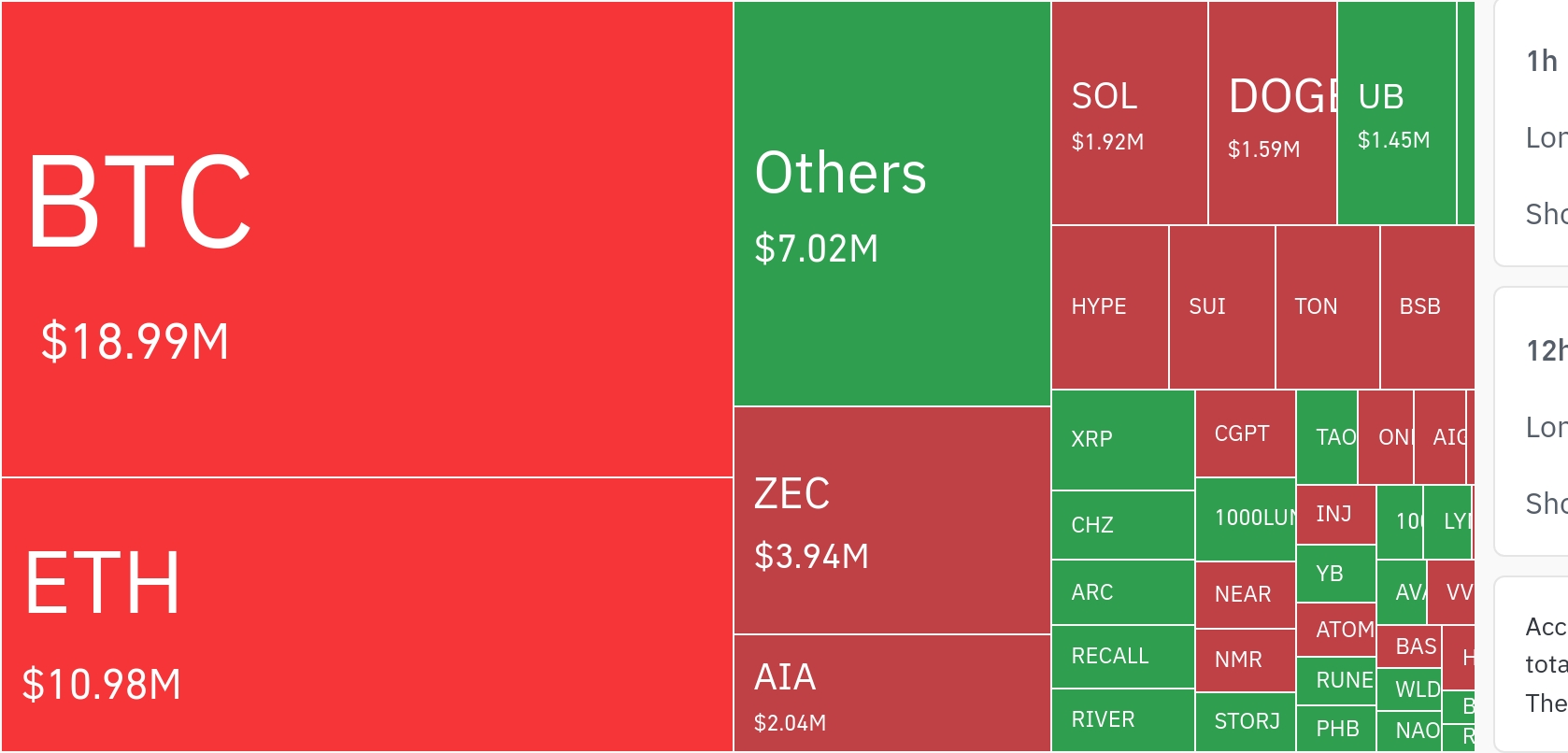
Crypto derivatives traders saw a fresh wave of forced liquidations over the past day, with data suggesting a largely two-sided washout overall but a sharp, short-lived burst of ‘short squeeze’ dynamics in the most recent hours.
Across the last 24 hours, roughly $176.17 million in leveraged positions were liquidated in the cryptocurrency market, based on aggregated ticker-level figures. Long liquidations totaled about $89.45 million, edging out short liquidations at around $86.72 million—close to evenly split, indicating no overwhelming directional consensus during the period.
That balance shifted materially in the most recent four-hour window. Exchange-by-exchange data showed $13.11 million in liquidations, dominated by shorts at $11.55 million, or 88.07% of the total. The concentration of short liquidations points to upward price pressure—however modest—being sufficient to push over-leveraged bearish positions past margin thresholds, accelerating a reflexive rebound.
Binance led liquidations over the past four hours with $5.34 million, representing 40.75% of the total, and shorts accounted for $4.41 million (82.51%). Bybit followed with $3.14 million, where short liquidations made up an even more pronounced 94.92%. Gate posted $1.75 million, OKX recorded $1.30 million, and Bitget saw about $0.98 million. Notably, Hyperliquid and Lighter registered 100% of their reported liquidations on the short side, reinforcing the view that the latest move was driven more by a squeeze in bearish positioning than by a broad risk-off selloff.
By asset, Bitcoin (BTC) remained the focal point of liquidation activity. BTC traded around $118,000, up roughly 0.3% over 24 hours, yet liquidation flows were heavy on both sides: in the past hour, about $13.16 million in longs and $11.25 million in shorts were liquidated; over four hours, $53.49 million in longs and $51.33 million in shorts; and over 24 hours, $61.78 million in longs versus $60.68 million in shorts. Separate heatmap-style readings also placed BTC at the highest liquidation intensity over 24 hours, at roughly $18.99 million.
Ethereum (ETH) was comparatively steady near $3,297, but still posted notable derivatives cleaning. Over 24 hours, ETH liquidations totaled roughly $0.99 million on the long side and $0.89 million on the short side. In the 24-hour liquidation heatmap, ETH ranked second behind BTC at about $10.98 million, underscoring how liquidations remain concentrated in the market’s two largest benchmark assets even when spot moves appear contained.
Among major altcoins, Solana (SOL) showed relative strength, rising about 1.9% over 24 hours to $170.67. SOL recorded approximately $0.19 million in long liquidations and $0.18 million in short liquidations over the day, while heatmap figures showed about $1.92 million in liquidation intensity. XRP traded around $2.474, up 1.1%, though its liquidation mix was more mixed. Dogecoin (DOGE) rose 0.8% to $0.1972, with short liquidations (~$84,590) exceeding long liquidations (~$53,640). DOGE also logged a relatively elevated heatmap figure of about $1.59 million, consistent with persistent ‘meme coin’ volatility and leverage-driven whipsaws.
One of the more unusual standouts was Zcash (ZEC). Despite only a modest 0.5% gain over 24 hours to $163.3, ZEC registered around $3.94 million on the 24-hour liquidation heatmap—surpassing SOL and DOGE. The divergence between muted spot performance and elevated liquidation intensity suggests leverage positioning may have become unusually crowded relative to liquidity, leaving traders vulnerable to incremental price moves.
Less prominent tokens also saw meaningful liquidation spikes, including AIA at roughly $2.04 million and UB at around $1.45 million on heatmap data. While these assets sit outside the core majors, the activity may indicate short-term dislocations in positioning and thinner order books amplifying forced unwinds.
Overall, the session’s defining feature was not a large spot-market drawdown—most tracked assets moved within a relatively narrow range of roughly -0.3% to +1.9% over 24 hours—but rather a derivatives-led reset. The data suggest a market that stayed broadly range-bound in aggregate, yet became briefly vulnerable to upside squeezes as bearish leverage accumulated and then unwound quickly during a rebound attempt.
Article Summary by TokenPost.ai
🔎 Market Interpretation
Total liquidations (24h): ~$176.17M, split nearly evenly between longs (~$89.45M) and shorts (~$86.72M), signaling a two-sided leverage flush rather than a one-direction capitulation.
Micro-regime shift (last 4h): Liquidations turned sharply short-dominant (~$11.55M shorts of ~$13.11M total; ~88.07%), consistent with a brief short squeeze where modest upside forced bearish positions to close.
Exchange concentration: Binance drove the largest share of 4h liquidations (~$5.34M; ~40.75%), with Bybit also notable for extreme short-heavy unwinds (~94.92% shorts). Hyperliquid and Lighter reported 100% short-side liquidations, reinforcing squeeze dynamics.
BTC remains the liquidation magnet: Despite BTC being only ~+0.3% near $118K, liquidation activity was heavy on both sides across multiple windows, implying crowded leverage and tight margin buffers even in a range-bound tape.
ETH steady, but still leveraged: ETH hovered near $3,297 with comparatively smaller direct 24h long/short liquidations, yet remained #2 in heatmap intensity—showing benchmark assets dominate forced flows even without large spot moves.
Altcoin dispersion and leverage crowding: SOL was stronger (+1.9%) with modest liquidations; DOGE showed meme-volatility characteristics with shorts > longs; ZEC stood out with high liquidation intensity despite only a small spot move—suggestive of crowded positioning and thinner liquidity.
Core takeaway: Price action stayed broadly contained (-0.3% to +1.9%), but derivatives positioning was unstable—producing a derivatives-led reset and a short-lived squeeze as bearish leverage unwound.
💡 Strategic Points
Watch for leverage re-accumulation after the flush: A near 50/50 24h split followed by a short-heavy 4h burst often indicates leverage is being rebuilt quickly; subsequent moves can be sharper if positioning clusters again.
Squeeze risk rises in tight ranges: When spot is range-bound but funding/positioning becomes one-sided, small price upticks can trigger cascading buy-to-cover events (short liquidations), temporarily amplifying upside.
Exchange-specific signals matter: Binance’s share of liquidations highlights where most forced activity is occurring; unusually high short liquidation ratios on venues (e.g., Bybit) can flag where squeezes may propagate first.
BTC/ETH still set the tone: Even when altcoins move, forced liquidations remain concentrated in BTC and ETH—risk management (margin, collateral, hedges) should prioritize exposure to these benchmarks.
Identify “quiet-price / loud-liquidation” assets: ZEC’s elevated liquidation intensity despite muted spot gains suggests crowded leverage relative to liquidity; such setups are prone to abrupt wicks and stop cascades.
Smaller tokens can be disorderly: Heatmap spikes in less prominent names (e.g., AIA, UB) may reflect thin order books—position sizing and slippage assumptions should be more conservative.
Operational takeaway: In squeeze-prone conditions, reduce over-leverage, widen liquidation buffers, and consider staggered entries/exits—forced unwinds can dominate PnL even when headline spot changes look minor.
📘 Glossary
Liquidation: Forced closure of a leveraged position when margin falls below required levels, typically executed by the exchange to prevent negative balances.
Long liquidation: Forced selling of a long (bullish) position after price falls enough to breach margin requirements.
Short liquidation: Forced buying/closure of a short (bearish) position after price rises enough to breach margin requirements.
Short squeeze: A rally accelerated by shorts being forced to buy back positions, pushing price higher and triggering further short liquidations.
Margin threshold: The minimum collateral level required to keep a leveraged position open; crossing it can trigger liquidation.
Leverage: Borrowed exposure that amplifies gains and losses; higher leverage increases liquidation risk from small price moves.
Heatmap (liquidation intensity): A visualization/metric highlighting where liquidations cluster by asset, time, or price levels—often used to infer crowded positioning.
Range-bound: A market regime where price oscillates within a relatively narrow band, often masking high derivative positioning underneath.
Order book liquidity: The depth of buy/sell orders available; thinner liquidity can magnify price impact and worsen liquidation cascades.