

 News
News  Coin Information
  About us
  Customer Service


 Add as a preferred source on Google

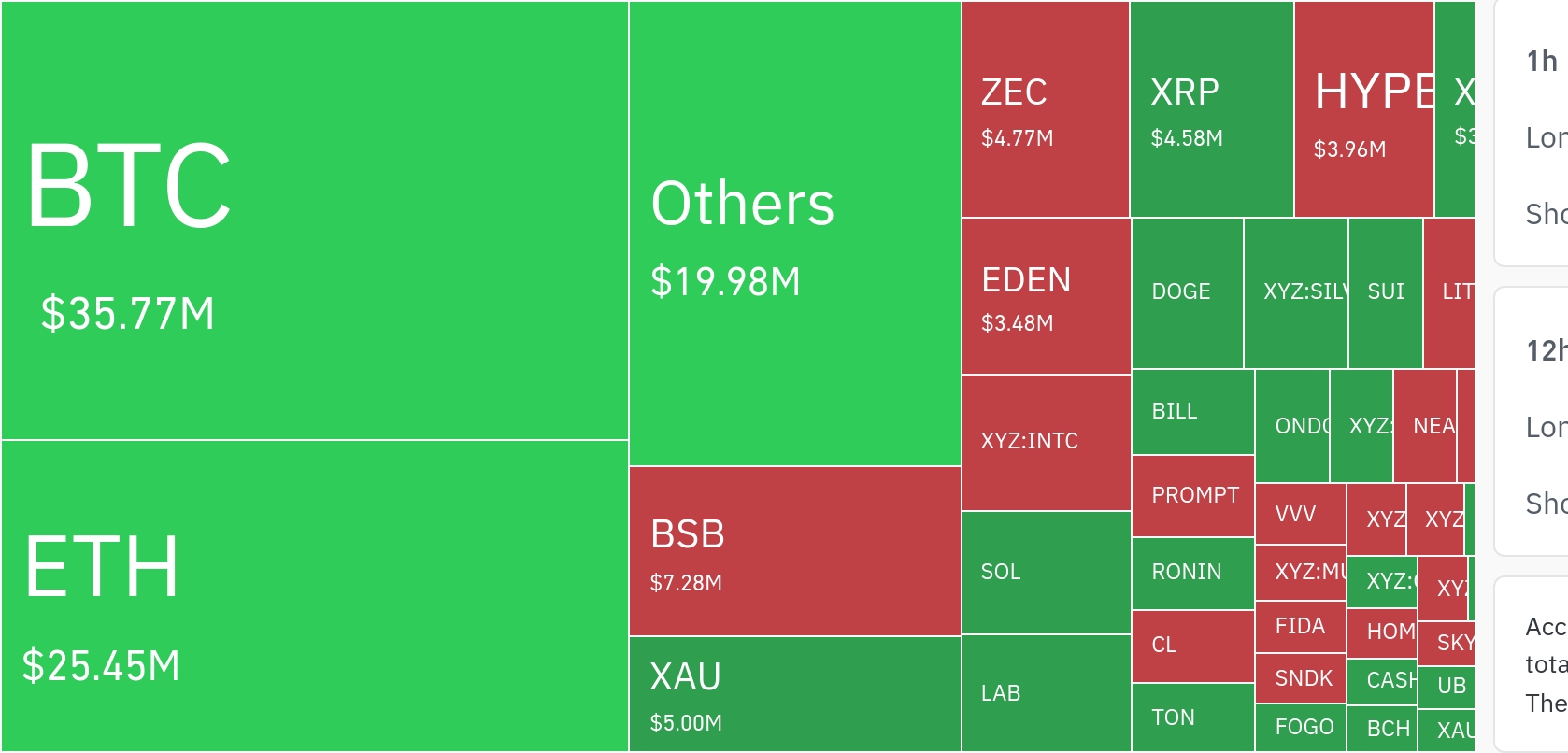
Crypto markets staged a modest rebound over the past day, but the move appeared to be driven less by fresh spot buying and more by a wave of forced deleveraging that squeezed bearish positioning. Roughly $265.41 million in leveraged positions were liquidated over the last 24 hours, with short liquidations accounting for the majority—an abrupt reset that temporarily tilted short-term momentum higher even as U.S. spot ETF flows stayed negative for the two largest assets.
Data showed $171.72 million in short positions were wiped out, representing 64.7% of total liquidations, compared with $93.69 million in long liquidations (35.3%). The imbalance suggests that a cautious, downside-leaning market was caught offside, amplifying the upside move as traders rushed to cover and positions were forcibly closed.
Liquidations were concentrated on major venues, pointing to broad-based repositioning rather than a single-token dislocation. Over a recent four-hour window, Binance led with about $35.80 million in liquidations, or 46.44% of the total. Bybit saw roughly $10.84 million, while OKX recorded around $9.69 million. On Hyperliquid, the skew was especially pronounced: short liquidations made up 98.17% of the platform’s total, consistent with sharper upside pressure in higher-volatility pockets of the market.
Prices bounced in the aftermath. Bitcoin (BTC) rose 1.10% to $77,592.61, while Ethereum (ETH) gained 1.32% to $2,138.26. The advances were relatively contained, but the liquidation-heavy backdrop indicates the move likely carried a meaningful 'short-covering' component rather than reflecting a clear pickup in directional spot demand.
Major altcoins tracked higher alongside the leaders. XRP (XRP) added 0.99%, BNB (BNB) climbed 1.65%, Solana (SOL) rose 2.13%, TRON (TRX) gained 1.05%, and Dogecoin (DOGE) advanced 0.95%. Hyperliquid posted an 8.13% jump, outperforming large-cap peers—an indication that 'risk appetite' rotated quickly into theme-driven or higher-beta assets as shorts were pressured.
Overall market metrics also suggested activity remained steady rather than retreating into wait-and-see mode. Total crypto market capitalization was estimated at $2.5862 trillion, with 24-hour trading volume of about $73.5 billion. Bitcoin dominance slipped slightly to 60.11% (down 0.06 percentage points), while Ethereum’s share edged up to 9.98% (up 0.01 percentage points), consistent with a modest broadening of participation during the rebound.
In derivatives, the liquidation event appeared to cool, not heat up, speculative intensity. Aggregate 24-hour derivatives trading volume fell 4.54% to roughly $652.8 billion, suggesting traders prioritized position reduction and risk reset over adding new leverage. In on-chain segments, DeFi market capitalization was around $64.8 billion, with volume at $8.6 billion—up 0.91% over 24 hours—pointing to a mild spillover of improved sentiment. Stablecoins moved in the opposite direction of complacency: total stablecoin market cap was estimated at $292.9 billion, while 24-hour volume rose 3.25% to about $78.2 billion, implying higher transactional demand and more capital standing by on the sidelines.
Institutional flow signals, however, diverged from the price action. U.S. spot Bitcoin ETFs saw net outflows totaling 4,374 BTC, and spot Ethereum ETFs recorded net outflows of 35,904 ETH over the same period. The withdrawals suggest that despite the rebound, large allocators have not broadly shifted into 'chasing' price strength in BTC and ETH.
At the same time, U.S. Solana ETFs logged net inflows of 27,115 SOL, hinting at a more selective rotation rather than a blanket risk-on allocation back into the two largest cryptocurrencies. The pattern fits a market narrative where liquidity is moving tactically across exposures even as top-tier inflows remain hesitant.
Macro and policy headlines added cross-currents. Minutes from the U.S. Federal Reserve were interpreted as dampening expectations for near-term rate cuts, with renewed discussion around the possibility of additional tightening—typically a headwind for risk assets. Yet in this session, crypto prices appeared more sensitive to the mechanical effects of liquidations than to macro repricing.
Separately, reports that the U.S. administration has directed work on rules to integrate digital assets into traditional finance and payment systems contributed to longer-term 'regulatory clarity' expectations, even if near-term positioning flows dominated market behavior. CME also argued that enacting the 'Clarity Act' could strengthen Bitcoin’s standing within mainstream financial markets, reinforcing the idea that clearer rule-making may improve institutional frameworks even as volatility persists.
Hyperliquid-related demand also drew attention after two U.S. spot ETFs tracking the asset reportedly attracted about $22.3 million in net inflows during their first week. Combined with the platform’s elevated short-liquidation share, the data suggest capital inflows and positioning stress may have reinforced each other in driving the day’s outsized move.
Overall, the session’s key development was not the magnitude of the price bounce but the speed of the reset: $171.72 million in short positions were forced out as the market flipped higher. With BTC and ETH spot ETFs still bleeding capital, the rebound looks less like a spot-led trend reversal and more like a liquidation-driven 'short squeeze' alongside selective rotation into alternative exposures.
🔎 Market Interpretation
- Rebound driven by forced positioning, not fresh spot demand: About $265.41M in liquidations over 24 hours—skewed heavily to shorts—suggests the price lift was largely mechanical (short covering/forced closes) rather than a spot-led trend change.
- Short squeeze characteristics: $171.72M shorts liquidated (64.7%) vs $93.69M longs (35.3%), indicating bearish positioning was crowded and got “caught offside,” accelerating upside momentum.
- Broad venue participation: Liquidations spread across major exchanges (Binance ~$35.80M, Bybit ~$10.84M, OKX ~$9.69M), implying a market-wide risk reset rather than an isolated token event.
- High-beta pockets amplified: Hyperliquid showed extreme skew (98.17% of its liquidations were shorts), aligning with sharper upside moves in higher-volatility segments.
- Price gains modest vs. liquidation intensity: BTC to $77,592.61 (+1.10%) and ETH to $2,138.26 (+1.32%)—contained advances despite large liquidations, reinforcing the “position squeeze” interpretation.
- Rotation beyond majors: Large-cap alts rose modestly (SOL +2.13%, BNB +1.65%), while Hyperliquid surged 8.13%, signaling fast rotation into higher-beta/theme-driven exposures once shorts were pressured.
- Derivatives activity cooled after the flush: Aggregate derivatives volume fell 4.54% to ~$652.8B, consistent with deleveraging and risk reduction rather than leverage reloading.
- Spot ETF flows diverged from prices: U.S. spot BTC ETFs saw net outflows of 4,374 BTC and ETH ETFs outflows of 35,904 ETH, indicating institutions were not broadly “chasing” the bounce.
- Selective institutional interest: U.S. Solana ETFs recorded net inflows of 27,115 SOL, suggesting tactical allocation/rotation rather than a uniform risk-on shift into BTC/ETH.
- Macro cross-currents secondary to positioning: Fed minutes were read as less supportive for near-term cuts (a typical risk-asset headwind), yet market action appeared more dominated by liquidation mechanics than macro repricing.
💡 Strategic Points
- Don’t over-interpret liquidation-led bounces: When shorts dominate liquidations, rallies can fade if spot demand and sustained inflows don’t follow—watch for follow-through in spot volumes and ETF flow stabilization.
- Track the “post-squeeze” regime shift: After a forced reset, markets often move from expansion to consolidation. Confirm whether momentum persists via open interest, funding rates, and basis rather than price alone.
- Use venue/asset skew as a risk signal: Extreme short-liquidation shares (e.g., Hyperliquid) can indicate crowded positioning. If repeated, it may imply ongoing vulnerability to sharp spikes—or, conversely, an exhausted squeeze if liquidations subside.
- Differentiate large-cap vs. high-beta behavior: BTC/ETH moving modestly while high-beta assets jump can indicate speculative rotation. Manage sizing and liquidity risk accordingly; beta rallies can reverse quickly.
- Institutional flows matter for durability: Continued BTC/ETH ETF outflows alongside price rebounds often signals fragile rallies. A sustained trend typically aligns with net inflows or at least a clear reduction in outflows.
- Watch stablecoin volume as “dry powder”: Rising stablecoin transaction volume alongside flat-to-higher caps can imply elevated sidelined capital and higher churn—useful for gauging potential dip-buying capacity or risk-off parking.
- Policy headlines are longer-horizon catalysts: Regulatory integration efforts and proposed clarity frameworks may improve institutional comfort over time, but near-term price action can still be dominated by leverage dynamics.
- Key levels are less informative than positioning: In liquidation events, the path often depends on where leverage is concentrated. Monitoring liquidation heatmaps/OI clustering can be more actionable than pure chart levels.
📘 Glossary
- Liquidation: Forced closure of a leveraged position when margin is insufficient, often accelerating price moves.
- Short liquidation: When short sellers are forced to buy back (close) positions as price rises, pushing price higher.
- Long liquidation: When leveraged buyers are forced to sell/close as price falls, pushing price lower.
- Short covering / Short squeeze: A rally fueled by shorts exiting under pressure—often sharp, sometimes temporary if spot demand doesn’t confirm.
- Deleveraging: Reducing leverage exposure (closing/reducing positions), often after volatility spikes.
- Spot demand: Direct buying of the underlying asset (not derivatives), typically seen as more durable than leveraged flows.
- ETF net inflow/outflow: Net capital moving into/out of an ETF; a proxy for institutional/allocators’ risk appetite.
- Derivatives volume: Trading activity in futures/perpetuals/options; can reflect speculative intensity and hedging demand.
- Bitcoin dominance: BTC’s share of total crypto market cap; declines can signal broader altcoin participation.
- High-beta asset: An asset that typically moves more than the market (higher volatility), often outperforming in risk-on bursts and underperforming in drawdowns.























Comment 0