

 News
News  Coin Information
  About us
  Customer Service


 Add as a preferred source on Google
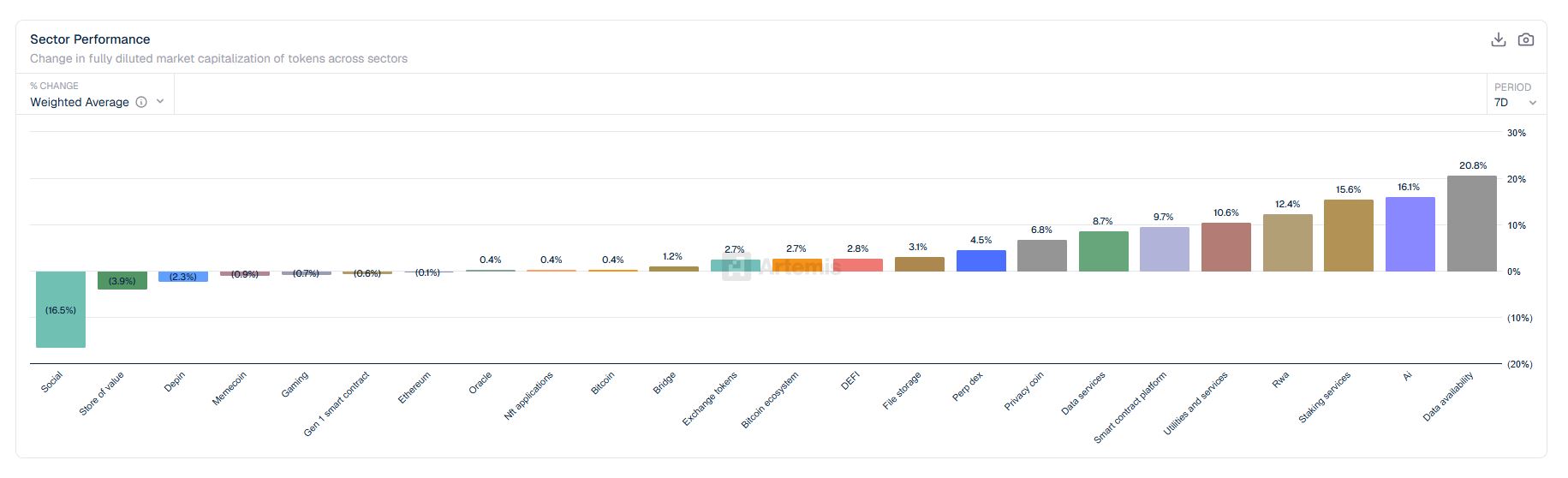
Crypto sector performance diverged sharply over the past week, with 'data availability' and AI-related tokens leading broad gains while the 'social' category suffered a steep pullback—an early sign that capital is rotating toward infrastructure and yield-focused narratives rather than pure attention-driven trades.
According to weekly data compiled by Artemis, the strongest sector by fully diluted valuation (FDV) performance over the seven-day period ending Monday, May 26 (UTC) was data availability, which climbed 20.8%. The AI sector followed with a 16.1% advance, while staking services rose 15.6% and real-world assets (RWA) gained 12.4%.
Several other segments posted solid increases, suggesting a fairly constructive risk backdrop across crypto. Utilities and services added 10.6%, smart contract platforms climbed 9.7%, and data services rose 8.7%. Privacy coins advanced 6.8%, while derivatives decentralized exchanges (DEXs) gained 4.5% and file storage tokens added 3.1%. Decentralized finance (DeFi) rose 2.8%, while the Bitcoin ecosystem and exchange tokens each increased 2.7%.
Price action was more subdued in large, established areas of the market. Bridges gained 1.2%, while Bitcoin (BTC), NFT applications, and oracle-related tokens each edged up 0.4%, effectively flat on the week.
On the downside, relatively few sectors posted meaningful losses. Ethereum-linked assets slipped 0.1%, first-generation smart contract tokens fell 0.6%, gaming declined 0.7%, and memecoins dipped 0.8%. Notably, DePIN—one of the more speculative themes that had recently attracted heavy momentum trading—fell 2.3%, hinting at cooling appetite for high-beta narratives.
The weakest performance came from the social sector, which plunged 16.5% over the week. Market participants broadly attributed the drop to 'profit-taking' after a short-term surge, a common pattern in thinner liquidity segments where rapid inflows can reverse quickly once traders move to lock in gains.
Overall, the weekly leaderboard underscores a market that is rewarding infrastructure-oriented themes such as data availability and staking—areas often associated with 'network utility' and yield—while trimming exposure to crowded social and store-of-value trades. If the rotation persists, it could reinforce a preference for sectors tied to measurable on-chain activity and protocol adoption rather than purely sentiment-driven rallies.
🔎 Market Interpretation
- Clear sector rotation: Weekly performance shows capital shifting toward infrastructure and yield-linked narratives (data availability, staking services, RWA) and away from attention/liquidity-sensitive trades (social).
- Leaders confirm “build layer” bid: Data availability (+20.8%) and AI (+16.1%) outperformed, implying investors are paying up for themes tied to scalability needs and compute/data demand.
- Yield and adoption signals supported: Staking services (+15.6%) and RWA (+12.4%) suggest a preference for cashflow/yield framing and narratives tied to real-world integration.
- Broadly constructive risk tone, not euphoric: Many sectors were green (utilities, L1s, data services, privacy, derivatives DEXs), while large established areas were mostly flat (BTC, oracles, NFT apps).
- Speculative heat cooled: DePIN (-2.3%) and memecoins (-0.8%) slipping hints at reduced appetite for high-beta momentum.
- Major laggard reflects liquidity dynamics: Social (-16.5%) is framed as profit-taking—typical of thinner markets where sharp rallies can reverse quickly.
💡 Strategic Points
- Positioning implication: If rotation continues, exposure may favor sectors with measurable on-chain usage (DA layers, staking infrastructure, data services) over purely narrative/attention tokens.
- Watch for confirmation signals:
- Rising fees/throughput and adoption metrics in DA and related ecosystems.
- Growth in staked assets, staking provider market share, and sustainable yield sources.
- RWA traction via TVL, issuance volume, and integrations with DeFi lending/AMMs.
- Risk management focus: Social and other thin-liquidity categories may remain prone to sharp mean reversion; sizing and liquidity considerations become critical.
- Barbell read: With BTC/oracles/NFT apps flat, the market may be allocating to (1) core majors for stability and (2) infra growth themes for upside—while trimming crowded momentum trades.
- Rotation trigger to monitor: A renewed surge in social/meme/DePIN could signal a return of reflexive risk-on behavior; continued outperformance of DA/staking suggests a more fundamental bid.
📘 Glossary
- FDV (Fully Diluted Valuation): Token price × total token supply (including locked/unreleased tokens); used to compare sectors on a fully diluted basis.
- Data Availability (DA): Infrastructure ensuring transaction data is published and accessible so networks/rollups can verify state and security assumptions.
- AI tokens: Crypto assets tied to AI compute, agent frameworks, data/compute marketplaces, or AI-integrated protocols.
- Staking services: Protocols/providers that help users stake assets to earn rewards, often via liquid staking tokens or delegated staking infrastructure.
- RWA (Real-World Assets): On-chain representations of off-chain assets (e.g., Treasuries, credit, commodities) used for yield or collateral in DeFi.
- Utilities & services: Tokens providing network services (tooling, infrastructure, payments, middleware) rather than single-purpose speculation.
- Smart contract platforms: Base layer networks (L1/L2) where applications are deployed and executed.
- DEX (Decentralized Exchange): On-chain trading venue using smart contracts instead of centralized intermediaries.
- DeFi: Financial applications on-chain (lending, borrowing, trading, derivatives) operating via smart contracts.
- Bridges: Protocols that move assets/data between blockchains, enabling cross-chain liquidity and interoperability.
- Oracles: Systems that deliver external data (prices, events) to smart contracts.
- DePIN: Decentralized Physical Infrastructure Networks—crypto incentives used to build real-world networks (compute, wireless, sensors, storage).
- High-beta narratives: Themes/tokens that tend to move more than the broader market—often momentum-driven and sensitive to risk appetite.
- Profit-taking: Selling after gains to lock in returns; can cause sharp pullbacks in low-liquidity segments.

















Comment 0