

 News
News  Coin Information
  About us
  Customer Service


 Add as a preferred source on Google
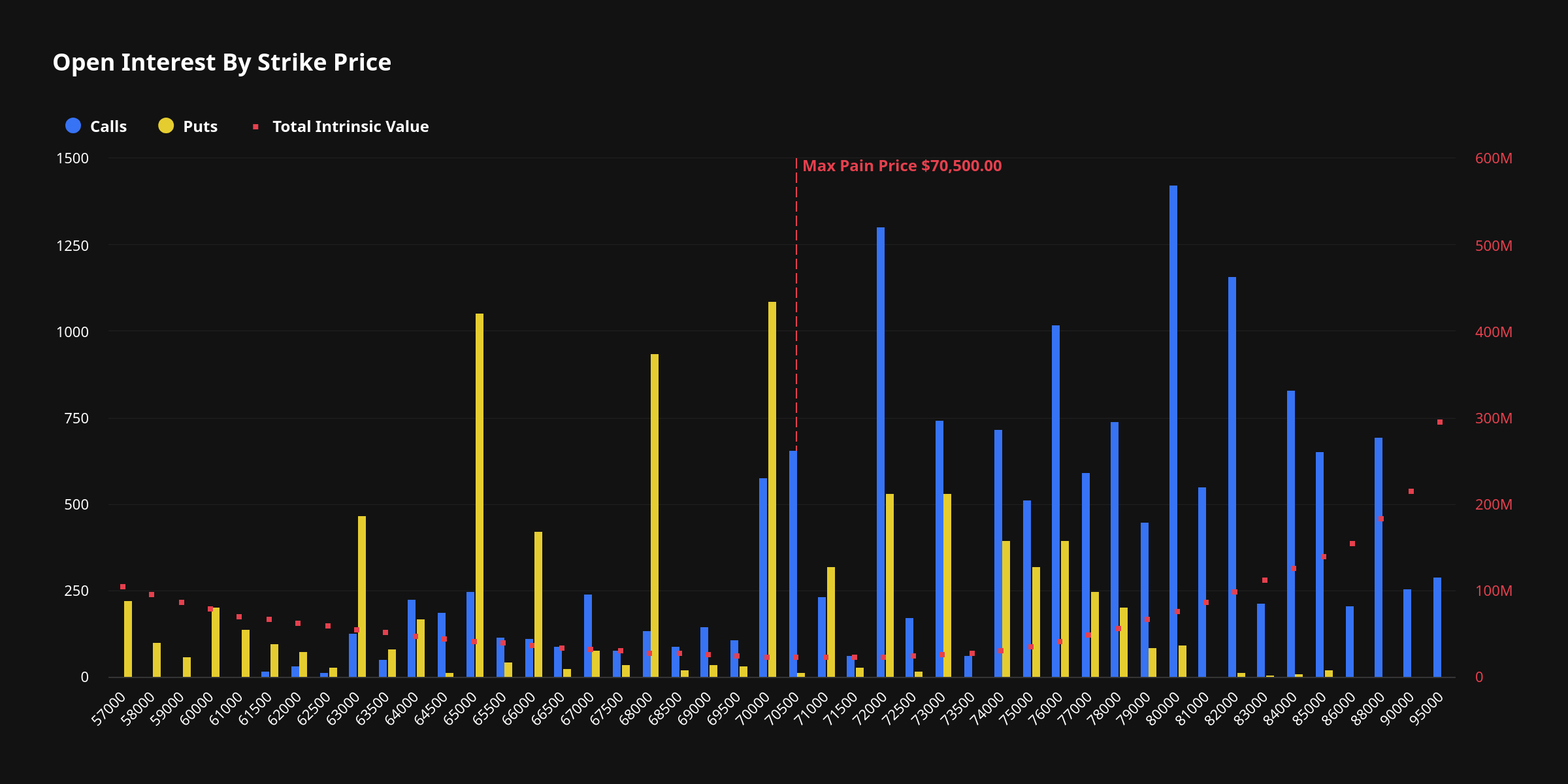
Bitcoin (BTC) options markets continued to flash a largely 'bullish' signal based on open interest, even as short-term flow showed a tilt toward protective downside positioning—an indication that traders are balancing upside expectations with near-term caution.
As of Thursday, June 5 (UTC), data from Deribit—one of the largest crypto options exchanges—showed total Bitcoin options open interest at 24,895 contracts, representing roughly $1.57 billion in notional value. Call options accounted for 16,184 contracts, while put options stood at 8,710.6 contracts, putting the open-interest put/call ratio at 0.54. In options markets, a put/call ratio below roughly 0.7–0.8 is often read as 'bullish,' while readings above 1 tend to signal 'bearish' positioning. A 0.54 ratio suggests demand remains meaningfully skewed toward upside exposure.
Deribit’s so-called 'max pain' level—the strike price where options buyers would suffer the largest aggregate losses at expiry—was estimated at $70,500. Traders often track this level as a potential gravitational point into key expiry windows, especially when positioning is concentrated around nearby maturities.
Positioning by strike highlighted a clear focal point: the $80,000 call was the single largest concentration of open interest for same-day expiry, followed by the $72,000 call and the $82,000 call. The clustering of exposure above the current spot price suggests that a segment of the market is still paying for upside convexity, reflecting the view that BTC could extend higher if momentum or catalysts emerge.
Across all maturities, the $80,000 call again held the largest open-interest concentration, reinforcing the market’s medium-term 'bullish' lean. At the same time, a sizable build in the $60,000 put indicated the persistence of downside hedging demand—effectively a defensive floor as traders protect portfolios against a deeper pullback. Open interest was also notable in the $90,000 call, pointing to continued appetite for longer-shot upside scenarios.
While open interest favored calls, the last 24 hours of trading activity leaned in the opposite direction. Put volume totaled 28,425.3 contracts versus 26,919.2 contracts in calls, producing a 24-hour volume put/call ratio of 1.06. That split suggests that, in the near term, traders are more actively buying protection or positioning for downside moves—often seen during periods when spot prices are rising but uncertainty remains elevated around macro signals, liquidity conditions, or event risk.
The most actively traded contracts over the past day were concentrated in June 26, 2026 expiries—particularly $60,000, $55,000, and $45,000 puts—alongside $65,000 and $68,000 calls for the same maturity. The combination underscores a market preparing for a wide range of outcomes: downside hedges further out on the curve alongside upside participation at higher strikes.
By expiry distribution, Deribit data showed open interest most concentrated in December 25 (calls 65%), September 25 (calls 64%), and June 26 (calls 57%). Meanwhile, top trading volume maturities were June 26 (puts 59%), June 12 (puts 56%), and July 31 (calls 55%), reinforcing the split between structural call-heavy positioning and more defensive short-term flow.
Bitcoin was last quoted at $63,353, up 0.8% day over day as of 1:45 p.m. ET on Thursday, according to TokenPost Market. The options complex suggests traders still see room for BTC to push higher over coming months, but the pickup in put activity implies the market is increasingly alert to near-term drawdown risk—even amid a generally constructive positioning backdrop.
🔎 Market Interpretation
{
"positioning_snapshot": [
{
"signal": "Open interest remains call-heavy (bullish lean)",
"evidence": "Deribit BTC options OI: 24,895 contracts (~$1.57B notional); calls 16,184 vs puts 8,710.6; OI put/call = 0.54",
"what_it_means": "Market is structurally positioned for upside exposure across maturities, implying expectation of higher BTC levels over coming months."
},
{
"signal": "Short-term trading flow turned defensive",
"evidence": "24h volume: puts 28,425.3 vs calls 26,919.2; volume put/call = 1.06",
"what_it_means": "Even with bullish structure, traders are actively buying protection or expressing near-term caution—often seen when uncertainty (macro, liquidity, events) is elevated."
},
{
"signal": "Key price magnets and crowded strikes",
"evidence": "Max pain estimated at $70,500; heavy OI at $80,000 calls (largest), plus $72,000 and $82,000 calls; notable $90,000 call OI",
"what_it_means": "Upside strikes clustered above spot suggest traders are paying for upside convexity; max pain may act as a reference level into expiries if positioning is concentrated."
},
{
"signal": "Downside floor-building persists",
"evidence": "Sizable OI at $60,000 puts; most actively traded included 2026-06-26 $60k/$55k/$45k puts",
"what_it_means": "Participants are willing to spend premium to guard against deeper drawdowns, indicating a two-sided market: optimistic on trend, cautious on tail risk."
}
],
"term_structure_read": [
{
"open_interest_by_expiry": "OI concentrated in Dec 25 (calls 65%), Sep 25 (calls 64%), Jun 26 (calls 57%)",
"volume_by_expiry": "Top volume maturities: Jun 26 (puts 59%), Jun 12 (puts 56%), Jul 31 (calls 55%)",
"interpretation": "Longer-dated positioning is call-skewed (constructive bias), while nearer-term activity leans toward hedging—suggesting investors want upside exposure but are insuring near-term downside."
}
],
"spot_context": {
"last_price": "$63,353",
"daily_change": "+0.8%",
"read_through": "Price is rising modestly, but options flows imply increased alertness to pullback risk despite a broadly bullish positioning backdrop."
}
}
💡 Strategic Points
{
"takeaways_for_traders": [
{
"theme": "Respect the bullish base case, but don’t ignore hedging demand",
"actionable_angle": "OI put/call at 0.54 supports an upside-biased medium-term narrative, yet volume put/call at 1.06 warns that near-term protection is being prioritized."
},
{
"theme": "Monitor crowded upside strikes for momentum triggers",
"levels_to_watch": [
"$72,000 call (nearby upside interest)",
"$80,000 call (dominant concentration across maturities)",
"$82,000 and $90,000 calls (higher-strike continuation bets)"
],
"why_it_matters": "If spot approaches these strikes into key expiries, hedging flows (e.g., dealer adjustments) can amplify moves, increasing volatility."
},
{
"theme": "Identify the market’s perceived downside ‘line in the sand’",
"levels_to_watch": [
"$60,000 puts (notable hedge demand; perceived defensive floor)",
"$55,000 and $45,000 puts (tail-risk hedges, actively traded in long-dated expiry)"
],
"why_it_matters": "Persistent put interest suggests participants are preparing for non-trivial drawdowns; breaks below heavily hedged levels may coincide with stress and higher implied volatility."
},
{
"theme": "Use max pain as a reference, not a target",
"reference_level": "$70,500",
"practical_note": "Max pain can act as a ‘center of gravity’ near expiries when positioning is dense, but strong spot trends or catalysts can overwhelm it—treat it as contextual rather than predictive."
},
{
"theme": "Time horizon split: calls for structure, puts for timing",
"interpretation": "Call-heavy OI in Sep/Dec 2025 and Jun 2026 reflects longer-horizon upside positioning, while heavier put volume in nearer maturities suggests traders are timing/insuring near-term risks (macro data, liquidity, event risk)."
}
],
"risk_signals_to_monitor": [
{
"signal": "Sustained volume put/call > 1 with stable call-heavy OI",
"meaning": "Hedging wave may be building without capitulation—often a precursor to volatility expansion."
},
{
"signal": "Rapid growth in $60k put OI or activity shifting to lower strikes",
"meaning": "Market may be increasing protection against a deeper correction; sentiment could be shifting from ‘hedged bullish’ to ‘bearish’."
}
]
}
📘 Glossary
{
"terms": [
{
"term": "Open Interest (OI)",
"definition": "The number of outstanding option contracts that remain open (not closed or exercised).",
"why_it_matters_here": "Higher call OI vs put OI (put/call 0.54) indicates structurally bullish positioning."
},
{
"term": "Notional Value",
"definition": "Approximate dollar value represented by the contracts (often contract count × underlying price × contract multiplier).",
"why_it_matters_here": "Shows the scale of exposure (~$1.57B) tied to BTC options positioning."
},
{
"term": "Put/Call Ratio (OI vs Volume)",
"definition": "Puts divided by calls; can be computed using open interest (structural positioning) or trading volume (recent flow).",
"why_it_matters_here": "OI ratio (0.54) reads bullish; 24h volume ratio (1.06) reads defensive—highlighting horizon mismatch."
},
{
"term": "Call Option",
"definition": "An option that benefits from the underlying price rising above the strike price by expiry.",
"why_it_matters_here": "Large OI in $80k calls implies demand for upside exposure/convexity."
},
{
"term": "Put Option",
"definition": "An option that benefits when the underlying price falls below the strike price by expiry.",
"why_it_matters_here": "Active trading and OI in $60k/$55k/$45k puts indicates portfolio protection and tail-risk hedging."
},
{
"term": "Strike Price",
"definition": "The price at which the option can be exercised (buy/sell the underlying).",
"why_it_matters_here": "Concentrations at specific strikes ($60k, $80k) reveal where hedges and speculative bets are focused."
},
{
"term": "Expiry (Maturity)",
"definition": "The date when the option contract expires.",
"why_it_matters_here": "Different expiries (Jun 12, Jul 31, Sep/Dec 2025, Jun 2026) show how positioning differs between short-term caution and medium-term optimism."
},
{
"term": "Max Pain",
"definition": "A level where option buyers would collectively experience the most loss at expiry, based on OI distribution.",
"why_it_matters_here": "Estimated at $70,500; sometimes used as a reference point for price behavior into expiry windows."
},
{
"term": "Convexity",
"definition": "The property of options where gains can accelerate as the underlying moves favorably, especially near/through the strike.",
"why_it_matters_here": "Clustering in higher-strike calls suggests traders are paying for leveraged upside if BTC momentum returns."
}
]
}

















Comment 0