
DEX Volume Hits $18.5 Billion as Solana Meme Tokens Drive Volatility
Decentralized exchanges recorded $18.53 billion in volume as Solana-based meme tokens fueled sharp gains and losses, highlighting ongoing speculative on-chain trading activity.





Decentralized exchange activity was mixed over the past 24 hours, with sharp moves in several Solana-linked meme pairs even as broader token performance remained uneven. Aggregate DEX volume reached about $18.53 billion, underscoring how quickly on-chain liquidity can rotate when speculative interest spikes.
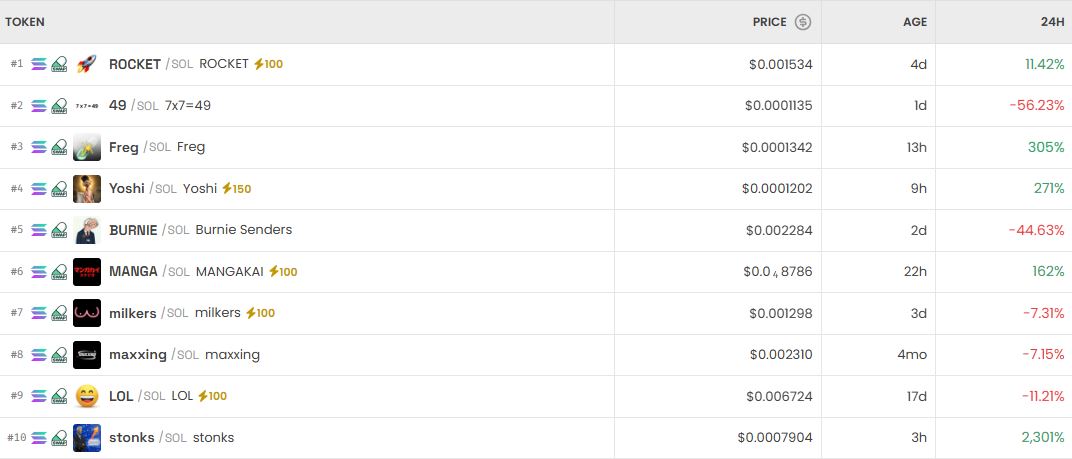
According to Dexscreener data as of April 3 UTC, the top trending pair was Rocket (ROCKET) against Solana (SOL), changing hands around $0.001517, up 10.20% on the day. The second most-watched pair, 49 (49) versus SOL, slid 56.13% to roughly $0.0001138, highlighting the whipsaw price action common in low-float tokens. Freg (Freg) ranked third, surging 312% to about $0.0001366 as momentum traders piled into the move.
Among pairs meeting a minimum threshold of $100,000 in volume and at least $250,000 in liquidity, KOMA (KOMA) / WBNB posted the largest 24-hour gain at 58.17%. It was followed by Fire Butterfly (火蝴蝶) / WBNB, up 56.18%, and HorseCoin (HorseCoin) / WBNB, up 40.96%. On the downside, Bedrock (BR) / USDT was the steepest decliner, down 24.26%, while Wrapped Solana (Wrapped SOL) / USDC fell 23.14% and OnePiece (OnePiece) / WBNB dropped 17.77%.
By raw volume, quq (quq) / USDT led all DEX pairs with approximately $401.2 million traded, followed by Wrapped Ether (WETH) / USDC at about $128.2 million and Siren (SIREN) / WBNB with roughly $91.5 million. The most active markets by transaction count were Longinus (LGNS) / DAI with about 883,624 transactions, FREAKJS (FREAKJS) / SOL at around 107,454, and MrBeast (MrBeast) / SOL with about 86,148.
Overall, DEXs recorded roughly 34.69 million transactions over the last 24 hours alongside the $18.53 billion in volume. The figures point to sustained 'on-chain speculation'—especially in meme-driven listings—where rapid listings, deepening liquidity pools, and wallet-to-contract trading mechanics can amplify both breakouts and drawdowns.
Decentralized exchanges are blockchain-based venues that enable peer-to-peer trading without traditional intermediaries, using smart contracts and on-chain settlement to provide operational transparency. Users typically trade by connecting a wallet—without depositing funds to a centralized platform—retaining direct control over assets while accessing a fast-moving marketplace that has become a primary launchpad during meme-coin cycles.
Article Summary by TokenPost.ai
🔎 Market Interpretation
Mixed DEX tape with concentrated meme volatility: Overall activity stayed elevated (about $18.53B DEX volume), but performance was uneven—sharp Solana meme-pair swings contrasted with broader inconsistency.
Solana-linked microcaps drove attention and whipsaws: Trending pairs showed extreme dispersion—ROCKET/SOL +10.20%, 49/SOL -56.13%, and Freg/SOL +312%—typical of low-float, hype-sensitive tokens.
Rotation across chains and quote assets: Big movers appeared on BNB Chain quotes (WBNB) while major declines included a blue-chip proxy pair (Wrapped SOL/USDC -23.14%), suggesting rapid liquidity rotation rather than a single-chain narrative.
High throughput confirms speculative intensity: Roughly 34.69M transactions in 24 hours indicates heavy bot and retail participation, where small price moves can cascade into larger swings via on-chain execution.
Volume vs. transactions reveal different "hot spots": The highest volume pair (quq/USDT at $401.2M) differed from the highest transaction count pair (LGNS/DAI at 883,624), implying some markets are dominated by large tickets while others are dominated by frequent small trades.
💡 Strategic Points
Expect outsized variance in trending microcaps: Large intraday moves (e.g., +312% and -56%) imply wide slippage bands and fast reversals; position sizing and limit/MEV-aware execution matter more than directionality.
Use liquidity/volume thresholds as a safety filter: The article highlights pairs with ≥$100k volume and ≥$250k liquidity; applying similar filters can reduce the chance of getting trapped in illiquid pools during spikes.
Separate "attention" from "depth": Trending lists can be driven by momentum and low float, while raw-volume leaders may reflect deeper markets or higher-conviction flow—consider corroborating with liquidity and trade count.
Watch quote-asset migration for risk signals: Moves across SOL, USDC/USDT, and WBNB pairs can indicate traders shifting between ecosystems or de-risking into stables; abrupt switching often precedes volatility expansions.
Be mindful of on-chain mechanics: Wallet-to-contract trades, rapid new listings, and pool rebalancing can amplify both breakouts and drawdowns; checking pool concentration and recent LP changes can help interpret sudden candles.
📘 Glossary
DEX (Decentralized Exchange): A blockchain-based trading venue using smart contracts for peer-to-peer swaps without a centralized intermediary.
Pair (e.g., ROCKET/SOL): A market quoting one asset against another; price and gains/losses are measured in the quote asset terms.
Liquidity: The amount of assets in a pool available for trading; higher liquidity generally reduces slippage and improves execution.
Volume: Total value traded over a period (here, 24 hours); indicates activity level but not necessarily price stability.
Transaction count: Number of on-chain trades/interactions; high counts can imply bot activity, small-ticket churn, or broad retail participation.
Low-float token: An asset with limited circulating supply available to trade, often leading to exaggerated price swings.
Slippage: The difference between expected and executed price, often larger in volatile or low-liquidity pools.
Smart contract: Self-executing code on a blockchain that governs swaps and settlement on DEXs.
On-chain settlement: Finalizing trades directly on the blockchain, making activity transparent and verifiable.
WETH / WBNB / Wrapped SOL: Wrapped versions of native assets used for compatibility in token standards and DEX trading.