

 News
News  Coin Information
  About us
  Customer Service


 Add as a preferred source on Google

A wave of forced liquidations jolted crypto markets over the past 24 hours, wiping out $355.98 million in leveraged positions and amplifying intraday volatility even as US spot Bitcoin (BTC) ETFs logged a sizeable $411 million net inflow—a split signal that highlights the growing gap between short-term trading stress and longer-term 'institutional demand'.
The liquidation data suggested the turbulence was less about a clean directional move and more about crowded positioning being rapidly unwound. Long liquidations totaled $133.44 million, while short liquidations reached $222.54 million—meaning roughly 62.5% of the damage was concentrated in short positions. In practice, that points to sharp rebound pockets within a broader risk-off session, where bearish bets were repeatedly squeezed during brief rallies.
Prices, however, remained broadly weak. Bitcoin fell about 4.0% over 24 hours to around $97,963, while Ethereum (ETH) slid roughly 1.1% to near $3,756. Major altcoins also softened: Solana (SOL) dropped in the mid-single digits, Dogecoin (DOGE) remained under pressure, and XRP (XRP) posted comparatively limited declines. The widening underperformance across higher-beta tokens reinforced the view that traders were prioritizing de-risking and profit-taking in the most volatile parts of the market.
One of the more notable dislocations emerged in BNB (BNB). Despite relatively muted price movement, BNB saw about $102.3 million in liquidations over the same 24-hour window, with short liquidations dominating. When liquidations run ahead of price, it often points to thinner liquidity conditions and rapid order-book moves—hallmarks of a localized 'short squeeze' rather than a broad-based spot-driven rally.
Exchange-level breakdowns added to the picture of uneven positioning. Over a recent four-hour stretch, total liquidations of roughly $17.29 million were led by Binance, which accounted for $6.96 million, or about 40.27% of the total. OKX followed with $3.39 million, where shorts made up about 53.88% of liquidations. Divergent skews across venues suggested traders were far from aligned on direction, and that the dominant mechanical driver was leverage reduction rather than conviction-led buying or selling.
Market structure underscored the defensive tilt. Total crypto market capitalization stood near $2.5002 trillion, with 24-hour trading volume around $159.2 billion. Turnover remained elevated, but price support did not hold—consistent with rotation, hedging, and stop-driven flows rather than sustained accumulation. Bitcoin dominance ticked up to about 59.16% (up 0.07 percentage points on the day), while Ethereum’s share slipped to roughly 11.19% (down 0.16 percentage points), a familiar pattern during periods of stress when liquidity concentrates in the market’s largest asset.
Within crypto sub-sectors, DeFi was notably weaker: the segment’s market capitalization hovered around $60.4 billion, down about 3.26% over 24 hours. By contrast, stablecoin trading volume surged to roughly $202.1 billion—up about 58.35%—a sign that sidelined capital and 'wait-and-see' positioning increased as volatility rose. Derivatives activity remained large at approximately $844.4 billion, but fell around 8.03% day over day, suggesting some speculative leverage was pared back after the liquidation flush.
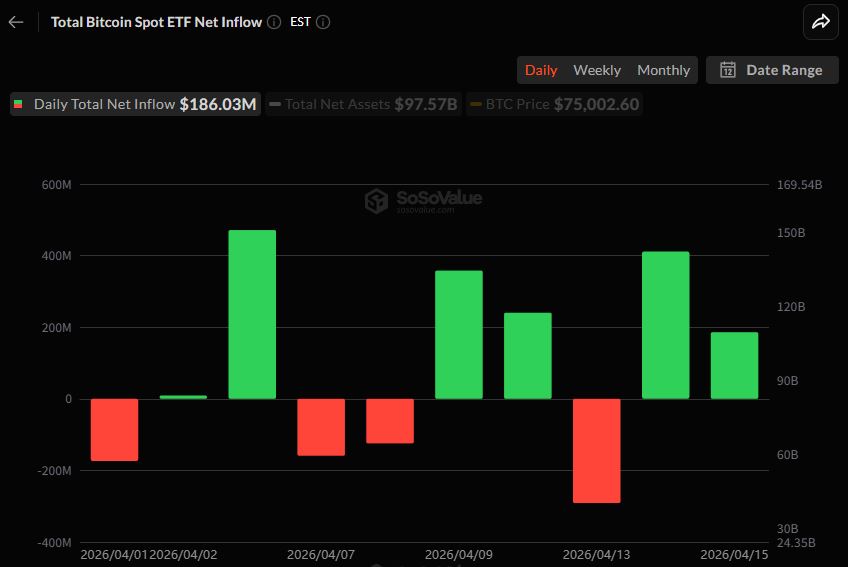
Amid the turbulence, ETF flows stood out as a counterweight. US spot Bitcoin ETFs recorded about $411.0 million in net inflows, led by BlackRock’s iShares Bitcoin Trust (IBIT) with around $214.0 million and Ark Invest/21Shares’ ARKB with roughly $113.0 million. The concentration of inflows into a handful of flagship products implied that some institutional allocators viewed the pullback as a more attractive entry point, even as shorter-term traders were forced out of positions.
US spot Ethereum ETFs also remained resilient, posting about $53.03 million in net inflows and extending their streak to four straight trading days of additions. Ethereum’s price weakness alongside steady ETF demand suggested spot-based appetite has not fully rolled over, even as tactical risk-taking cooled across broader crypto markets.
Macro and geopolitics added headwinds. A US announcement related to restricting Iranian-linked maritime trade, alongside plans to end certain sanctions waivers, elevated Middle East tension and contributed to a wider 'risk-off' backdrop. For crypto, the episode reinforced how digital assets—despite their idiosyncratic catalysts—can still trade in sympathy with global risk sentiment during periods of heightened uncertainty.
Meanwhile, a string of corporate and institutional developments continued to point toward deeper mainstream integration: renewed talk of Kraken pursuing an IPO, Goldman Sachs’ reported filing efforts tied to a Bitcoin-linked premium income ETF, and Visa ($V) participating as a validator in a blockchain payment network all fed into the narrative of gradual normalization. Separately, Japan’s Rakuten’s reported plan to introduce Ripple-based payments could renew attention on XRP’s 'real-world payments' angle by tying the asset ecosystem to a large consumer platform.
Overall, the day’s trading was defined by a leverage-driven shakeout: $355.98 million in liquidations, pockets of 'short squeeze' dynamics, and broad price softness—yet paired with meaningful ETF inflows that suggested structural demand has not disappeared. The immediate outlook remains volatile, but the reset in positioning and the shift toward more defensive capital allocation may reduce near-term overheating across derivatives-heavy corners of the market.
🔎 Market Interpretation
- Leverage flush dominated tape: $355.98M in 24h liquidations signals a mechanically driven move (forced deleveraging) rather than a clean trend.
- Shorts hit harder than longs: Shorts accounted for ~$222.54M (~62.5%) vs longs $133.44M, implying repeated short-squeeze bursts inside an overall risk-off session.
- Price weakness persisted despite squeezes: BTC ~-4% to ~$97,963; ETH ~-1.1% to ~$3,756; higher-beta alts underperformed, consistent with de-risking.
- BNB showed a localized dislocation: ~$102.3M liquidations with muted price change suggests thin liquidity and order-book air pockets (squeeze/liquidation cascade) more than spot-led demand.
- Venue skews show disagreement: Binance led a recent 4h window (40.27% share); OKX had a short-heavy mix—pointing to fragmented positioning and leverage reduction as the main driver.
- Defensive market structure: BTC dominance rose to ~59.16% while ETH share slipped to ~11.19%, typical of stress regimes when liquidity concentrates in majors.
- Stablecoin activity jumped: Stablecoin volume ~$202.1B (+58.35%) indicates capital moving to sidelines and “wait-and-see” positioning.
- Derivatives cooled after the shock: Derivatives volume ~$844.4B (-8.03%) suggests leverage was trimmed post-liquidation.
- ETF flows contradicted short-term stress: US spot BTC ETFs +$411M (IBIT +$214M; ARKB +$113M) and spot ETH ETFs +$53.03M (4-day inflow streak) imply longer-horizon demand remains intact.
- Macro risk-off contributed: Middle East-related geopolitical headlines reinforced broader risk aversion, keeping crypto correlated with global sentiment during uncertainty.
💡 Strategic Points
- Interpretation framework: When liquidations rise faster than spot price movement (e.g., BNB), prioritize liquidity/positioning diagnostics (funding, OI, order-book depth) over narrative trading.
- Positioning reset may reduce near-term overheating: Flushes often lower immediate liquidation risk by clearing crowded leverage—though aftershocks can persist if volatility stays high.
- Watch “squeeze-to-sell” pattern: Short squeezes inside downtrends can create sharp rallies that fade; confirmation requires improving breadth (alts stabilizing) and sustained spot bid.
- Use dominance and sector rotation as risk gauges: Rising BTC dominance + falling DeFi cap (-3.26% to ~$60.4B) typically signals defensive posture; reversal would hint at risk appetite returning.
- ETF inflows as structural signal: Concentrated inflows into flagship products (IBIT/ARKB) may provide medium-term support, even if derivatives-driven volatility remains elevated short term.
- Stablecoin surge implies optionality: Elevated stablecoin turnover can precede either dip-buying or continued caution; track whether stablecoins rotate into spot accumulation or remain parked.
- Risk management focus: In liquidation-heavy regimes, reduce leverage, widen stop logic to avoid wick-outs, and size positions to withstand intraday spikes.
- Headline sensitivity remains high: Geopolitical/macroeconomic updates can quickly shift correlations; consider hedges or reduced exposure around key announcements.
- Longer-term normalization narrative continues: IPO/ETF product development and payments/validator participation (Kraken IPO talk, Goldman filing efforts, Visa validator, Rakuten/Ripple payments) supports adoption thesis, but doesn’t negate cyclical drawdowns.
📘 Glossary
- Forced liquidation: Automatic position closure by an exchange when margin is insufficient, often accelerating moves and creating sharp wicks.
- Leveraged positions: Trades using borrowed funds (margin) to amplify gains/losses; more leverage increases liquidation risk.
- Long liquidation / Short liquidation: Longs are liquidated when price drops; shorts are liquidated when price rises (often during squeezes).
- Short squeeze: Rapid price uptick forcing shorts to buy back positions, pushing price higher temporarily.
- Order-book liquidity: How much buy/sell interest exists at various prices; thin liquidity can cause outsized moves from modest orders.
- Open interest (OI): Total outstanding derivatives contracts; rising OI with volatility can raise liquidation cascade risk.
- Funding rate: Periodic payment between longs and shorts in perpetual futures; helps indicate crowded positioning.
- Risk-off: Market environment where investors reduce exposure to volatile assets and prefer safer holdings/cash equivalents.
- Bitcoin dominance: BTC’s share of total crypto market cap; tends to rise during stress as capital concentrates in BTC.
- Spot ETF inflow: Net new capital into an ETF that buys underlying assets (e.g., BTC/ETH), often viewed as longer-horizon demand.
- Derivatives volume: Trading activity in futures/options; high levels can amplify moves via leverage and liquidations.
- Stablecoin: Crypto asset designed to track a fiat value (e.g., USD); often used as a parking place during volatility.



















Comment 0