

 News
News  Coin Information
  About us
  Customer Service


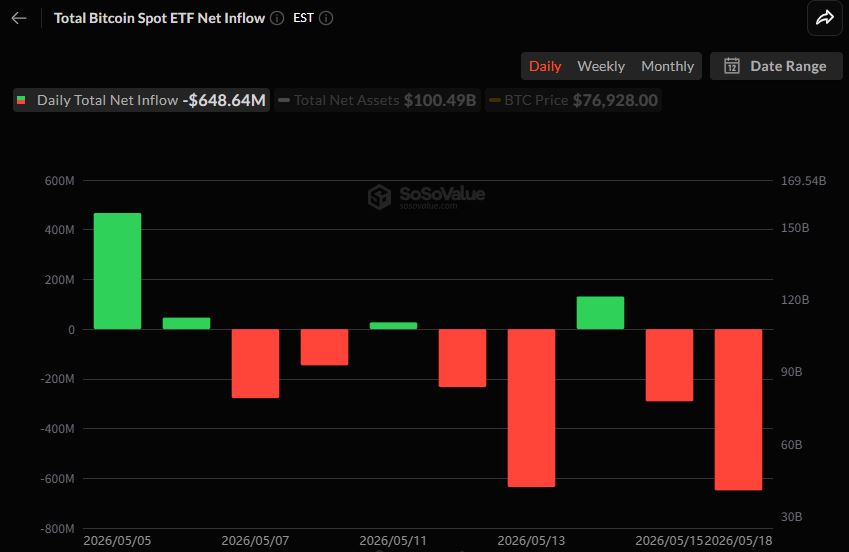
U.S. spot Bitcoin (BTC) ETFs extended their recent reversal on May 18, posting a second consecutive session of net outflows as investors pulled capital from the sector’s largest products—led by BlackRock’s iShares Bitcoin Trust ($IBIT).
According to data compiled by SosoValue, U.S.-listed spot Bitcoin ETFs recorded total net outflows of $648.64 million on May 18 (U.S. Eastern Time). The sell-off intensified from May 15, when the group saw $290.42 million in net redemptions, suggesting that short-term positioning has shifted more defensively after a period of steady inflows.
Cumulative net inflows across the spot Bitcoin ETF category still stood at $57.69 billion, underscoring that the broader trend remains one of meaningful 'institutional demand' despite periodic drawdowns.
Outflows were concentrated in seven funds. BlackRock’s $IBIT led the declines with $448.36 million exiting the fund, followed by ARK 21Shares Bitcoin ETF ($ARKB) with $109.64 million and Fidelity Wise Origin Bitcoin Fund ($FBTC) with $63.42 million. Smaller daily redemptions were also recorded in Bitwise Bitcoin ETF ($BITB) at $9.16 million, VanEck Bitcoin Trust ($HODL) at $7.59 million, Franklin Bitcoin ETF ($EZBC) at $6.65 million, and Invesco Galaxy Bitcoin ETF ($BTCO) at $3.82 million. Other spot Bitcoin ETFs were flat on the day.
While flows weakened, trading activity remained elevated. Total daily turnover across the spot Bitcoin ETF complex reached $3.14 billion. BlackRock’s $IBIT dominated volumes at $2.42 billion, followed by Fidelity’s $FBTC at $288.22 million and Grayscale Bitcoin Trust ($GBTC) at $128.71 million—an indication that 'liquidity' continues to cluster in the market’s largest, most actively traded vehicles.
Total net assets across U.S. spot Bitcoin ETFs were measured at $100.49 billion, representing roughly 6.52% of Bitcoin’s total market capitalization. By assets, $IBIT remained the clear leader with $62.2 billion under management, followed by $FBTC at $14.19 billion and $GBTC at $11.43 billion.
The latest outflows highlight how quickly ETF demand can swing in response to broader market sentiment, even as the category remains structurally significant to Bitcoin’s market plumbing. With spot ETFs now controlling a measurable share of BTC’s circulating value, near-term flow trends are increasingly watched as a barometer for risk appetite and 'institutional allocation' into crypto markets.
🔎 Market Interpretation
- Second straight outflow session: U.S. spot Bitcoin ETFs posted $648.64M in net outflows on May 18, accelerating from $290.42M on May 15—signaling a sharper short-term shift toward risk-off positioning.
- Outflows led by market leader IBIT: BlackRock’s IBIT drove the move with $448.36M redeemed, indicating that even the most dominant, liquid product is not insulated when sentiment turns.
- Rotation looks tactical, not structural: Despite the pullback, cumulative net inflows remain high at $57.69B, implying continued longer-term institutional participation with periodic de-risking.
- Liquidity remains strong despite redemptions: Total spot ETF turnover reached $3.14B, with IBIT alone at $2.42B, suggesting active repositioning rather than market abandonment.
- ETFs are now systemically relevant: Total net assets at $100.49B equate to about 6.52% of Bitcoin’s market cap, making ETF flows a prominent short-term barometer for broader BTC risk appetite.
💡 Strategic Points
- Watch concentration risk in flow signals: With IBIT capturing the majority of both assets ($62.2B) and volume, headline flow prints can be heavily skewed by a single fund’s creations/redemptions.
- Differentiate “flows” from “volume”: High trading volume alongside outflows may reflect hedging, arbitrage, or reallocations (e.g., moving between issuers) rather than a broad-based exit from BTC exposure.
- Near-term sentiment gauge: Consecutive outflows after steady inflows often mark a transition to defensive positioning; continued outflows could pressure spot BTC via reduced incremental demand, while stabilization may signal re-risking.
- Monitor the next-largest funds for confirmation: Notable redemptions in ARKB (-$109.64M) and FBTC (-$63.42M) suggest the move is not isolated; a reversal to inflows across multiple issuers would strengthen a “risk-on” read.
- Structural importance remains intact: Even with drawdowns, spot ETFs have become part of Bitcoin’s “market plumbing,” so persistent flow trends can influence price discovery and volatility expectations.
📘 Glossary
- Spot Bitcoin ETF: An exchange-traded fund designed to track Bitcoin’s spot price by holding BTC directly (or via closely linked spot holdings), enabling investors to gain BTC exposure through traditional brokerage accounts.
- Net inflows / net outflows: The daily net change in ETF shares created minus redeemed, typically reflecting new capital entering or exiting the fund.
- Redemptions: The process where authorized participants return ETF shares to the issuer in exchange for the underlying value, often associated with capital leaving the fund.
- Turnover (trading volume): The dollar value of shares traded in a day; high volume can coexist with outflows and may indicate active repositioning rather than net buying.
- Net assets (AUM): Total market value of assets held by the ETF(s); used to assess product size and market influence.
- Liquidity: How easily an asset can be traded without significantly impacting price; typically higher in larger funds with heavier volume (e.g., IBIT).
- Institutional allocation/demand: Investment activity by large entities (asset managers, funds, corporates) that can materially influence market flows and price trends.
- Market plumbing: The infrastructure and mechanisms (vehicles, liquidity, settlement links) through which capital moves into and out of an asset class, impacting price formation.





















Comment 0