

 News
News  Coin Information
  About us
  Customer Service


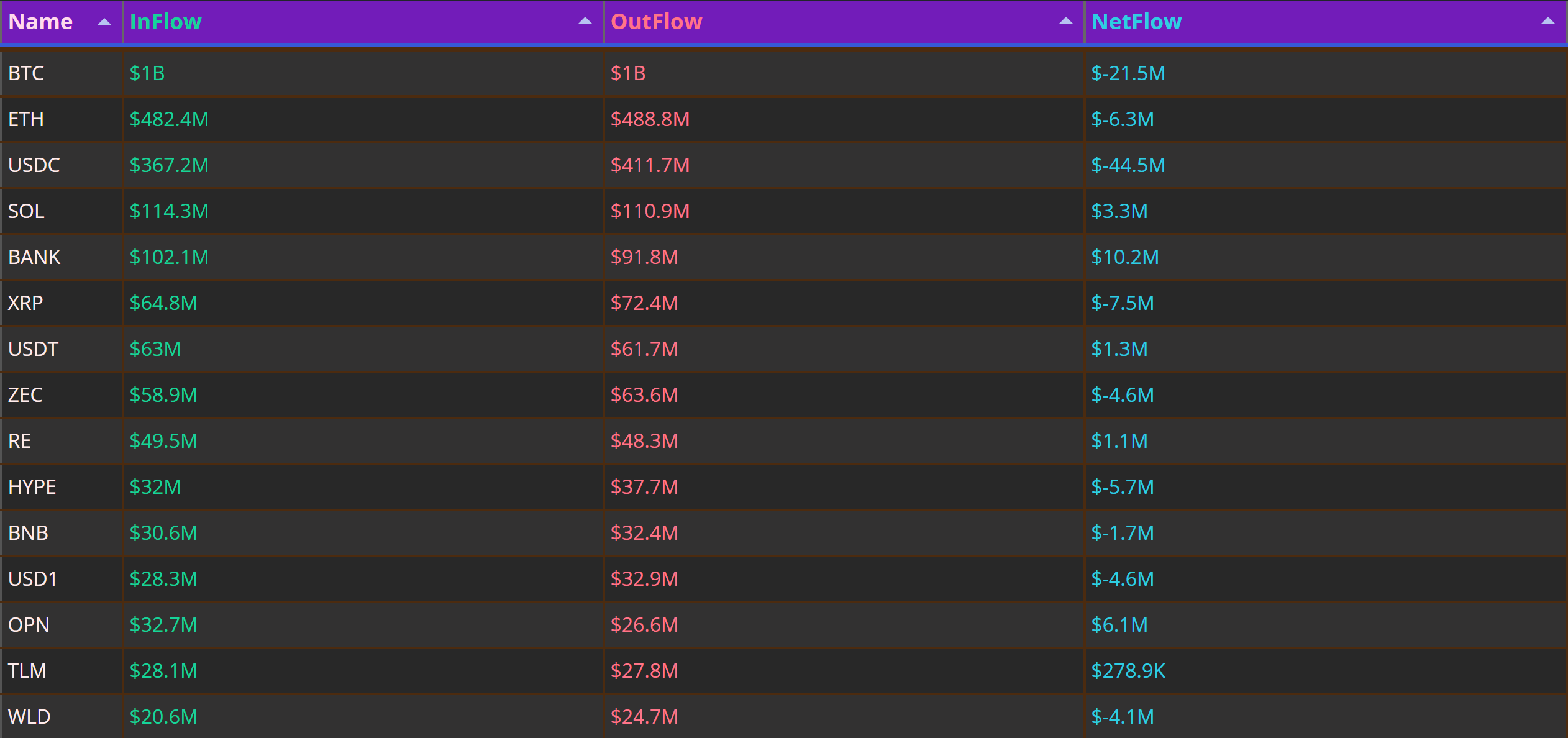
Crypto market flows showed renewed 'outflow pressure' in major assets on Sunday, while a handful of mid- and lower-cap tokens attracted selective buying—an uneven positioning pattern that often signals cautious risk appetite rather than a broad rebound.
As of 12:00 p.m. in South Korea on July 20 (03:00 a.m. UTC), data compiled by CryptoMeter indicated that Bitcoin (BTC) posted roughly $1.0 billion in inflows and $1.0 billion in outflows, leaving a net outflow of about $21.5 million. Ethereum (ETH) recorded $482.4 million in inflows versus $488.8 million in outflows, translating to a net outflow of around $6.3 million.
Stablecoin activity was mixed. Tether (USDT) saw $63.0 million of inflows and $61.7 million of outflows for a modest net inflow of approximately $1.3 million, suggesting near-neutral 'liquidity parking' behavior. In contrast, USD Coin (USDC) registered $367.2 million in inflows against $411.7 million in outflows, producing a comparatively large net outflow of about $44.5 million—one of the most notable figures in the day’s flow table.
Outside the majors, a few tokens stood out for net inflows. BankrCoin (BANK) led the second tier with a net inflow of $10.2 million, while OPN (OPN) followed with $6.1 million in net inflows. Ripple (XRP), meanwhile, faced net outflows of about $7.5 million, placing it among the day’s more pressured large-cap names.
By asset ranking, the top five net inflows were: Liquid Staked ETH (LSETH) at $14.5 million, BankrCoin (BANK) at $10.2 million, OPN (OPN) at $6.1 million, Ripple USD (RLUSD) at $4.1 million, and the euro-denominated stablecoin EUR (EUR) at $3.5 million.
The top five net outflows were led by USD Coin (USDC) at $44.5 million, followed by Bitcoin (BTC) at $21.5 million, First Digital USD (FDUSD) at $9.0 million, Ripple (XRP) at $7.5 million, and Ethereum (ETH) at $6.3 million.
Market participants typically read flow data as a short-horizon barometer of positioning and exchange-related liquidity rather than a definitive signal of trend. Still, Sunday’s profile—steady-to-negative net flows for BTC and ETH alongside a sharp USDC drawdown and pockets of inflow in select tokens—points to 'selective risk-taking' and ongoing sensitivity to liquidity conditions across both major crypto assets and stablecoin rails.
🔎 Market Interpretation
- Choppy, risk-managed positioning: Major assets showed net outflow pressure (BTC −$21.5M, ETH −$6.3M), while a few mid/low caps drew targeted inflows—typical of cautious risk appetite rather than a broad market rebound.
- Stablecoin rails diverged: USDT was near flat with a slight net inflow (+$1.3M), consistent with liquidity parking. USDC saw a notable net outflow (−$44.5M), the largest in the table, pointing to meaningful short-term liquidity rotation or withdrawal.
- Selective bids outside majors: Net inflows concentrated in a small set of tokens (e.g., LSETH +$14.5M, BANK +$10.2M, OPN +$6.1M), suggesting participants are picking spots rather than increasing exposure broadly.
- Large-cap dispersion: XRP posted a net outflow (−$7.5M), placing it among pressured large-cap names even as some second-tier assets attracted inflows.
- Overall read-through: The combined pattern—major-coin softness + sharp USDC drawdown + isolated inflow pockets—implies markets remain liquidity-sensitive with selective risk-taking dominating short-term behavior.
💡 Strategic Points
- Use flows as context, not a standalone signal: The article emphasizes flows are a short-horizon barometer. Pair them with price action, funding, open interest, and macro/liquidity conditions before drawing trend conclusions.
- Watch stablecoin outflows for tradable liquidity shifts: The USDC −$44.5M print can precede reduced on-exchange buying power or reflect migration to other rails (e.g., USDT, fiat, or off-exchange custody). Monitor whether this persists over multiple sessions.
- Majors’ “steady-to-negative” flows suggest defensive posture: BTC and ETH being slightly net negative despite large gross turnover signals distribution/rotation rather than aggressive accumulation.
- Follow-through matters for mid-cap inflows: BANK and OPN inflows may indicate tactical positioning. Confirmation could come from sustained net inflows plus improving liquidity/volume; otherwise, they may represent short-lived rotations.
- Track the day’s leaders/laggards list:
- Top net inflows: LSETH (+$14.5M), BANK (+$10.2M), OPN (+$6.1M), RLUSD (+$4.1M), EUR (+$3.5M).
- Top net outflows: USDC (−$44.5M), BTC (−$21.5M), FDUSD (−$9.0M), XRP (−$7.5M), ETH (−$6.3M).
- Interpret LSETH inflows carefully: Inflows into liquid-staked ETH products can reflect yield-seeking allocation even when spot ETH flow is slightly negative—potentially signaling preference for carry/yield exposure over directional spot risk.
📘 Glossary
- Inflow / Outflow: Estimated value moving into/out of exchanges or measured venues for a given asset over a period.
- Net Flow: Inflows minus outflows. Positive net flow often implies net capital entering measured venues; negative implies net withdrawal or distribution.
- Outflow Pressure: A market state where net flows are negative, suggesting more capital is leaving than entering measured venues for that asset.
- Stablecoin Rails: The stablecoin-based liquidity infrastructure (e.g., USDT, USDC) used to move capital and execute trades across crypto markets.
- Liquidity Parking: Holding funds in stablecoins (or moving into them) as a temporary, low-volatility position while waiting for clearer opportunities.
- Selective Risk-Taking: Capital deployment limited to specific tokens or themes rather than broad-based buying across the market.
- Large-cap / Mid-cap / Low-cap: Classification by market capitalization; large-caps are generally more liquid, while smaller caps can be more volatile and flow-sensitive.
- Liquid Staked ETH (LSETH): A tokenized representation of staked ETH designed to retain liquidity while earning staking-related yield.

















Comment 0