

 News
News  Coin Information
  About us
  Customer Service


 Add as a preferred source on Google
Solana (SOL) is pulling back into the low-$70 range, but a string of on-chain milestones and expanding ties with major payments companies are reinforcing a larger narrative: the network is increasingly being used as a real-world settlement layer rather than merely a speculative trading vehicle.
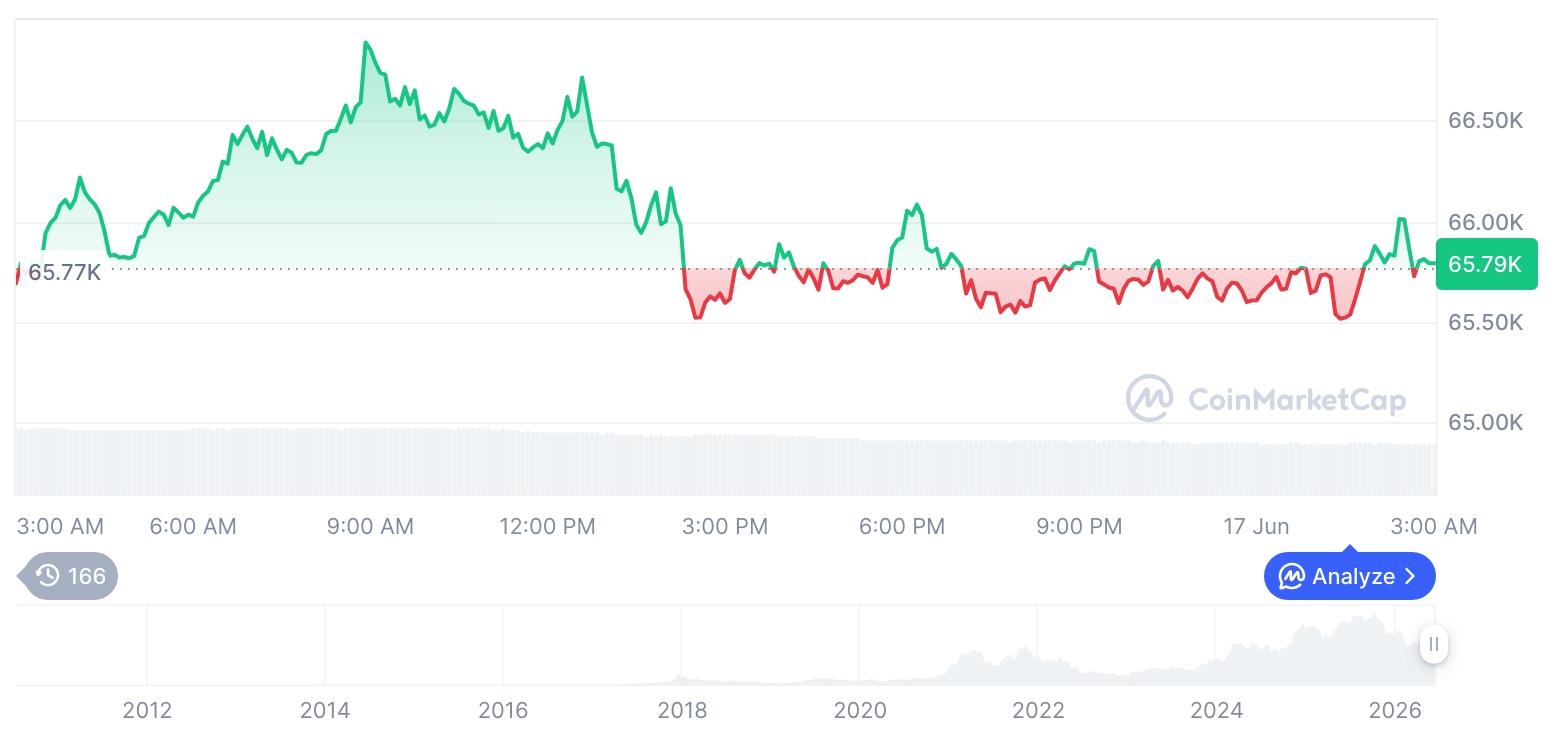
As of Wednesday 10:00 UTC (6:00 a.m. ET) on June 18, SOL traded at $70.79, down 4.04% over the past 24 hours. Solana’s market capitalization stood at roughly $41.0 billion, representing about 1.87% of the total crypto market. Daily trading volume was around $2.57 billion, up 23.69% from the prior day, with most activity concentrated on centralized exchanges (CEXs).
The most striking signal of Solana’s evolution has been its role in stablecoin transfers. In the first quarter of 2026, the network processed an estimated 76% of global stablecoin transfer volume, according to figures cited in the report. In February 2026 alone, stablecoin transactions on Solana reached approximately $850 billion—an unusually large footprint for a single chain, highlighting Solana’s positioning as a high-throughput payments rail where fees, speed, and reliability can materially affect user behavior.
Liquidity on the network has also grown into a meaningful base for payments and DeFi activity. USD-denominated stablecoins on Solana total about $14.7 billion. Tether (USDT) accounts for roughly $2.53 billion of that figure—about 1.36% of global USDT supply—with a reported 0.40% increase over the last 30 days. Market observers typically view stablecoin supply expansion on a chain as a proxy for rising utility, as it can support merchant settlement, remittances, and on-chain trading without forcing users into volatile assets.
Solana’s institutional narrative is being strengthened by participation from some of the world’s largest payment and financial infrastructure companies. The report says Visa, PayPal ($PYPL), Stripe, Western Union ($WU), and Fiserv ($FI) are operating live payment activity on Solana, signaling movement beyond pilot programs into ongoing deployment. For global payment networks, stablecoin rails can reduce settlement frictions, particularly across jurisdictions and outside traditional banking hours—benefits that are most compelling when a network can consistently handle large, bursty transaction flows.
One of the most consequential developments came on June 3, when Mastercard ($MA) announced it had selected eight blockchains—including Solana—for a global stablecoin payments network designed to operate 24/7, including weekends and holidays. While details on volume and rollout timelines were not provided, the selection itself is being interpreted as a credibility boost that could accelerate integrations across wallet providers, processors, and merchant endpoints, tightening Solana’s link to the broader financial system.
On the decentralized finance side, Solana’s total value locked (TVL) remains near $4.94 billion, reflecting continued activity across DeFi, NFTs, gaming, decentralized physical infrastructure networks (DePIN), and real-world asset tokenization (RWA). Analysts have also pointed to Solana’s protocol upgrades as an important counterweight to its earlier reputation for outages, arguing that improved stability and scalability are prerequisites for enterprise-grade payments and sustained consumer adoption.
Solana’s growing relevance is also showing up in policy discussions. The report says South Korea’s Democratic Party is considering consultations with Solana policy specialists as it works on digital asset legislation—an indication that the network is increasingly being discussed in regulatory and institutional contexts, not just within crypto-native circles.
Solana’s circulating supply was listed at about 580.05 million tokens, with total supply at roughly 628.56 million, according to the report. Despite the near-term price correction, the combination of large stablecoin balances, outsized stablecoin transfer share, meaningful DeFi liquidity, and active integrations with major payments firms is strengthening the case that Solana is becoming a core layer for 'stablecoin settlement' and high-performance on-chain finance—an evolution that could shape its competitive standing as stablecoin adoption moves deeper into mainstream commerce.











Comment 0