

 News
News  Coin Information
  About us
  Customer Service


 Add as a preferred source on Google

XRP is trading in a narrow range as investors weigh two near-term catalysts that could reshape its outlook: a major XRP Ledger (XRPL) software upgrade and a looming U.S. legislative vote that may clarify whether XRP is treated as a regulated 'digital commodity' rather than a security. The combination has kept price expectations highly sensitive to regulatory headlines and signs of fresh 'institutional demand' via exchange-traded products.
As of Aug. 2, 2026 at 11:00 UTC, XRP was priced at $1.0803, up 1.75% over the past 24 hours, according to CoinMarketCap data. Despite the daily bounce, the token remains softer on a broader horizon, down 1.78% over the past week and 2.50% over the past 30 days. XRP’s market capitalization stood near $67.5 billion, with roughly $842.7 million in 24-hour trading volume.
Technically, XRP has retreated significantly from its year-to-date high around $1.55 and is attempting to stabilize around the psychologically important $1.00 level. Market watchers have pointed to a support band in the $0.95–$1.00 area, while near-term resistance is often cited around $1.15, setting up what traders describe as a tight 'range-bound' battle.
On the network side, attention is shifting to the upcoming release of xrpld v3.3.0, an XRPL upgrade described by local crypto media as one of the most consequential updates in recent history. The release is expected next week and is aimed squarely at improving usability for enterprises and financial institutions—an important theme as tokenized assets and blockchain settlement tools continue to move toward the mainstream.
Among the most anticipated additions is 'Batch Transactions', which allows up to eight transactions to be grouped and processed as a single package. Supporters argue the feature could improve operational efficiency for high-frequency flows, corporate payment systems, and other institutional use cases where throughput and cost predictability matter. Another significant feature is 'Sponsored Fees and Reserves', which would allow a business to pay network fees and reserve requirements on behalf of end users—reducing friction for consumer-facing applications where users may not want to manage blockchain-native balances.
The package also strengthens support for tokenized assets and includes privacy and institutional tooling enhancements. However, developers and users should not assume immediate activation. As noted in coverage of the upgrade, new capabilities typically require XRPL network 'amendment' approval through consensus processes before they become fully operational, meaning the market impact may unfold in phases rather than all at once.
The larger swing factor, analysts say, may come from Washington. The U.S. Congress is currently considering the 'Digital Asset Market Clarity Act' (CLARITY Act), a bill that would explicitly categorize XRP, Bitcoin (BTC), Ethereum (ETH), and Solana (SOL) as 'digital commodities' and place their spot-market oversight under the Commodity Futures Trading Commission (CFTC). The bill passed the Senate Banking Committee unanimously (13–0) on May 14, 2026, and reporting in Korean crypto press suggests a full Senate vote could come before the chamber’s recess on Aug. 8.
If enacted, the measure would provide a clearer statutory basis for treating XRP as a commodity rather than a security, potentially lowering compliance uncertainty for brokerages, custodians, and asset managers. That narrative has been reinforced by the conclusion of the SEC’s case against Ripple last year, which ended with a $125 million settlement and helped solidify market expectations that XRP trading on public exchanges is less likely to be treated as a securities transaction under current interpretations.
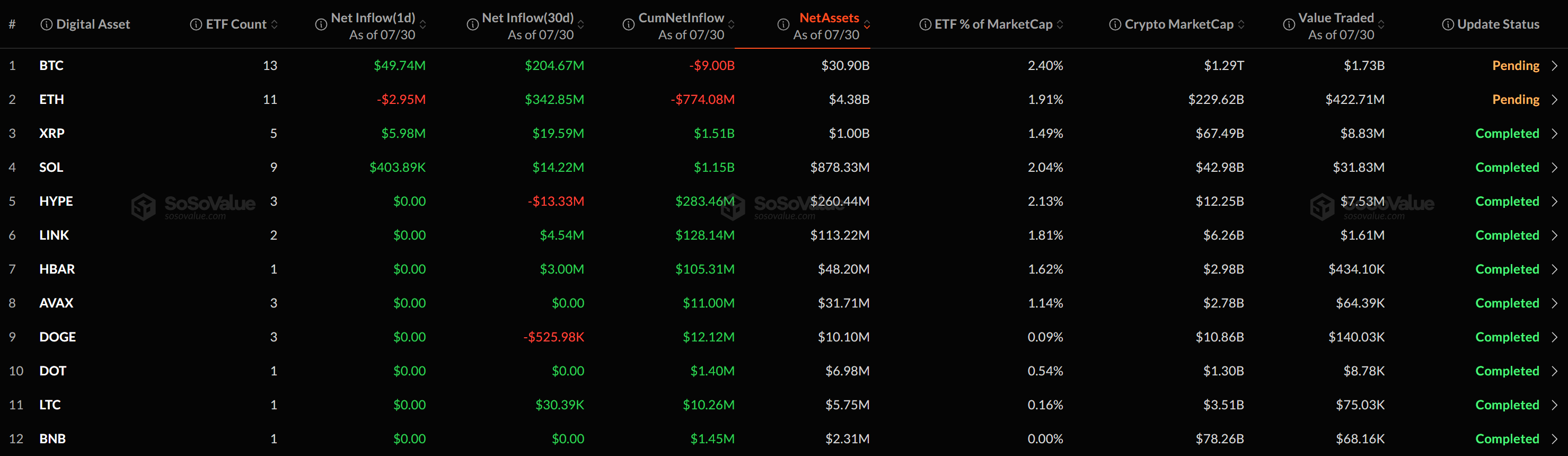
ETF flows have become the other key variable. Since November 2025, spot XRP ETF products have attracted an estimated $1.0 billion to $1.37 billion in net inflows, according to figures cited by CryptoTicker. Standard Chartered has argued that a favorable CLARITY outcome could expand that demand sharply, projecting potential cumulative inflows of up to $8 billion if regulatory conditions meaningfully improve and distribution broadens.
Still, near-term enthusiasm is being tempered by seasonality and recent flow data. Some market trackers have warned that July’s ETF inflows appeared to stagnate, while August has historically been one of XRP’s weaker months. That backdrop suggests price may remain headline-driven, with upside bursts vulnerable to profit-taking unless 'liquidity inflow' becomes more consistent.
Forecasts for 2026 remain wide. FinanceFeeds outlined three scenarios: a base case with XRP oscillating between $1.00 and $1.56 if the bill’s outcome remains unclear; a more constructive case of $1.00 to $2.80 if the bill passes alongside supportive market conditions; and a bullish scenario of roughly $4.94 to $8.00 if passage coincides with a sharp acceleration in ETF demand.
Other indicators imply the market is still anchored near current levels. A machine-learning projection cited by Finbold placed XRP’s average price around $1.11 as of Aug. 1, 2026. On Polymarket, traders recently assigned a 43% probability to XRP reaching $1.20, versus a 34% probability of falling below $1.00—signaling a fairly balanced distribution of expectations around the $1 handle.
On-chain signals also offer mixed cues. Data showing Binance’s XRP deposits falling to about 3.6 million XRP—described as an all-time low—has been interpreted as a potential reduction in immediate sell pressure. Yet XRP remains down more than 41% from earlier-year levels, and analysts caution that seasonal weakness and macro uncertainty can still cap rallies.
Beyond price action, longer-term fundamentals are being supported by continued ecosystem expansion efforts, including CBDC interoperability pilots in markets such as Brazil and Hong Kong, as well as exploration of sidechains, smart contracts, and DeFi tooling. For now, however, market participants broadly agree that a sustained move back above $2 would likely require two things: a decisive outcome on the CLARITY Act and a measurable step-up in real ETF-driven institutional allocations.
🔎 Market Interpretation
- Price is range-bound near a key psychological level: XRP is attempting to stabilize around $1.00 after falling from a ~$1.55 YTD high, with commonly watched support at $0.95–$1.00 and resistance near $1.15.
- Two near-term catalysts dominate: (1) the upcoming XRPL software upgrade (xrpld v3.3.0) and (2) a potentially market-moving U.S. Senate vote on the CLARITY Act, which could categorize XRP as a “digital commodity” under CFTC spot oversight.
- Regulatory clarity is the primary volatility trigger: Price expectations are described as highly sensitive to Washington headlines; a clear “commodity” framework is framed as reducing compliance uncertainty for institutions (brokers, custodians, asset managers).
- ETF flows act as the real-time demand indicator: Since Nov 2025, spot XRP ETF products reportedly drew $1.0B–$1.37B net inflows; a favorable regulatory outcome is expected (by some banks) to potentially expand demand materially, though recent flow data is said to have stagnated.
- Sentiment is balanced, not euphoric: Polymarket odds cited imply a relatively even distribution around $1.00–$1.20 (43% for $1.20 vs 34% for sub-$1.00), suggesting traders see two-sided risk rather than a one-way breakout.
- Seasonality and macro may cap rallies: August is noted as historically weaker for XRP, implying upside bursts may face profit-taking unless liquidity/ETF inflows strengthen.
💡 Strategic Points
- Event-driven playbook: Expect compressed price action until either (a) a CLARITY Act timeline becomes firm or (b) the XRPL upgrade translates into clearly measurable network adoption. Traders may treat the period as a “headline breakout” setup.
- Watch the activation path, not just the software release: The upgrade’s features may require XRPL amendment approvals via consensus before going live. Market impact may therefore be staged (announcement → amendment vote → adoption metrics).
- Institutional UX improvements are the upgrade’s core thesis:
- Batch Transactions (up to 8 grouped) targets operational efficiency for high-frequency settlement/corporate flows.
- Sponsored Fees and Reserves lets businesses pay fees/reserves for users—potentially lowering onboarding friction for consumer apps.
- Broader tooling for tokenized assets, privacy, and institutional workflows aims to strengthen XRPL’s enterprise positioning.
- Regulatory outcome defines the “multiple” the market is willing to pay: A statutory shift toward commodity treatment could expand permissible distribution channels and reduce legal overhang—key for ETF growth and larger allocators.
- Flow confirmation matters more than forecasts: Bull cases (e.g., projections up to ~$8B cumulative inflows) hinge on sustained ETF demand. Given hints of July stagnation, investors may prioritize weekly net inflow trends over long-range price targets.
- Key levels to frame risk:
- Below $1.00: narrative shifts to failed stabilization/seasonal weakness; support band becomes critical.
- Above $1.15: suggests range resolution; follow-through likely requires positive policy/flow confirmation.
- Above $2.00 (longer-term trigger level cited): likely requires both CLARITY clarity and a step-up in ETF allocations.
- Secondary indicators to monitor:
- Exchange deposits (e.g., low Binance deposits) as a proxy for near-term sell pressure—use with caution because it can be distorted by internal transfers.
- On-chain/enterprise pilots (CBDC interoperability, sidechains, smart contracts/DeFi tooling) as longer-term adoption signals, even if near-term price remains policy-driven.
📘 Glossary
- XRPL (XRP Ledger): The blockchain network associated with XRP, used for payments/settlement and tokenized asset functionality.
- xrpld v3.3.0: A referenced upcoming XRPL node software release containing new features; release does not necessarily mean immediate network-wide activation.
- Amendment (XRPL): A protocol change that typically requires network consensus/approval before features become fully active on the ledger.
- Batch Transactions: A feature allowing multiple transactions (up to eight, per the article) to be bundled and processed together to improve efficiency and predictability.
- Sponsored Fees and Reserves: Mechanism allowing an organization to pay transaction fees and reserve requirements for users, improving onboarding and user experience.
- CLARITY Act (Digital Asset Market Clarity Act): Proposed U.S. legislation that would classify certain major tokens (including XRP) as “digital commodities” and assign spot oversight to the CFTC.
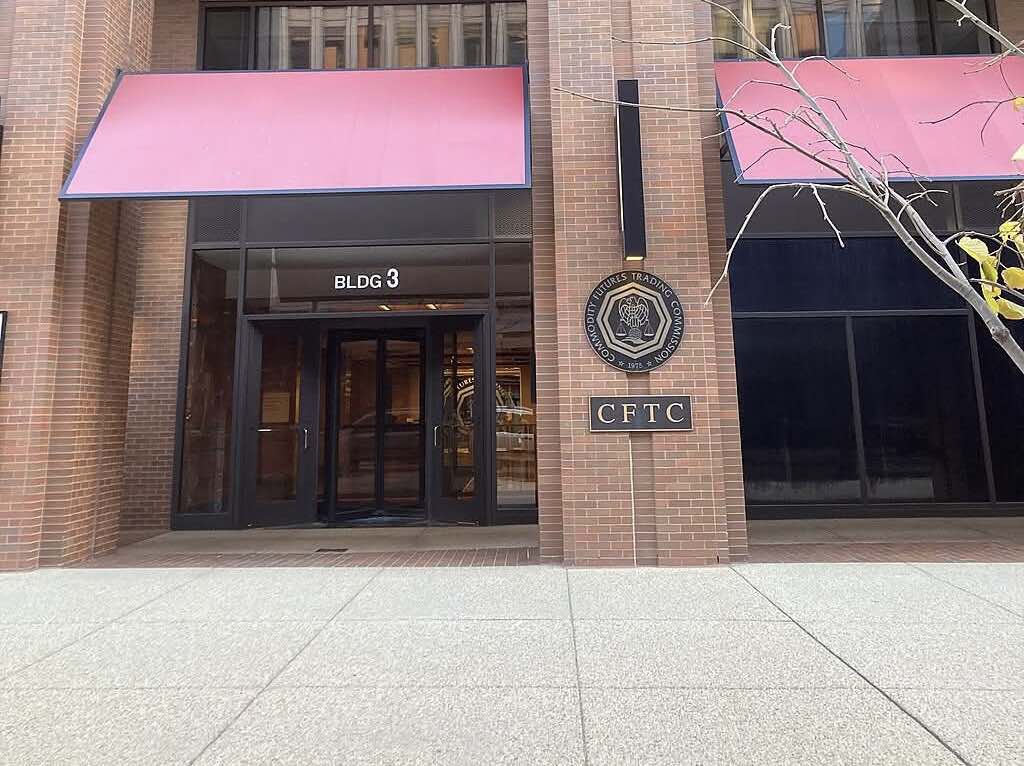
- CFTC: Commodity Futures Trading Commission, the U.S. regulator that oversees commodity derivatives and, under the bill’s framing, would oversee spot markets for “digital commodities.”
- ETF inflows (spot XRP ETFs): Net new capital entering exchange-traded products holding XRP, often treated as a proxy for institutional/wealth-platform demand.
- Range-bound: A market condition where price moves within a relatively tight band between support and resistance rather than trending strongly.
- Support / Resistance: Common technical analysis terms for price zones where buying (support) or selling (resistance) pressure has historically been stronger.




















Comment 0