
 Add as a preferred source on Google
TokenPost Revamps PRO Platform Into Korea-Focused Digital Asset Data Terminal
TokenPost launched an upgraded PRO platform transforming it into a Korea-style digital asset data terminal integrating macro, derivatives, and institutional indicators.

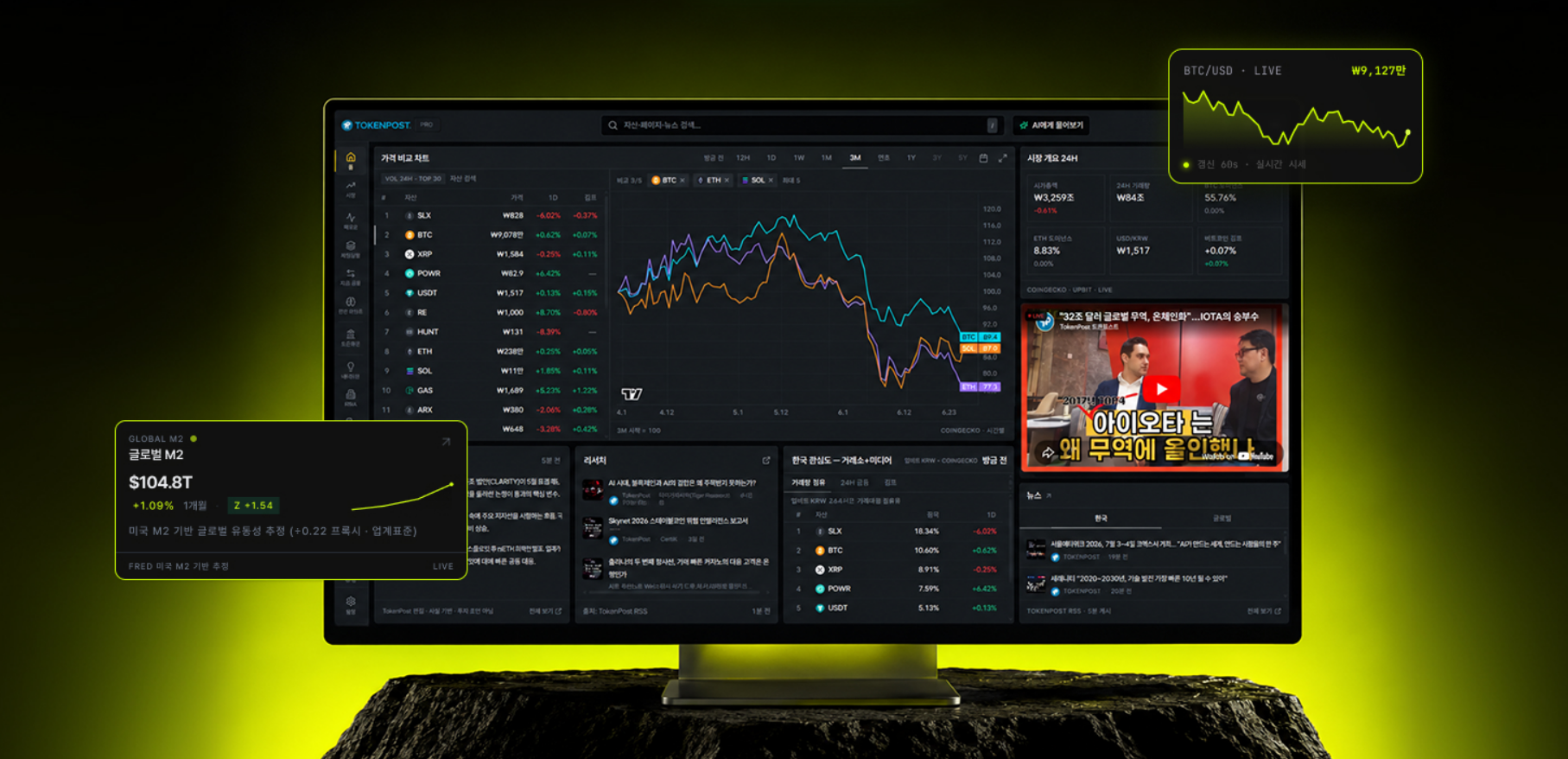
TokenPost has rolled out a major upgrade to TokenPost PRO, repositioning its premium product from an AI-driven crypto investing tool into what the outlet describes as a Korea-style ‘digital asset data terminal’ designed to consolidate fragmented market signals into a single interface.
The revamped platform expands beyond basic price and chart coverage to incorporate a broad set of indicators that often drive crypto’s day-to-day moves—ranging from interest rates, the U.S. dollar, and liquidity conditions to derivatives positioning, ‘institutional flow’ proxies, and Korea-specific demand metrics such as the ‘kimchi premium’. The service also introduces new monitoring features for tokenized equities and sector-level capital rotation.
TokenPost said the redesign reflects how digital asset markets have matured. While spot prices remain the first datapoint most traders check, price action alone can be difficult to interpret without understanding the macro backdrop, leverage concentrations, and where large pools of capital are moving. By placing these datapoints side by side, TokenPost aims to help users quickly assess why Bitcoin (BTC) or major altcoins may be moving—and whether the drivers are macro, derivatives-led, or localized to Korea.
At the core of the upgrade are 22 data modules delivering real-time dashboards spanning macro indicators, futures market positioning, and flow-style analytics. TokenPost highlighted that interest-rate and dollar indicators are meant to contextualize the risk environment for digital assets, while futures market gauges such as open interest and funding rates can signal whether leveraged positioning is becoming crowded on one side of the trade.
Institutional-facing datasets—often difficult for retail users to synthesize—are also more prominent in the new build. The platform aggregates signals from areas such as ETFs, CME-linked indicators, and prediction-market data to help users infer what larger market participants may be pricing in. TokenPost framed the feature as a way to make institutionally relevant information more readable without requiring specialized tooling.
The updated TokenPost PRO places particular emphasis on Korea-specific market structure. In addition to global price benchmarks, it offers views into domestic volume trends, Korea concentration indicators, and the ‘kimchi premium’—a spread metric that can widen or narrow depending on local demand, capital controls, and exchange-specific liquidity. TokenPost said these tools are intended to help users track which assets are attracting attention on Korean venues, even when global pricing alone may not reveal the same demand dynamics.
One notable addition is tokenized equities monitoring. TokenPost PRO now displays 24/7 data for tokenized versions of well-known Korean stocks, including Samsung Electronics and SK Hynix, reflecting a wider market push to bring traditional assets on-chain. As the line between conventional finance and crypto market infrastructure continues to blur, TokenPost positioned tokenized equities as a key area to watch for future expansion in digitally native trading activity.
AI features have also been expanded. The service now includes an ‘AI briefing’ function that translates complex indicators into plain-language explanations aimed at speeding user comprehension of what the data implies. TokenPost emphasized that these AI summaries are fact-focused and do not provide investment advice or price predictions.
In another upgrade aimed at reducing information latency for Korean traders, TokenPost PRO added real-time AI interpretation for market-moving events—such as Federal Open Market Committee decisions, U.S. CPI releases, and major corporate announcements—providing Korean subtitles and rapid summaries. The goal, TokenPost said, is to narrow the time gap between overseas announcements and local comprehension of their market impact.
According to TokenPost, the terminal is built on data sourced from five major exchanges, with key indicators refreshed at 60-second intervals. The company also said it provides source attribution within the interface to strengthen data credibility—an important consideration in a 24/7 market where traders depend on fast updates and verifiable inputs.
Pricing is set at 100,000 won per month for a monthly plan and 960,000 won per year for an annual subscription, which TokenPost said equates to 80,000 won per month—about a 20% discount. Beyond retail subscriptions, TokenPost plans to offer tailored solutions for institutions and enterprises, including API connectivity, customized datasets, and onboarding support.
“The digital asset market has entered a stage where it can’t be understood through simple price tracking alone,” a TokenPost representative said, adding that interpreting market direction increasingly requires monitoring rates, the dollar, ETFs, futures positioning, domestic supply-demand, tokenized assets, and sector rotation together. The representative described TokenPost PRO as a Korea-style data terminal designed to help Korean investors and institutions interpret global digital asset markets “faster and more systematically,” and said the company will continue expanding data modules, AI interpretation tools, and institutional solutions.
TokenPost PRO is available through the PRO service page on TokenPost’s official website.
Article Summary by TokenPost.ai
🔎 Market Interpretation
Product repositioning: TokenPost upgraded TokenPost PRO from an AI-assisted investing tool into a Korea-style digital asset data terminal that consolidates fragmented market signals into one interface.
Beyond price charts: The platform emphasizes that spot price moves are often unclear without context from macro conditions (rates, USD, liquidity), derivatives leverage, and cross-market capital flows.
Driver attribution framework: By placing macro, futures positioning, institutional proxies, and Korea-local metrics side by side, users can infer whether BTC/altcoin moves are driven by (1) macro risk regime shifts, (2) derivatives/leverage positioning, or (3) Korea-specific supply–demand dynamics.
Real-time orientation: Data is sourced from five major exchanges and key indicators refresh every 60 seconds, reflecting the need for fast, verifiable inputs in 24/7 markets.
Convergence with TradFi: New tokenized equities monitoring (24/7) for tokenized Korean stocks signals TokenPost’s view that the boundary between traditional finance and crypto infrastructure is increasingly blurred.
💡 Strategic Points
22 modular dashboards: Core upgrade centers on 22 real-time data modules spanning macro indicators, derivatives positioning, and flow-style analytics for quicker situational awareness.
Derivatives risk checks: Futures metrics like open interest and funding rates are positioned as tools to detect crowded leverage (one-sided positioning) that can amplify volatility and trigger squeezes.
Institutional signal accessibility: The terminal elevates harder-to-synthesize datasets (ETF signals, CME-linked indicators, prediction markets) to help retail users interpret what larger participants may be pricing in—without specialized institutional tooling.
Korea-specific edge: Dedicated views for domestic volume trends, Korea concentration indicators, and the kimchi premium aim to reveal Korean venue demand that may not be visible via global benchmarks alone.
Sector and rotation monitoring: Added tooling for sector-level capital rotation and tokenized equities tracking broadens coverage from coin-by-coin monitoring to theme/sector allocation behavior.
AI for comprehension, not advice: Expanded AI features include (1) an AI briefing that converts complex indicators into plain language, and (2) real-time AI interpretation of market-moving events (FOMC, CPI, major corporate news) with Korean subtitles—explicitly framed as fact-focused and non-predictive.
Trust/verification: Source attribution inside the interface is highlighted as a credibility feature, addressing the high cost of misinformation in fast markets.
Commercial model: Pricing is 100,000 won monthly or 960,000 won annually (effective 80,000 won/month, ~20% discount). TokenPost also plans institutional/enterprise offerings (API access, custom datasets, onboarding).
📘 Glossary
Digital asset data terminal: A unified interface that aggregates multiple market inputs (prices, macro, derivatives, flows, local metrics) to interpret market conditions quickly.
Macro indicators: Economy-wide variables such as interest rates, the U.S. dollar, and liquidity that influence risk appetite across markets, including crypto.
Liquidity conditions: Measures of how much capital is available and how easily assets can be traded without moving price—often tied to central bank policy and funding markets.
Derivatives positioning: Information about futures/perpetual markets that reflects leveraged bets, hedging, and trader crowding.
Open interest (OI): The total number of outstanding derivatives contracts; rising OI can indicate increasing leverage and potential volatility.
Funding rate: A periodic payment between long and short traders in perpetual futures; extreme funding can signal one-sided positioning and potential reversals.
Institutional flow proxies: Indirect indicators used to infer institutional activity (e.g., ETF-related signals, CME-linked metrics) when direct flow data is limited.
CME-linked indicators: Metrics derived from or related to CME futures markets, often used as a benchmark for institutionally oriented crypto trading.
Prediction-market data: Market prices from prediction platforms that reflect collective expectations of future events or outcomes.
Kimchi premium: The price spread between Korean exchanges and global markets, influenced by local demand, capital frictions, and exchange liquidity.
Korea concentration indicators: Measures intended to show how strongly activity in certain assets is concentrated on Korean venues versus globally.
Tokenized equities: Blockchain-based tokens that track or represent equity exposure (e.g., tokenized Samsung Electronics), enabling 24/7 trading-style monitoring in a crypto-like format.
Sector rotation: Capital shifting between themes or sectors (e.g., L1s, DeFi, AI tokens), often signaling changing risk preferences.
FOMC: The U.S. Federal Open Market Committee, whose rate decisions can materially affect global risk assets.
CPI: Consumer Price Index, a key inflation measure that can influence interest-rate expectations and market volatility.