
 Add as a preferred source on Google
IREN Shifts From Bitcoin Mining to AI Data Centers With Microsoft, NVIDIA Deals
IREN is pivoting from Bitcoin mining to AI cloud infrastructure through major deals with Microsoft and NVIDIA to build large-scale data center capacity.


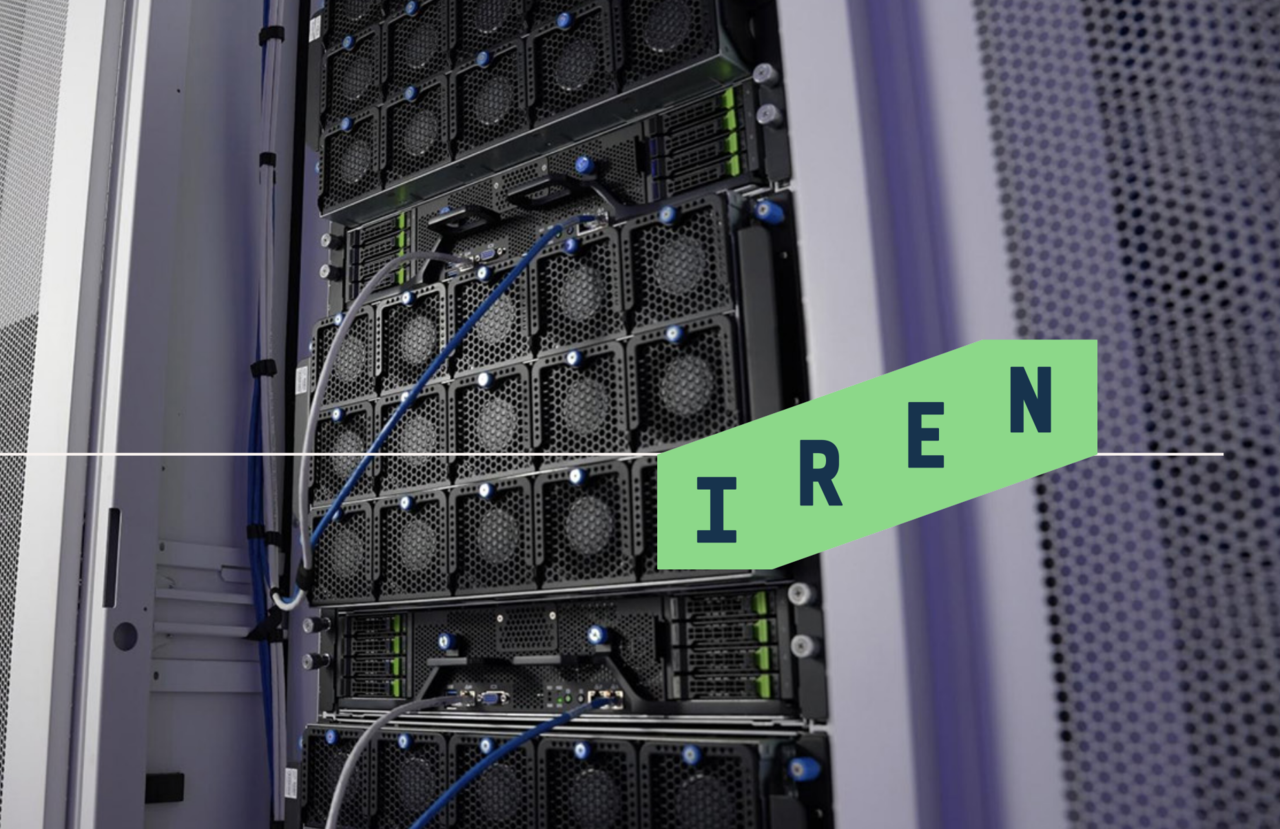
IREN Limited ($IREN) is accelerating its pivot from Bitcoin mining to AI cloud infrastructure, aiming to reposition itself as a large-scale data center and GPU compute provider just as demand for ‘AI compute’ tightens globally. The strategic shift comes amid a sharp pullback in the stock, underscoring how quickly market expectations have reset for former mining names trying to become AI infrastructure plays.
Shares of IREN were recently changing hands around $41.14, roughly 43% below the company’s record high of $76.87. The move follows an extended rally off cycle lows, after which the stock entered a consolidation phase that has also weighed on a broader group of crypto-linked infrastructure equities.
From a technical perspective, traders have been watching near-term resistance around the 4-hour chart’s 200-period exponential moving average near $49.98 and the 50-period exponential moving average near $51.68. On the downside, a key support zone is clustered in the $27.57 to $29.99 range—often described as a ‘golden ratio’ Fibonacci retracement area—viewed by many market participants as a critical level for the longer-term trend. In European trading, IREN recently closed at €36.01, down about 1.5% on the day and roughly 19% over the past month, while still up about 147% year-on-year.
The core of IREN’s transformation is being shaped by a pair of headline partnerships with major U.S. technology firms. The company disclosed a $9.7 billion agreement with Microsoft ($MSFT), and said it secured a $3.65 billion GPU financing facility to support the build-out. According to the company, the structure covers roughly 96% of GPU capital expenditures at an average interest rate of about 6%, easing the near-term balance sheet burden typically associated with hyperscale AI infrastructure rollouts.
IREN has also signed a five-year partnership valued at $3.4 billion with NVIDIA ($NVDA). Under the arrangement, NVIDIA is expected to run AI cloud workloads at IREN’s Childress, Texas site using air-cooled Blackwell systems—NVIDIA’s next-generation architecture designed for large-scale model training and inference. The agreement also includes an option for NVIDIA to purchase up to 30 million shares at $70 per share over the next five years, implying a potential $2.1 billion equity investment if exercised.
To scale execution, IREN has strengthened its leadership bench with hires from major cloud and data-center operators. The company appointed Kambiz Aghili, previously at Oracle ($ORCL), as chief product officer, and named Michael Nudelman—whose background includes Google (Alphabet, $GOOGL) and CyrusOne—as chief development officer. The appointments are intended to support product development for AI cloud services, large-scale data-center construction, and power infrastructure expansion.
IREN operates sites in Australia and Canada and says it controls a grid-connected power portfolio totaling about 5 gigawatts. Management has framed its end-state ambition as a fully ‘vertically integrated’ AI cloud and data-center supplier, spanning power procurement, site development, and compute delivery. The company also noted a partnership with BE Networks to simulate deployment scenarios for NVIDIA Blackwell GPU infrastructure, a step aimed at shortening time-to-deployment for next-generation hardware.
Financially, IREN’s internal roadmap targets approximately $8.7 billion in revenue and about $500.48 million in profit by 2029, implying exceptionally rapid growth from current levels. Some analysts model an even more aggressive trajectory, projecting 2029 revenue of $14.9 billion and profit of $1.4 billion, reflecting expectations that AI infrastructure revenue can scale quickly once capacity comes online and utilization rates normalize.
Freedom Capital Markets recently upgraded IREN to ‘strong buy’ from ‘hold’ and set a $58 price target, implying roughly 49% upside from recent levels. The firm cited the AI data-center transition and the NVIDIA agreement as central to its reassessment. Analysts following the story expect revenue to rise from an estimated $717 million this year to about $3.1 billion by fiscal 2027, with gains driven predominantly by AI infrastructure rather than the legacy Bitcoin mining business.
Still, the pivot is unfolding against a softer backdrop for the sector. Arlington Capital Management Inc. disclosed a $3.45 million position in IREN, signaling continued institutional interest, but an index tracking AI-infrastructure-linked Bitcoin miners has fallen about 16% over the past month. Market participants have also noted instances of insider selling across the group, adding to near-term sentiment pressure.
For IREN, the headline contracts, fresh executive hires, and a clearly articulated capacity build-out plan have strengthened the company’s medium-term fundamental narrative. At the same time, analysts and investors are watching familiar risks in capital-intensive infrastructure models—customer concentration, leverage tied to GPU financing, and execution timelines—as the company attempts to convert large commitments into sustainable, recurring ‘AI cloud’ revenue.
Article Summary by TokenPost.ai
🔎 Market Interpretation
Repositioning narrative: IREN is accelerating a shift from Bitcoin mining to AI cloud/data-center infrastructure, attempting to capture tightening global demand for GPU compute.
Reset expectations reflected in price: Shares around $41.14 remain roughly 43% below the $76.87 peak, showing that markets are still discounting execution and funding risk despite major AI headlines.
Key technical levels: Near-term resistance is watched around the 4H 200 EMA (~$49.98) and 50 EMA (~$51.68). A major support zone sits at $27.57–$29.99 (commonly labeled a “golden ratio” Fibonacci retracement area), viewed as pivotal for the longer-term trend.
Cross-market performance snapshot: European close at €36.01 (about -1.5% on day, -19% over a month), but still about +147% year-on-year—highlighting elevated volatility typical of “pivot” stories.
Sector headwinds persist: An index tied to AI-infrastructure-linked Bitcoin miners fell about 16% over the past month, and reports of insider selling have pressured sentiment broadly, even as institutions selectively add exposure.
💡 Strategic Points
Microsoft-scale demand signal: IREN disclosed a $9.7B agreement with Microsoft, positioning itself as a potential hyperscale AI compute supplier if capacity comes online as planned.
GPU financing reduces upfront strain (but adds leverage risk): A $3.65B GPU financing facility is said to cover ~96% of GPU capex at ~6% average interest, potentially easing near-term balance sheet pressure while increasing sensitivity to utilization and contract durability.
NVIDIA partnership anchors workload credibility: A 5-year, $3.4B partnership has NVIDIA running AI cloud workloads at IREN’s Childress, Texas site using air-cooled Blackwell systems (next-gen architecture for training/inference).
Embedded equity option could become a major catalyst: NVIDIA holds an option to buy up to 30M shares at $70 over five years—implying up to $2.1B potential equity investment if exercised (supportive if it validates execution; dilutive if framed as financing substitute).
Operational capability build: Executive hires from major operators—Kambiz Aghili (ex-Oracle) as CPO and Michael Nudelman (ex-Google/Alphabet, CyrusOne) as CDO—are meant to strengthen productization, delivery timelines, and large-scale build execution.
Vertical integration thesis: IREN cites a grid-connected power portfolio of ~5 GW across sites in Australia and Canada, targeting control over power procurement, site development, and compute delivery—key to competing on cost and reliability.
Deployment acceleration efforts: Partnership with BE Networks to simulate NVIDIA Blackwell deployment scenarios aims to shorten time-to-deployment—critical in a market where uptime and speed-to-capacity are monetization drivers.
Ambitious 2029 financial targets: Company targets ~$8.7B revenue and ~$500.48M profit by 2029; some analysts forecast even higher (~$14.9B revenue, $1.4B profit), reflecting a “capacity + utilization” scaling assumption.
Street view turning more constructive: Freedom Capital Markets upgraded to Strong Buy with a $58 target (~49% upside), expecting growth from ~$717M this year to ~$3.1B by FY2027, driven primarily by AI infrastructure.
Key risks to monitor: Customer concentration (large counterparties), leverage and refinancing tied to GPU financing, construction/energization timelines, and the ability to translate headline contracts into recurring AI cloud revenue and stable utilization.
📘 Glossary
AI compute: Specialized computing capacity (often GPUs) used for training and running AI models.
GPU (Graphics Processing Unit): High-parallelism processors central to modern AI training and inference workloads.
Hyperscale: Extremely large-scale data center deployments typically associated with major cloud providers.
Capex (Capital Expenditures): Upfront spending to build/expand long-lived assets such as data centers and GPU clusters.
Utilization rate: The percentage of installed compute capacity that is actively used and generating revenue.
Customer concentration: Dependence on a small number of customers for a large share of revenue; increases contract/renewal risk.
EMA (Exponential Moving Average): A technical indicator that weights recent prices more heavily to gauge trend and potential support/resistance.
Fibonacci retracement / “golden ratio” zone: Technical analysis levels derived from Fibonacci ratios; “golden ratio” commonly refers to ~61.8% retracement often watched as support in pullbacks.
Blackwell (NVIDIA architecture): NVIDIA’s next-generation GPU/platform designed for large-scale AI training and inference.
Vertically integrated: Operating across multiple parts of the value chain (power, land/site, build, and compute delivery) to control costs and execution.
Insider selling: Sales of shares by company insiders; not always negative but can pressure sentiment in high-duration growth stories.