
 Add as a preferred source on Google
Iris Energy Shares Drop 38% as Bitcoin Miner Bets on AI Pivot
Iris Energy (IREN) shares fell sharply as the firm pivots from Bitcoin mining to AI data centers, with investors weighing execution risks against long-term AI demand.


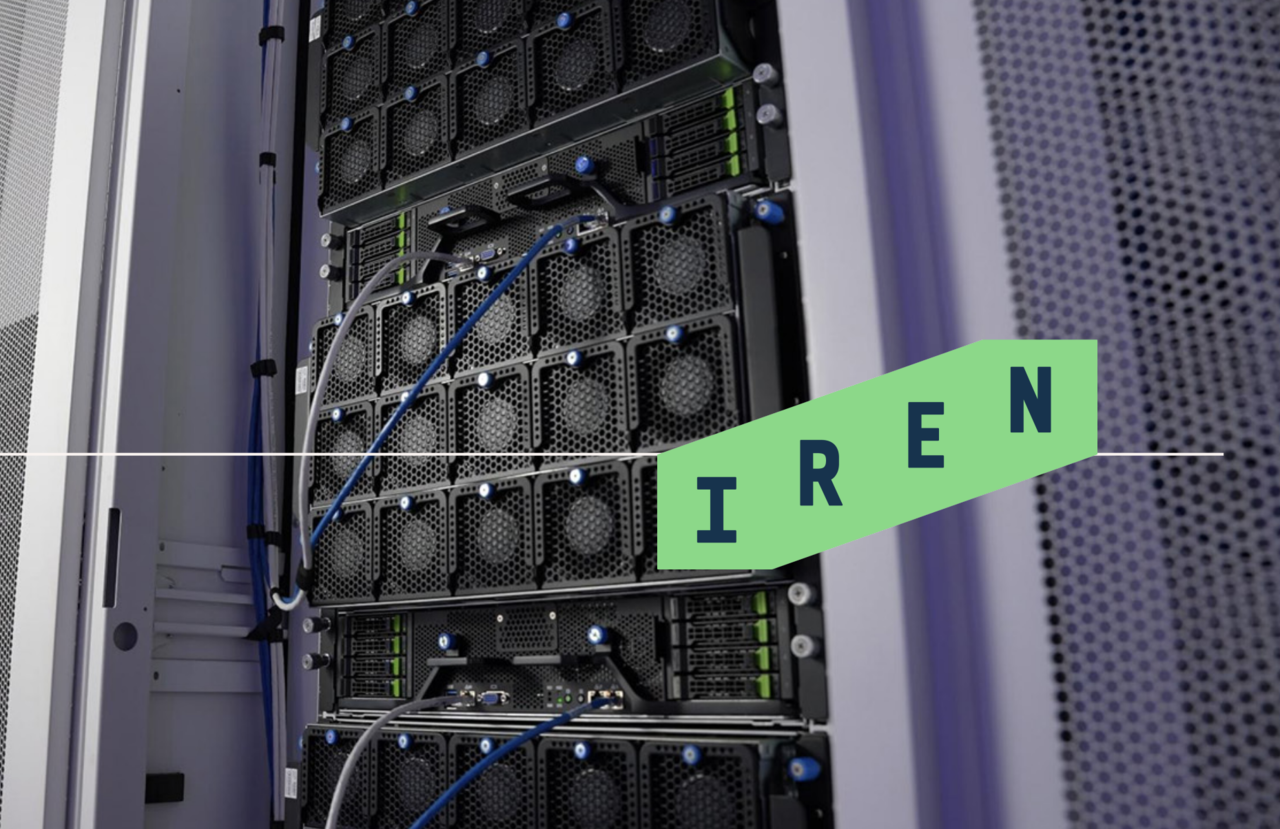
Iris Energy ($IREN), which is in the midst of pivoting from Bitcoin mining to AI-focused data centers, has seen volatility spike as investors weigh near-term execution risks against a potentially larger long-term addressable market.
Over the past month, IREN shares have sold off sharply, with the stock recently around $34.83—down roughly 38% to 41% from the prior month’s levels. Despite the pullback, the company’s 12-month performance remains strong, with the stock still up about 95% to 96% over the period, underscoring the split between shorter-term positioning and longer-term optimism tied to AI infrastructure demand.
The Australian-based company has historically been associated with Bitcoin (BTC) mining infrastructure, but it is increasingly marketing itself as an AI cloud and high-performance computing (HPC) provider. That transition has brought a new set of questions to the forefront: declining mining revenue sensitivity, the scale of capital required to build out data centers, and the operational complexity of deploying large GPU clusters—each a source of 'execution risk' that can amplify day-to-day price swings.
IREN’s 52-week high stands at $76.87, leaving the stock roughly 55% below its peak. Even so, sell-side expectations remain elevated. Market data cited average analyst price targets around $82.36, implying more than 100% upside from current levels—a reflection of expectations that AI compute demand could continue to expand and that data center operators with available power and build capacity may be able to capture meaningful 'liquidity inflow' from enterprise and hyperscale customers.
Notably, the stock’s recent decline has been interpreted less as a company-specific breakdown and more as part of a broader valuation reset across the 'neo-cloud' and AI infrastructure segment. As investors rotate capital and reprice growth assumptions, infrastructure names that previously benefited from AI enthusiasm have faced renewed scrutiny around funding needs, timelines, and near-term margins.
Against that backdrop, IREN has taken steps to bolster its institutional profile and operational readiness. The company’s inclusion in the Russell 1000 index has increased its visibility among large asset managers, while the appointment of a new chief information security officer (CISO) signals an effort to strengthen governance and security posture—an increasingly important credential for firms seeking enterprise AI and HPC workloads.
However, the market continues to focus on the capital intensity of the pivot. Alger Capital, referenced in market commentary, highlighted the financing and buildout risks associated with scaling GPU deployments and expanding data center capacity. For investors, the key tension is whether IREN can manage the transition period—when mining-linked cash flows may be less supportive—without diluting shareholders or overextending the balance sheet.
Derivative and synthetic products linked to the stock have also attracted attention, adding another layer of risk for retail traders. Robinhood has highlighted the Defiance Daily Target 2X Long IREN ETF ($IRE), a leveraged vehicle designed to seek two times the daily performance of IREN shares and recently trading around $10.81. Such products are typically used for short-term trading and can diverge significantly from expected outcomes over longer holding periods due to daily compounding.
Separately, market participants have flagged that certain exchange-listed tokens referencing the company—such as MEXC’s IREN-related synthetic pair—are not part of IREN’s official ecosystem, underscoring the need for due diligence when navigating tokenized or synthetic representations of public equities.
Looking ahead, IREN’s near-term share performance is likely to remain sensitive to sector-wide sentiment and to progress milestones in its buildout. While the sell-off reflects pressure from weaker Bitcoin mining economics and a broader re-rating in AI infrastructure, bulls argue that Russell 1000 inclusion and the expanding market for AI compute could provide longer-term tailwinds. For now, the company’s ability to execute on capacity expansion while maintaining financial discipline will be central to how investors ultimately price the pivot.
Article Summary by TokenPost.ai
🔎 Market Interpretation
High-volatility reprice during a business-model pivot: Iris Energy (IREN) is shifting its identity from Bitcoin mining to AI/HPC data centers, increasing uncertainty and amplifying share-price swings.
Near-term drawdown vs. long-term narrative: The stock is down ~38%–41% over the past month (around $34.83) but still up ~95%–96% over 12 months, reflecting a split between short-term execution risk and long-term AI infrastructure optimism.
Benchmark gap signals sentiment reset: IREN trades ~55% below its 52-week high ($76.87), suggesting the market is discounting timelines, capital needs, and margin trajectories for AI buildouts.
Analyst optimism remains elevated: Average price targets cited around $82.36 imply 100%+ upside, based on assumptions that AI compute demand expands and power-ready operators attract enterprise/hyperscaler spend.
Sector-wide valuation reset: The decline is framed as less company-specific and more tied to a broader re-rating across “neo-cloud”/AI infrastructure names as investors reassess growth assumptions and funding needs.
Added trading risk from leverage/synthetics: Leveraged ETFs and synthetic products tied to IREN can intensify volatility and create outcomes that differ from spot equity performance over time.
💡 Strategic Points
Execution milestones are the catalyst set: The next leg in performance likely depends on GPU cluster deployment progress, data-center capacity expansion, and customer ramp—rather than mining metrics alone.
Capital intensity is the core investment debate: Scaling AI data centers requires significant capex; investors are focused on how IREN funds expansion without excessive dilution or balance-sheet strain.
Transition risk: cash-flow mix shift: As mining-linked cash flows become less supportive, the company must bridge the period before AI/HPC revenues scale, which can pressure near-term margins.
Institutional signaling helps, but doesn’t remove build risk: Russell 1000 inclusion can broaden the investor base and improve visibility; hiring a CISO strengthens enterprise credibility, but execution and funding remain decisive.
Risk management for traders: Leveraged instruments (e.g., daily 2x ETFs) are generally short-term tools; compounding effects can cause significant divergence from expected returns if held longer.
Due diligence on tokenized/synthetic exposure: Exchange-listed “IREN” tokens/pairs may not be officially affiliated with the company; investors should verify product structure, issuer, tracking method, and redemption rights.
📘 Glossary
AI-focused data centers: Facilities optimized to run AI workloads, often requiring high power density, advanced cooling, and high-speed networking.
HPC (High-Performance Computing): Large-scale computing used for compute-intensive tasks, including AI training/inference, scientific modeling, and simulations.
GPU cluster: A networked group of graphics processing units used to accelerate AI and parallel computing workloads.
Execution risk: The risk that a company fails to deliver on plans (timelines, budgets, capacity, customer onboarding), leading to financial or valuation setbacks.
Capital intensity: A business characteristic requiring large upfront investment (capex) to build capacity before revenues scale.
Dilution: Reduction in existing shareholders’ ownership percentage, typically from issuing new shares to raise capital.
Balance sheet: A financial statement showing assets, liabilities, and equity; often scrutinized for leverage and funding flexibility.
Neo-cloud: A newer cohort of cloud/infrastructure providers positioned around AI-native compute offerings and specialized data-center capacity.
Liquidity inflow: New capital entering a stock/sector, potentially supporting higher valuations or funding expansion.
Russell 1000 inclusion: Index membership that can increase institutional ownership and passive fund demand due to benchmark tracking.
CISO (Chief Information Security Officer): Executive responsible for information security strategy, controls, and enterprise security governance.
Leveraged ETF (daily): An exchange-traded fund targeting a multiple of a stock’s daily return; performance can diverge over multi-day periods due to compounding.
Synthetic product/token: An instrument designed to mirror the price of an asset via derivatives or internal accounting, without necessarily providing direct equity ownership.