
 Add as a preferred source on Google
Grid Batteries Beat Gas in Australia’s NEM Evening Peak for the First Time in Any Quarter
Batteries supplied 8% of evening-peak generation versus 5.1% for gas, while NEM underlying demand averaged a Q3 record 25,471 megawatts.

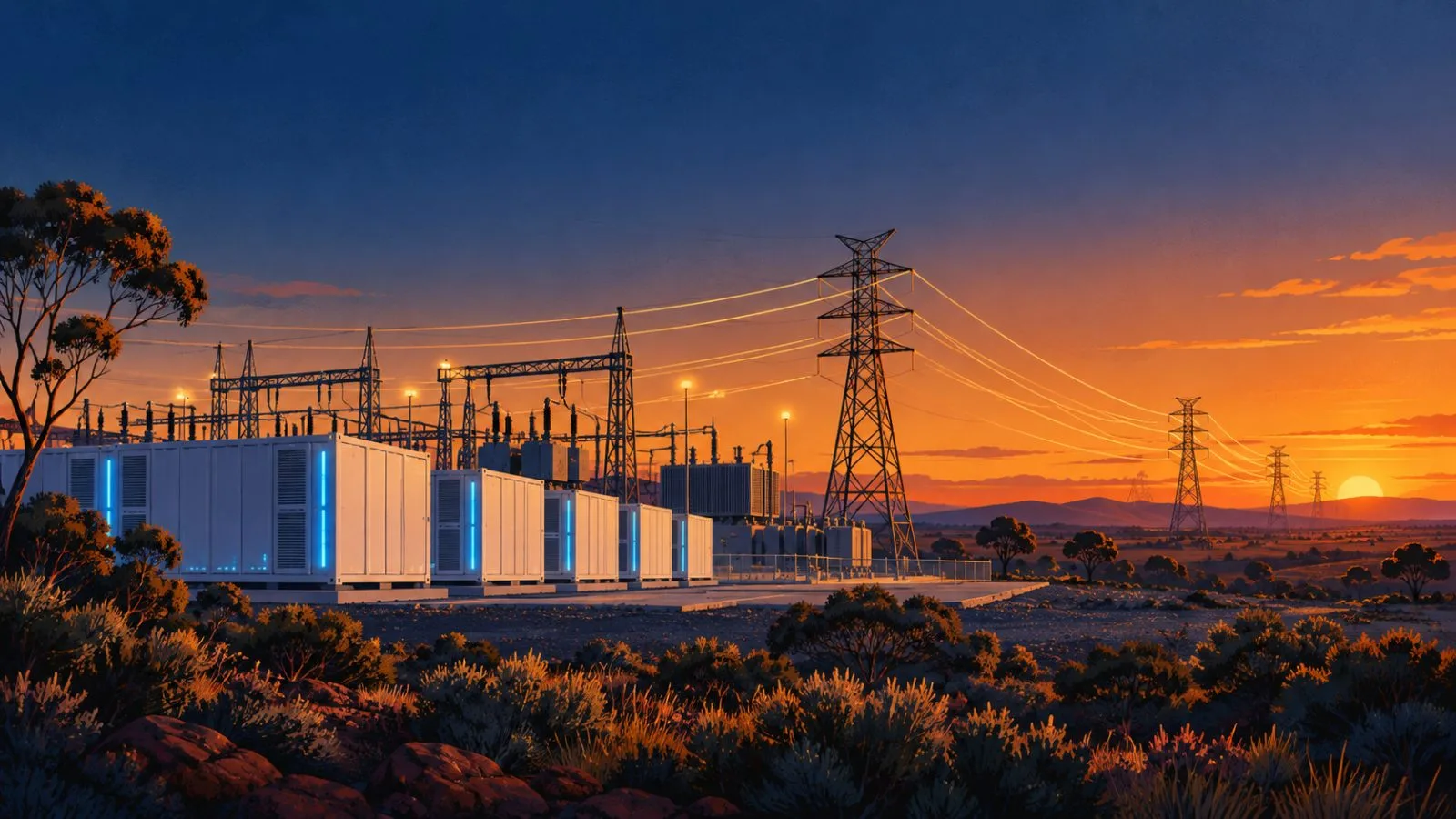
Grid-scale batteries supplied more of Australia’s National Electricity Market (NEM) evening-peak generation than gas in July-September, as NEM underlying demand reached a Q3 record average of 25,471 megawatts.
In the peak-period comparison, batteries accounted for 8% of total generation and gas-fired plants accounted for 5.1%. It was the first quarter in which batteries’ share exceeded gas’s. The period ran from July 1 to Sept. 30, 2026. The figures cover the NEM, which spans Queensland, New South Wales, the Australian Capital Territory, Victoria, South Australia and Tasmania—not all of Australia.
Gas-fired generation in the NEM averaged 881 megawatts (MW), down 453 MW, or 34%, from the same quarter a year earlier. That was the lowest Q3 average since 2000. Renewables provided a record 44.3% of NEM generation, compared with 41.8% a year earlier. Grid-scale solar averaged 2,211 MW, up 30%, and hydro averaged 1,572 MW, up 15%. Wind generation fell 6%.
Grid-scale batteries charged an average of 13.4 gigawatt-hours (GWh) per day during daytime hours and discharged an average of 10.9 GWh per day during evening peaks. In Q3 2025, the comparable daily averages were 3.7 GWh charged and 3.2 GWh discharged.
NEM underlying demand averaged 25,471 MW for the quarter, 1.3% above the year-earlier level. Victoria’s data center demand averaged 225 MW, up 65%. Violette Mouchaileh, executive general manager of policy and corporate affairs at the Australian Energy Market Operator, said, “Electricity use continues to grow, but more solar and storage is changing when energy is produced, drawn from the grid and shifted across the day.”
Wholesale spot prices fell 27% from a year earlier to their lowest Q3 average since 2021. Batteries set prices in 48% of dispatch intervals, up from 18% in Q3 2025. Western Australia has a separate electricity market; there, gas-fired generation rose 110 MW, or 12%, year over year as wind output and coal availability declined.
John Kim
John Kim reports on the digital-asset business for TokenPost. Send corrections or tips to info@tokenpost.com.