

 News
News  Coin Information
  About us
  Customer Service


 Add as a preferred source on Google
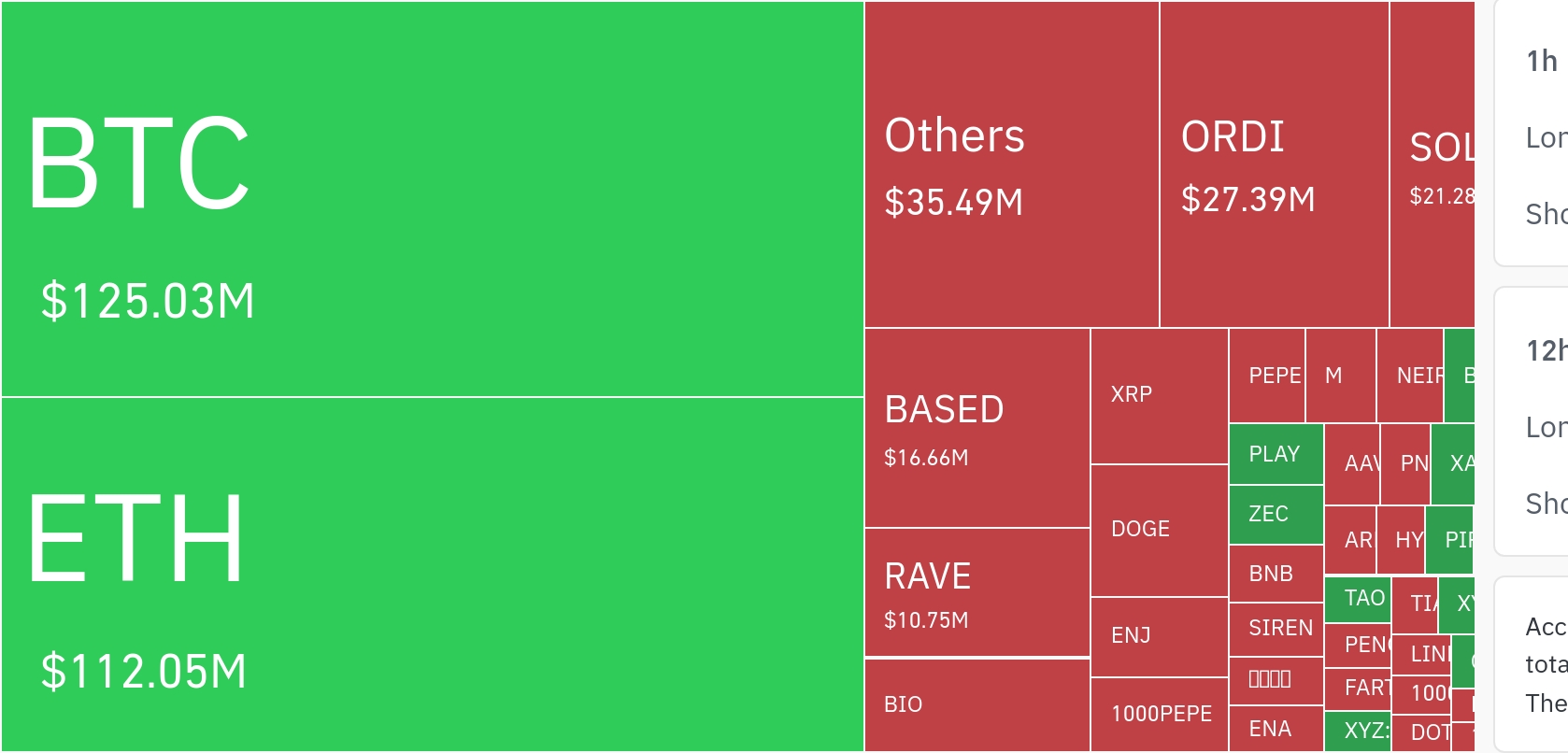
Roughly $115.99 million in leveraged crypto positions were liquidated over the past 24 hours, underscoring how quickly volatility has returned to major derivatives venues as traders were caught on the wrong side of a sharp move.
Data compiled by CoinGlass shows liquidations were heavily skewed toward bearish bets: short positions accounted for $87.93 million, or 75.81% of the total, while long positions made up $28.06 million, or 24.19%. A short-heavy wipeout typically signals a sudden upside move that forces bearish traders to buy back positions—often amplifying momentum through 'short squeeze' dynamics.
In the most recent four-hour window, Binance led all venues by a wide margin with $55.47 million in liquidations—47.82% of the total across tracked exchanges. Of that figure, $42.49 million (76.6%) came from short positions, indicating concentrated pressure on traders positioned for downside.
Bybit ranked second with $16.47 million (14.2%) in liquidations, again dominated by shorts at $12.93 million (78.49%). OKX followed with approximately $14.82 million (12.78%) liquidated, with shorts representing 71.07%. One notable outlier was HTX, where long liquidations exceeded shorts, with long positions comprising 57.86%—a sign that price action and positioning can diverge materially across venues depending on client mix and leverage preferences.
Coin-level breakdowns showed the largest liquidations clustered in the most traded assets. Bitcoin (BTC) positions recorded the highest figure, with about $125.03 million liquidated in the past 24 hours, according to the dataset. Ethereum (ETH) followed with roughly $112.05 million. Solana (SOL) saw around $21.28 million liquidated, while other large-cap altcoins also contributed notable totals, including XRP at about $116.42 million and Dogecoin (DOGE) near $30.68 million. More speculative tokens were also caught in the unwind, with ORDI and BASED posting approximately $27.39 million and $16.66 million in liquidations, respectively—highlighting how smaller, thinner-liquidity markets can experience outsized forced selling or buying during rapid swings.
In crypto derivatives markets, a 'liquidation' occurs when a leveraged trader can no longer meet margin requirements and the exchange forcibly closes the position. Episodes like this often reflect a crowded trade being rapidly repriced, and they can act as a reset for 'open interest' as excessive leverage is flushed out.
While liquidation spikes do not on their own determine direction, the dominance of short liquidations suggests a meaningful portion of the market had leaned bearish into the move. If volatility persists, traders will likely continue to reduce leverage, which can temporarily stabilize price action—though the same conditions can also set up further abrupt moves if positioning again becomes one-sided.
🔎 Market Interpretation
- Liquidation wave signals a sharp upside move: $115.99M in forced closes in 24h with shorts = $87.93M (75.81%) implies bears were caught offside and squeezed.
- Short-squeeze mechanics likely amplified momentum: Shorts being liquidated typically triggers buy-to-cover flows, which can push price higher and cascade into more liquidations.
- Venue concentration shows where leverage was most crowded: In the latest 4h window, Binance dominated with $55.47M (47.82%) liquidations, with 76.6% from shorts—suggesting positioning was heavily skewed bearish on that venue.
- Cross-exchange divergences highlight different client positioning: While Binance/Bybit/OKX were short-heavy, HTX saw long liquidations > shorts (57.86% longs), indicating participant mix and leverage preferences can lead to opposite pain points across exchanges.
- Leverage reset underway: Such spikes often reduce excessive leverage and can temporarily calm markets, but if one-sided positioning rebuilds, volatility can return quickly.
💡 Strategic Points
- Risk management in high-volatility regimes: When short liquidations dominate, consider tightening leverage, widening stop placement to account for wick risk, or using options/hedges rather than high-leverage perps.
- Watch for follow-through vs. fade: A short squeeze can produce continuation rallies if spot demand joins, or mean reversion if the move was primarily liquidation-driven. Confirmation cues: spot volume strength, funding rates stabilizing, and declining liquidation intensity.
- Exchange-by-exchange signals matter: Heavy liquidations on a single venue (e.g., Binance) can hint at localized crowding. Compare funding/open interest across venues to gauge whether repositioning is broad-based or isolated.
- Altcoins and thin liquidity = outsized swings: Smaller markets (e.g., ORDI/BASED) can see disproportionate forced flows; consider lower position sizing and higher slippage assumptions during fast markets.
- Monitor open interest reset: If open interest drops meaningfully after the squeeze, price can stabilize; if open interest rebuilds rapidly alongside one-sided funding, another liquidation cascade becomes more likely.
📘 Glossary
- Liquidation: Forced closure of a leveraged position when margin falls below maintenance requirements.
- Short liquidation: A short position is closed by the exchange, typically requiring buying back the asset—often occurring during rapid price increases.
- Long liquidation: A long position is forcibly closed, typically during sharp price declines.
- Short squeeze: A rapid rise that forces shorts to buy back, adding fuel to upward momentum.
- Open interest (OI): Total outstanding derivatives positions; liquidation spikes can reduce OI by flushing leverage.
- Margin / Maintenance margin: Collateral required to keep a position open; falling below maintenance triggers liquidation.
- Funding rate: Periodic payment between longs and shorts in perpetual futures that reflects positioning imbalance.
- Thin liquidity: Market condition where limited order book depth can cause larger price moves from smaller orders.




















Comment 0