
 Add as a preferred source on Google
$4.7 Billion Crypto Liquidations Signal Short Squeeze as Bitcoin, Ethereum Rise
Roughly $4.73 billion in crypto positions were liquidated as a market rebound triggered a short squeeze, with Bitcoin and Ethereum leading losses across major exchanges.








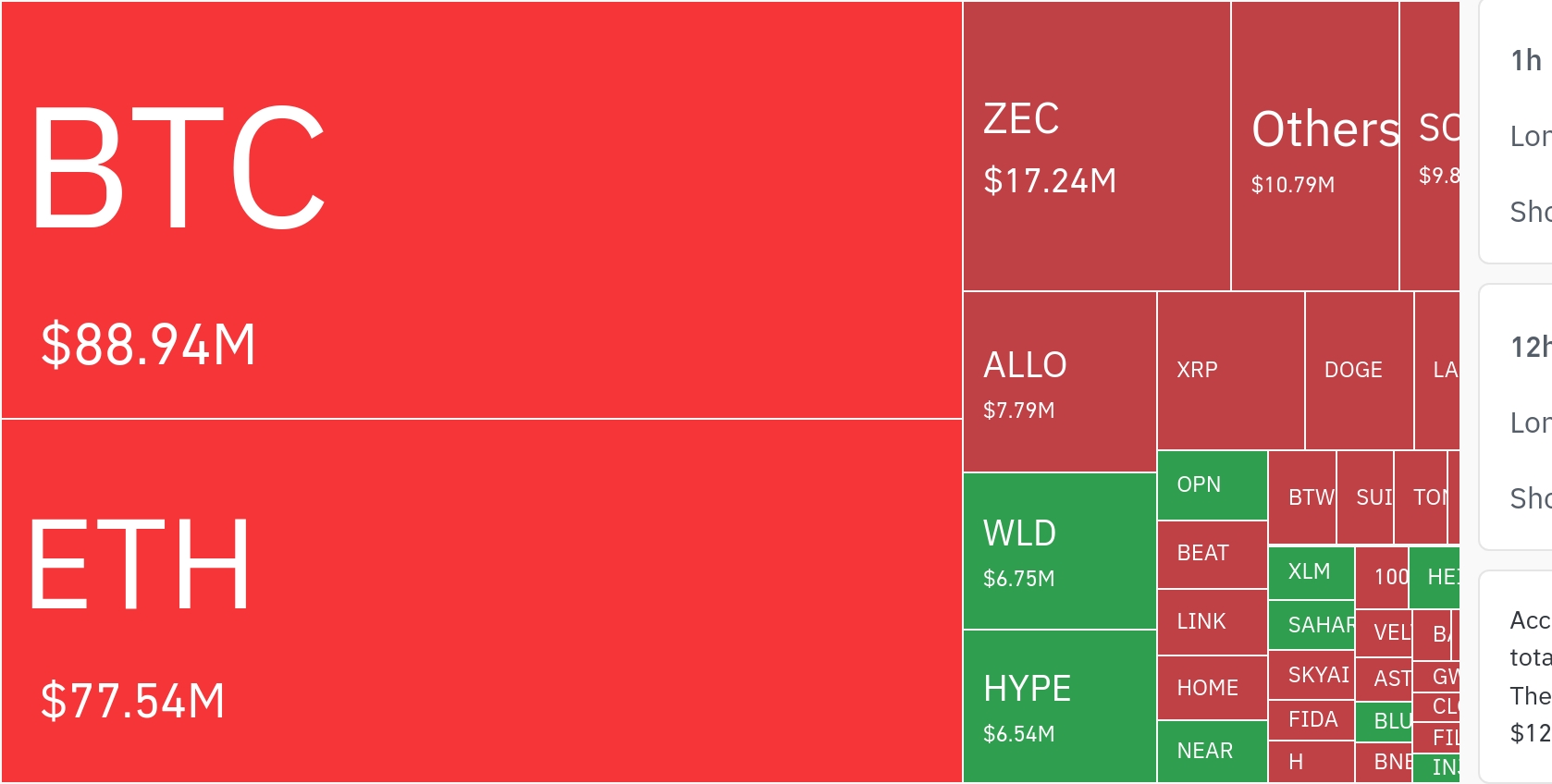
Crypto markets saw a wave of forced deleveraging over the past 24 hours, with roughly $4.73 billion in leveraged positions liquidated as a short-term rebound punished both sides of the trade—slightly more so for those positioned for downside. The scale of liquidations underscores how quickly 'leverage' has rebuilt across majors and high-beta altcoins, leaving traders vulnerable to sharp intraday swings.
Aggregated liquidation data showed long liquidations totaling about $2.27 billion, while short liquidations reached approximately $2.46 billion. Shorts accounted for around 51.9% of the total, edging out longs at 48.1%, suggesting that traders betting against the recent bounce absorbed somewhat larger losses as prices pushed higher.
In the most recent four-hour window, total exchange liquidations were tallied at roughly $75.6 million. Binance led the pack with about $45.45 million—around 60.12% of the observed total—making it the largest single venue for liquidations during the period. Notably, Binance’s liquidations were overwhelmingly short-driven, with about $38.62 million, or 84.99%, attributed to short positions.
Other major venues followed at a distance: Bitget recorded about $6.05 million (8.0%), Gate about $5.45 million (7.21%), Bybit around $5.14 million (6.8%), and OKX approximately $4.86 million (6.43%). Decentralized and derivatives-focused platforms also reflected the squeeze dynamics. Hyperliquid posted about $4.69 million in liquidations, of which roughly $4.52 million—about 96.31%—were shorts. By contrast, Aster stood out as a rare case where long liquidations dominated, with longs representing about 73.46% of its $1.49 million total.
The exchange breakdown points to a market where a rapid upswing intensified short-covering pressure—a classic 'short squeeze' setup in which rising prices force bearish traders to buy back positions, potentially amplifying upside momentum.
By asset, Bitcoin (BTC) and Ethereum (ETH) dominated liquidation activity. Bitcoin saw about $871.7 million liquidated over 24 hours, split between approximately $423.8 million in long liquidations and $447.9 million in shorts. Ethereum posted the largest total, around $1.4343 billion, with about $703 million in longs and $731.5 million in shorts wiped out—highlighting how concentrated leverage remains in the two market bellwethers.
Among major altcoins, Solana (SOL) registered around $620.4 million in liquidations, XRP (XRP) about $489.7 million, and Dogecoin (DOGE) roughly $270.5 million. Heatmap-style tallies over the same 24-hour period also showed elevated liquidation clusters in Bitcoin (BTC) at roughly $88.94 million and Ethereum (ETH) at about $77.54 million, with notable prints in Zcash (ZEC) near $17.24 million and smaller but still significant figures across several tokens, including Worldcoin (WLD), Hyperliquid’s HYPE, and ALLO.
Price action during the window aligned with the squeeze dynamic in several high-beta names. Bitcoin (BTC) gained about 0.9% and Ethereum (ETH) rose around 0.6%, while Solana (SOL) advanced roughly 2.1%. Sui (SUI) climbed about 2.8% and Pepe (PEPE) rose around 3.4%, moves that likely contributed to the outsized short liquidations observed across venues.
Still, liquidation patterns were not uniformly directional. XRP (XRP) fell about 0.8%, WLD (WLD) declined around 1.1%, and BNB (BNB) slipped roughly 0.5% over the same period, yet each saw meaningful liquidation totals—suggesting that crowded positioning, cross-margin effects, and volatility spikes can trigger forced exits even when spot performance is mixed.
Market watchers also flagged unusually heavy liquidation concentrations in some mid- and small-cap assets. ZEC’s appearance near the top of the liquidation heatmap, alongside elevated readings in HYPE and ALLO, points to rapidly expanding short-term volatility beyond the largest tokens. The fact that shorts represented about 81.85% of liquidations in the latest four-hour exchange snapshot reinforces the view that the rebound caught bearish positioning offside, accelerating forced buying.
Liquidations occur when leveraged traders fail to meet margin requirements and exchanges forcibly close positions, turning price moves into rapid cascades during periods of thin order books or crowded trades. The latest figures suggest volatility is reasserting itself around Bitcoin (BTC) and Ethereum (ETH), while spillover into altcoins indicates that 'risk appetite' and speculative leverage remain elevated—conditions that can amplify both rallies and drawdowns in the days ahead.
Article Summary by TokenPost.ai
🔎 Market Interpretation
Forced deleveraging event: About $4.73B in crypto leveraged positions were liquidated in 24 hours, signaling that leverage had rebuilt quickly and made markets fragile to sharp intraday swings.
Slight short-side pain dominance: Long liquidations were ~$2.27B vs short liquidations ~$2.46B (shorts ~51.9%), indicating the rebound squeezed bearish positioning a bit more than bullish positioning.
Short-squeeze dynamics: The move higher forced short-covering (buybacks), which can mechanically amplify upside momentum—especially in thin or fast-moving books.
Venue concentration: In the latest 4-hour window (~$75.6M liquidations), Binance accounted for ~60.1% and was heavily short-driven (~85% of its liquidations), highlighting where the squeeze pressure was most acute.
Leverage concentrated in majors: ETH led total liquidations (~$1.434B), followed by BTC (~$871.7M), confirming the highest systemic leverage remains in the dominant benchmarks.
Altcoin spillover: Large liquidation totals in SOL (~$620M), XRP (~$490M), and DOGE (~$271M) suggest elevated speculative positioning and “risk-on” leverage beyond BTC/ETH.
Mixed spot returns, still high liquidations: Some tokens fell (e.g., XRP, WLD, BNB) yet still saw meaningful liquidations—consistent with cross-margin effects, volatility spikes, and crowded one-sided positioning getting unwound even without clean directional trends.
💡 Strategic Points
Expect higher volatility after cascades: Post-liquidation environments often remain jumpy as positioning resets and liquidity thins—plan for wider ranges and faster reversals.
Watch short-dominant venues for continuation signals: A short-heavy liquidation profile (e.g., Binance, Hyperliquid) can imply ongoing squeeze risk if price holds above key intraday levels.
Majors as risk barometers: With ETH and BTC leading liquidations, continued stability in these two can reduce broader contagion; renewed drops can quickly re-trigger cascades across alts.
Altcoin leverage is elevated: Heavy liquidations in SOL/XRP/DOGE and notable heatmap prints in mid-caps (e.g., ZEC, HYPE, ALLO) suggest tighter risk controls are warranted for high-beta names.
Mind cross-margin & correlated drawdowns: Losses in one position can force liquidation elsewhere under cross-margin, so portfolio-wide leverage—rather than single-trade leverage—should be managed.
Use sizing and invalidation, not conviction: In squeeze conditions, directional calls can be punished on both sides; define stop/exit levels and reduce leverage to avoid forced closures.
Track liquidation clusters: Heatmap “clusters” often mark crowded levels; if price revisits them, liquidations can accelerate moves (up or down) due to cascading forced orders.
📘 Glossary
Liquidation: Forced closing of a leveraged position by an exchange when margin requirements are no longer met.
Leverage: Borrowed exposure that magnifies gains and losses; higher leverage reduces the distance to liquidation.
Deleveraging: A reduction in aggregate market leverage, often occurring abruptly via liquidations during volatility spikes.
Margin (maintenance margin): Minimum collateral required to keep a leveraged position open; falling below it triggers liquidation.
Short squeeze: A rapid price rise that forces short sellers to buy back positions, potentially accelerating the upward move.
Long liquidation / Short liquidation: Forced closure of bullish (long) or bearish (short) leveraged positions, respectively.
High-beta altcoins: Tokens that tend to move more than the overall market, often reacting strongly to BTC/ETH volatility.
Cross-margin: A margin mode where collateral is shared across positions, allowing losses in one trade to affect others.
Order book liquidity: The amount of available buy/sell orders; thin liquidity can intensify cascading liquidations.