

 News
News  Coin Information
  About us
  Customer Service


 Add as a preferred source on Google

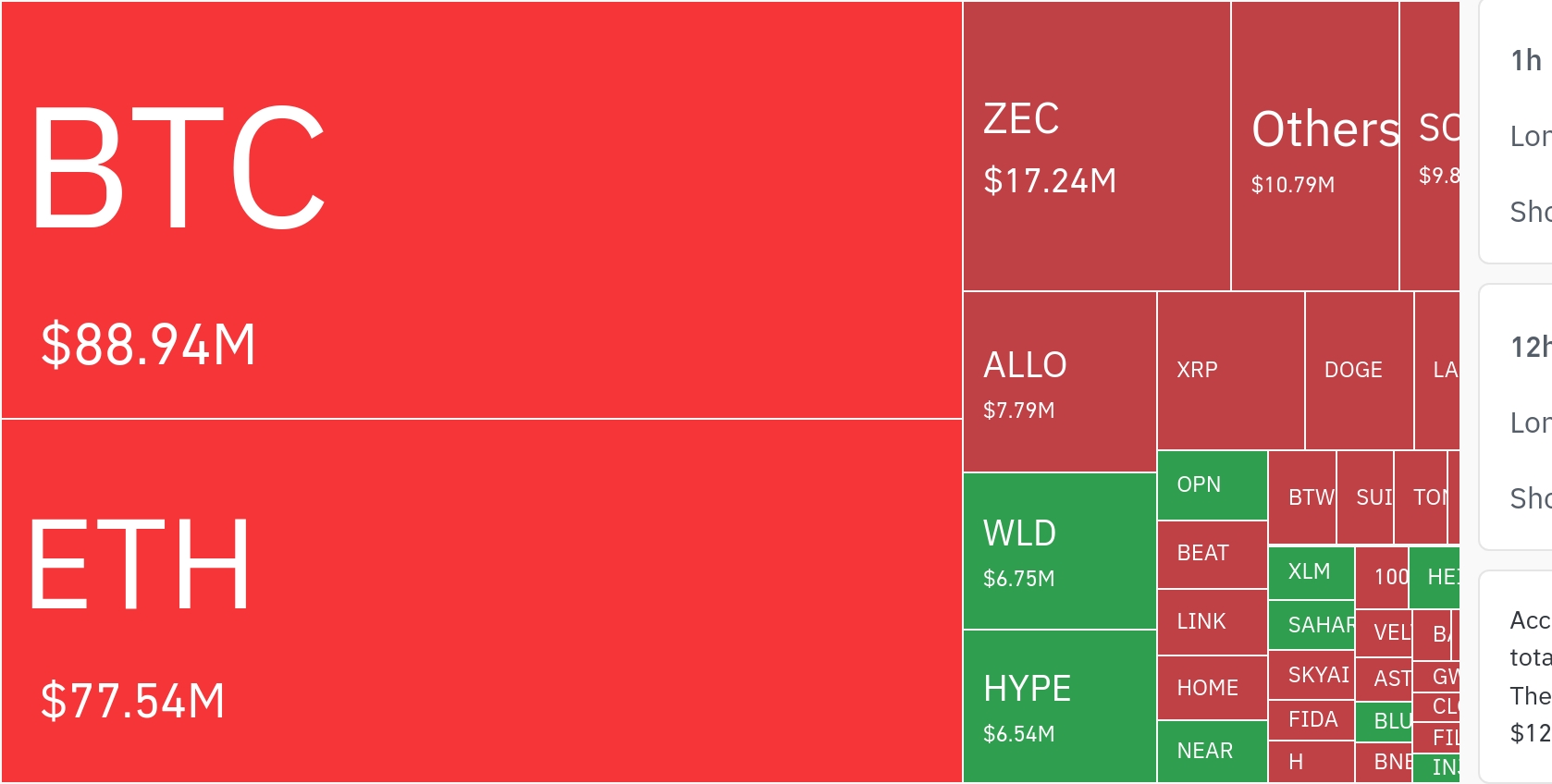
Cryptocurrency markets saw a sharp wave of forced deleveraging over the past 24 hours, with roughly $315.32 million in leveraged positions liquidated—a reset that briefly rattled sentiment but ultimately coincided with a rebound led by Ethereum (ETH) and major altcoins.
The liquidation event mattered less for the headline number than for what it revealed about positioning: the market had become heavily tilted toward short-term upside bets, and that imbalance unwound quickly. Around 86.3% of the liquidations were concentrated in long positions, signaling that crowded bullish trades were flushed out and that near-term ‘overheating’ may be easing.
Liquidations were distributed across major venues, but Binance accounted for a sizable share on shorter timeframes. Over a four-hour window, about $25.48 million was reportedly liquidated on Binance alone, representing 45.66% of that segment. Concentrated liquidations on the deepest-liquidity exchange are often interpreted as evidence that volatility is impacting the broader futures positioning stack, not just isolated pockets of thin order books.
By asset, Bitcoin (BTC) and Ethereum dominated the forced closes. Bitcoin-related liquidations were the largest, while Ethereum saw more than $94.17 million in liquidations, underscoring that the leverage drawdown was centered on the market’s most widely used collateral and trading pairs.
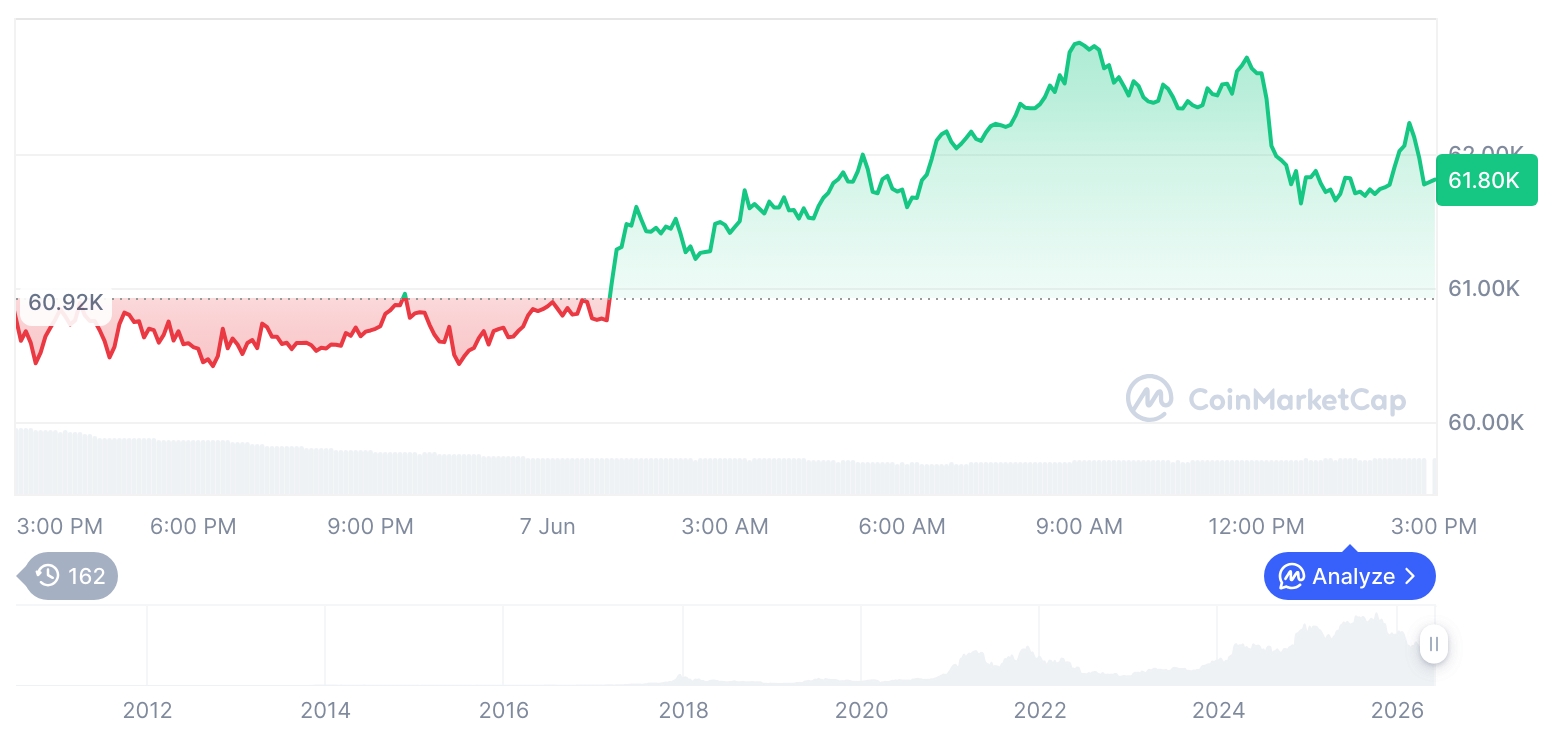
Notably, prices did not cascade lower after the washout. Bitcoin rose 1.07% over 24 hours to $61,257, while Ethereum climbed 3.68% to $1,614. The ability to stabilize and rebound after a liquidation-heavy selloff is often read as a sign that spot demand absorbed at least part of the forced selling, even as derivatives traders reduced exposure.
Strength extended across large-cap altcoins. XRP (XRP) gained 3.84%, Solana (SOL) advanced 3.55%, Dogecoin (DOGE) added 3.16%, and BNB (BNB) rose 2.55%. Rather than a broad retreat from risk, the price action suggested a degree of rotation into high-liquidity altcoins once the most crowded leverage was cleared.
Market share metrics echoed that shift. Bitcoin’s dominance slipped to 58.04%, down 0.19 percentage points from the prior day, while Ethereum’s share rose to 9.20%, up 0.20 percentage points. The move hints at a modest broadening of market leadership—away from an exclusively BTC-led tape toward a mix that includes ETH and select altcoins.
Activity, however, looked more cautious beneath the surface. Total crypto trading volume was about $75.6 billion, while derivatives volume came in around $696.6 billion, down 19.10% day over day. The drop points to a market prioritizing ‘position reduction’ over fresh leverage deployment following the liquidation shock.
Deceleration was also visible in sector-specific flows. DeFi-related trading volume fell 17.05%, and stablecoin volume declined 23.57%, suggesting that while prices recovered, traders were not yet aggressively recycling capital back into high-octane strategies.
On the corporate side, Strategy signaled plans for additional Bitcoin purchases, though it did not disclose size or timing. Market participants often view continued corporate accumulation as supportive of BTC’s downside psychology, particularly during periods of leverage-driven volatility.
Still, some market data feeds showed conflicting breakdowns of long-versus-short liquidations, highlighting how rapid intraday swings and differing aggregation windows can produce divergent snapshots—an added layer of noise for traders trying to read the tape in real time.
Overall, the session resembled a textbook ‘deleveraging-and-rotation’ day: roughly $300 million in liquidations cleared overheated long positioning, while the center of gravity shifted toward Ethereum and major altcoins. The shock was significant, but the subsequent rebound suggested a market recalibrating rather than capitulating.
🔎 Market Interpretation
- Forced deleveraging reset: About $315.32M in liquidations functioned as a rapid leverage “clean-out,” primarily removing crowded bullish exposure rather than triggering a full risk-off breakdown.
- Longs were the main casualty: Roughly 86.3% of liquidations were long positions, implying the market was overheated on the upside and vulnerable to a downside volatility sweep.
- Binance concentration signals systemic positioning: A notable share of short-window liquidations occurred on Binance (e.g., $25.48M over 4 hours; 45.66% of that slice), often read as liquidation pressure hitting the deepest liquidity venue—i.e., not just thin-market noise.
- BTC/ETH anchored the unwind: Bitcoin had the largest liquidation footprint, while ETH saw ~$94.17M liquidated—consistent with leverage being concentrated in the most-used collateral and pairs.
- Rebound after the washout: Prices stabilized and rose (BTC +1.07% to $61,257; ETH +3.68% to $1,614), suggesting spot buyers absorbed some forced selling as derivatives risk came off.
- Rotation toward large-cap alts: Strength in XRP, SOL, DOGE, BNB indicates a “deleveraging then rebalance” day rather than broad capitulation.
- Leadership broadened modestly: BTC dominance dipped to 58.04% while ETH share rose to 9.20%, hinting at a slight shift away from an exclusively BTC-led tape.
- Risk appetite cooled beneath the rebound: Despite higher prices, derivatives volume fell ~19.10% day-over-day, aligning with a post-shock posture of position reduction over new leverage.
- Flows show caution: DeFi volume (-17.05%) and stablecoin volume (-23.57%) declined, implying traders were not rapidly recycling capital into higher-octane strategies.
- Supportive narrative input: Strategy (company) indicated plans for additional BTC purchases, which can help anchor downside sentiment during leverage-driven volatility.
- Data noise warning: Conflicting long/short liquidation breakdowns across feeds highlight how differing aggregation windows can distort real-time interpretations.
💡 Strategic Points
- Use liquidation asymmetry as a positioning signal: A liquidation skew heavily toward longs can indicate upside crowding has been cleared, sometimes improving near-term market balance (but not guaranteeing reversal).
- Watch post-liquidation price behavior: A rebound after a liquidation spike often suggests spot absorption and reduced forced-selling pressure; failure to rebound can imply continuing deleveraging risk.
- Track venue concentration: Large liquidation clusters on high-liquidity exchanges (e.g., Binance) may reflect broader systemic leverage stress—useful for assessing whether the move is market-wide.
- Confirm rotation with dominance metrics: Falling BTC dominance paired with rising ETH share can support an “alt participation” thesis; if dominance quickly reverses, rotation may have been temporary.
- Volume divergence matters: Rising prices while derivatives volume drops can mean risk is being taken off; sustainability often requires either renewed spot inflows or carefully rebuilt leverage.
- Mind the aftershock window: Following a leverage flush, the market can chop as positions reset; consider reduced sizing, wider invalidation levels, or waiting for a second confirmation move.
- Prioritize high-liquidity names in rotation phases: The session’s gains clustered in majors (ETH, XRP, SOL, BNB, DOGE), consistent with capital preferring liquid betas during recalibration.
- Cross-check liquidation dashboards: Because feeds can disagree, triangulate with multiple sources and compare time windows before concluding whether longs or shorts were dominant.
📘 Glossary
- Liquidation: Forced closure of a leveraged position when collateral is insufficient to meet margin requirements.
- Deleveraging: Reduction of leverage (debt/borrowed exposure), often via liquidations or voluntary position cuts.
- Long position: A bet that price will rise.
- Short position: A bet that price will fall.
- Derivatives volume: Trading activity in futures/options/perpetuals; often reflects leveraged speculation more than spot activity.
- Spot demand/absorption: Buying in the spot market that can offset forced selling from leveraged traders.
- BTC dominance: Bitcoin’s market-cap share of the total crypto market; used as a proxy for relative leadership and risk appetite.
- Rotation: Market behavior where capital shifts from one segment (e.g., BTC) to another (e.g., ETH/large-cap alts).
- Collateral: Assets (often BTC/ETH/stablecoins) posted to support leveraged positions.
- Aggregation window: The time range used to compute metrics; differing windows can yield conflicting liquidation breakdowns.





















Comment 0