
 Add as a preferred source on Google
Fundstrat’s Tom Lee Calls Ethereum ‘Operating System’ for Tokenized Finance Future
Fundstrat’s Tom Lee said at WebX 2026 that Ethereum could serve as the core settlement layer for tokenized assets, stablecoins, and AI-driven commerce.



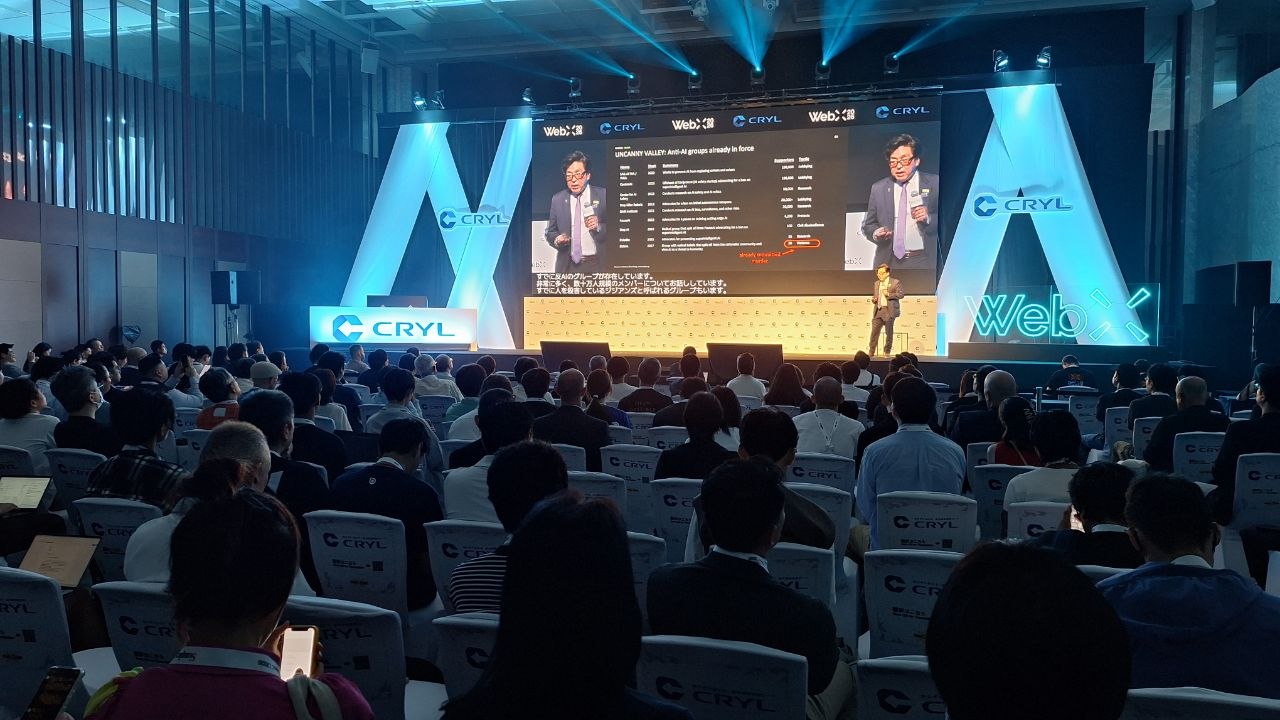
Ethereum (ETH) should be understood less as a speculative ‘coin’ and more as the ‘operating system’ for next-generation finance, Fundstrat co-founder Tom Lee told attendees at WebX 2026 in Tokyo on Monday, arguing that the network could become the settlement backbone for stablecoins, tokenized real-world assets, and emerging AI-driven commerce.
Lee—also chairman of the board at BitMine Immersion Technologies—delivered a special keynote shortly after the opening ceremony at The Prince Park Tower Tokyo, outlining what he framed as a structural shift in how money and assets will move over the coming decade. Rather than focusing on price targets, he posed a broader question: which network will underpin the circulation of global capital as payments become programmable and asset ownership becomes token-based.
According to the official WebX 2026 agenda, Lee’s keynote ran for 30 minutes beginning at 11:25 a.m. Japan time (2:25 a.m. UTC). He was also scheduled to join an afternoon discussion focused on corporate adoption under the theme “Ethereum on the Corporate Balance Sheet: A New Treasury Strategy.”
At the core of Lee’s thesis is a division of labor between Bitcoin (BTC) and Ethereum. “If Bitcoin is ‘digital gold,’ Ethereum is the rails of the digital economy,” he said, describing BTC as a scarce, censorship-resistant store of value, while positioning Ethereum as an execution layer for contracts and settlement—where payments, securities transfers, and automated financial logic can occur on the same network.
The difference matters for corporates, he argued, because an Ethereum-based treasury is not simply about holding an asset in cold storage. Companies can stake ETH to participate in network validation and earn rewards, turning what would otherwise be idle balance-sheet exposure into productive capital tied to the growth of on-chain activity. In that framing, ETH holdings become not only a bet on appreciation but also a mechanism for recurring yield and infrastructural participation in decentralized finance and tokenized markets.
Tokenization as a Wall Street demand driver
Lee identified ‘tokenization’—the migration of traditional financial claims onto blockchain rails—as the first major structural catalyst. Today’s markets still rely on fragmented ledgers and settlement systems across asset classes such as equities, bonds, real estate, funds, and deposits. Even after a trade is executed, ownership transfer and cash settlement typically require multiple intermediaries and time delays.
Tokenizing these assets, Lee argued, compresses trading, ownership transfer, and settlement into a single programmable workflow. Delivery-versus-payment can occur instantly; coupon distributions can be automated; and assets like real estate or funds can be split into smaller units to enable broader and more liquid secondary markets. In his view, this is not merely “digitizing” financial products, but re-architecting the market’s ledger and settlement structure.
BitMine has publicly suggested that tokenization could ultimately reshape a market spanning roughly $300 trillion in real-world assets. Still, Lee stressed that tokenized finance will not require every institution to operate directly on Ethereum’s main network. Banks and brokerages may use permissioned chains, proprietary infrastructure, or layer-2 networks for compliance and scalability. The key, he said, is that cross-network exchange and final settlement tend to converge on a broadly trusted, neutral base—an argument for Ethereum as a potential ‘final settlement layer’ even in a multi-chain institutional world.
Stablecoins as the first mass-market use case
Lee pointed to stablecoins as the clearest evidence that tokenized finance is already moving from theory to practice. While dollar-pegged tokens may appear similar to bank deposits on the surface, their utility comes from being natively digital, globally transferable 24/7, and programmable—capabilities that enable automated payouts, machine-triggered transactions, and cross-border settlement without banking-hour constraints.
Rather than limiting stablecoins to crypto exchange plumbing, Lee argued their footprint is expanding into corporate remittances, trade settlement, securities settlement assets, and—crucially—transactional cash for AI systems. As stablecoin issuance and circulation grow, demand could rise for the blockchains that mint, move, and settle them. Ethereum, already one of the most active public networks for stablecoins and DeFi, stands to benefit from that infrastructure pull, he said.
His broader point echoed a familiar pattern from the internet era: the winners were not only the consumer-facing platforms, but also the underlying enablers—networks, cloud infrastructure, and semiconductors. In a stablecoin-driven world, Lee suggested, attention should extend beyond issuers and wallets to the settlement networks themselves.
Why ‘agentic AI’ may need blockchain rails
The second long-term demand driver, Lee said, is ‘agentic AI’—systems that do more than answer prompts and generate content, instead acting as economic agents that compare products, purchase services, negotiate with other software agents, and pay for execution in real time.
That evolution collides with a financial system designed around humans and legal entities. AI agents cannot walk into a bank, easily obtain payment cards, or navigate jurisdiction-by-jurisdiction onboarding and settlement frictions. If millions of agents conduct high-frequency microtransactions, existing card fee structures and authorization models could become prohibitively inefficient.
Lee argued AI agents will require three components: digital identity, programmable money, and a neutral network accessible to anyone. Blockchains can provide wallets, automated execution via smart contracts, and verifiable records without manual reconciliation. In that model, stablecoins function as the spendable unit, while Ethereum acts as the transaction and contract fabric on which AI-native commerce runs.
BitMine’s ‘5%’ accumulation bet—and its trade-offs
Lee’s positioning carried added weight because BitMine is not only advocating for Ethereum’s role—it is building a balance-sheet strategy around it. The company has been pursuing what it calls the ‘Alchemy of 5%,’ a plan to acquire roughly 5% of ETH’s total supply.
BitMine said it held 5,742,237 ETH as of July 5, representing about 4.8% of an estimated 120.7 million ETH in circulation—roughly 95% of its stated goal. It reported total holdings, including digital assets, cash, and other investments, of approximately $11.1 billion. Of its ETH, about 4.879 million—or around 85%—is staked, with the company estimating annualized staking income of roughly $235 million.
The approach resembles the corporate crypto-treasury playbook popularized in Bitcoin markets—most notably by Strategy—yet differs in a key respect: ETH can generate protocol-native yield through staking. Lee suggested this enables a compounding model in which capital raised through equity or debt can be deployed into ETH, staked for rewards, and potentially reinvested to expand holdings over time.
But the model also introduces new risks. Concentrating roughly 5% of ETH supply within a single corporate treasury—while staking a large portion—could intensify debates over decentralization and validator influence. If public companies and major financial institutions rapidly accumulate validation power, critics argue that blockchain governance could begin to mirror the concentration dynamics of traditional finance.
Market and financing risk remain significant as well. Even if staking yields sit in the low single digits, a sharp decline in ETH’s price can overwhelm that income, hitting both asset values and equity-market perception. Moreover, repeated capital raises to buy ETH may be attractive in bullish conditions but become punitive if shares trade below net asset value, increasing dilution and funding costs.
Lee emphasized that for Ethereum treasury strategies to scale sustainably, institutional-grade custody, accounting practices, security standards, and governance frameworks must evolve alongside adoption—particularly as regulators scrutinize staking, securities treatment, and risk disclosures.
A ‘crypto spring’ defined by usage, not hype
Lee has recently described the market as entering an early-stage ‘crypto spring’—not simply a rebound in prices, but a shift in the primary drivers of growth. Where the previous cycle leaned on retail leverage and digital collectibles, he argued the next phase will be shaped by institutions, corporates, stablecoins, tokenized assets, and AI-native demand.
In that environment, Ethereum’s value proposition becomes increasingly tied to network economics: how much value is settled, how widely stablecoins circulate, and how much fee revenue and staking yield the network generates—metrics more akin to digital infrastructure utilization than social-media-driven speculation.
What the thesis implies for global markets
Lee’s message in Tokyo was ultimately less a call to buy ETH and more a claim about where financial infrastructure is heading. Tokenization, stablecoin settlement, and AI-mediated commerce are pushing markets toward always-on, programmable rails. Whether Ethereum becomes the dominant ‘operating system’ is not guaranteed—competing public chains, permissioned networks, tokenized deposits, and central bank digital currency initiatives are all in play.
Still, Lee’s framing underscored a question that institutions can no longer avoid: if financial assets and machine-driven payments increasingly move on-chain, which neutral settlement layer will the market trust for finality? At WebX 2026, Lee’s answer was Ethereum.