
 Add as a preferred source on Google
Bitcoin, Ethereum Edge Higher as Trading Volumes Signal Cautious Market Sentiment
Bitcoin and Ethereum posted modest gains while declining spot and derivatives volumes signaled cautious positioning across the broader crypto market.








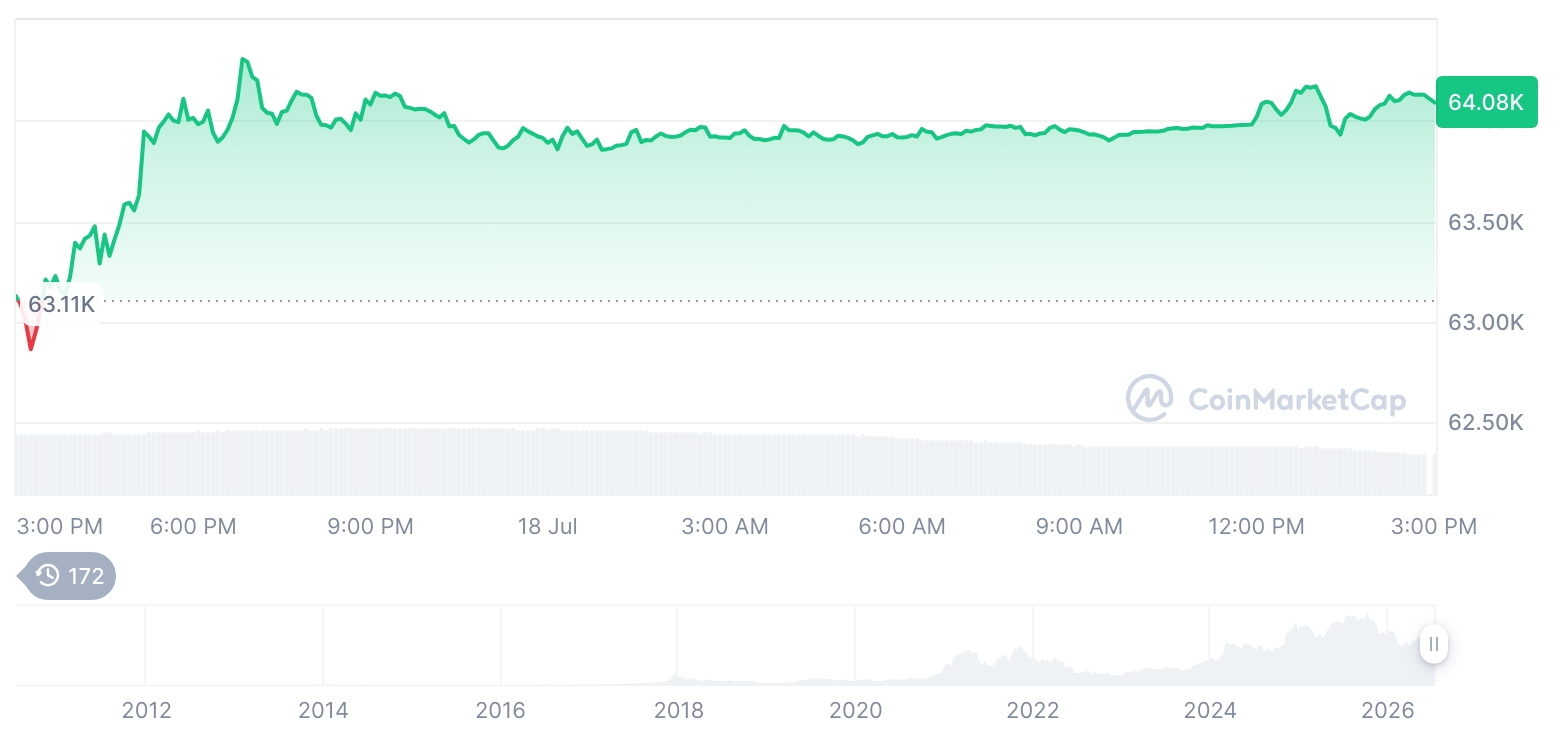
The cryptocurrency market traded in mixed fashion early Saturday, with Bitcoin (BTC) and Ethereum (ETH) posting modest gains even as overall trading activity cooled—an alignment that often signals 'wait-and-see' positioning rather than broad-based risk-on momentum.
According to TokenPostMarket data as of 11:07 a.m. ET on Saturday, July 18, Bitcoin was up 1.52% over the past 24 hours at $64,083.38. Ethereum rose 1.45% to $1,844.71 over the same period.
Most major altcoins also edged higher, though the moves were relatively restrained. XRP (XRP) gained 0.51%, BNB (BNB) added 1.64%, Solana (SOL) rose 0.96%, Dogecoin (DOGE) increased 0.53%, and TRON (TRX) was nearly flat with a 0.05% uptick. Hyperliquid (HYPE) was a notable laggard, slipping 1.09%.
In aggregate, the altcoin market capitalization stood at about $908.62 billion, with 24-hour trading volume near $25.38 billion. The total cryptocurrency market capitalization was approximately $2.19 trillion, while total 24-hour spot trading volume was about $42.41 billion.
Despite the price gains in large-cap tokens, market structure indicators suggested capital continued to concentrate in the most liquid assets. Bitcoin 'dominance'—its share of the total crypto market cap—rose to 58.59%, up 0.19 percentage points from the prior day. Ethereum’s share also inched higher to 10.15%, up 0.02 percentage points. Simultaneous increases in BTC and ETH dominance typically reflect investors prioritizing perceived relative safety and liquidity over smaller, higher-beta tokens.
On the activity side, more speculative segments showed clearer signs of retrenchment. The DeFi sector’s market capitalization was around $64.42 billion, while its 24-hour trading volume totaled about $6.44 billion—down 29.37% day over day. Stablecoins also saw a sharp drop in turnover: total stablecoin market cap was approximately $282.02 billion, but 24-hour trading volume fell 34.51% to roughly $42.90 billion. A decline in stablecoin volume is often interpreted as weaker movement of 'sideline liquidity'—capital waiting to deploy into risk assets or to rotate between venues.
Derivatives activity cooled even more markedly. Total crypto derivatives volume reached about $402.50 billion over the past 24 hours, down 44.64% from the previous day. Such a pullback can indicate reduced short-term leverage demand and a market still searching for direction, particularly after rapid moves that can temporarily exhaust momentum.
Overall, the session’s combination of modest price appreciation and sharply lower volumes points to a rally driven more by incremental positioning than aggressive chase buying. If large-cap dominance continues to rise while spot and derivatives turnover remains subdued, it may reinforce a market regime where liquidity concentrates in Bitcoin and Ethereum, and altcoin strength becomes increasingly selective rather than broadly correlated.
Article Summary by TokenPost.ai
🔎 Market Interpretation
Mixed risk tone: BTC (+1.52% to $64,083) and ETH (+1.45% to $1,844) rose modestly, but falling activity signals a pause/assessment market rather than a strong risk-on surge.
Rally on lighter participation: Total spot volume (~$42.41B) and especially derivatives volume (~$402.50B, -44.64% DoD) declined sharply, implying reduced leverage and less aggressive dip-buying or breakout chasing.
Liquidity concentrating in majors: Bitcoin dominance increased to 58.59% (+0.19pp) and Ethereum share rose to 10.15% (+0.02pp). Concurrent rises often reflect preference for liquidity and perceived safety over higher-beta altcoins.
Altcoins up, but restrained and selective: Large alts posted small gains (XRP, BNB, SOL, DOGE) while HYPE lagged (-1.09%), consistent with a market where performance diverges rather than moving in lockstep.
Speculative segments cooling: DeFi volume (~$6.44B) fell -29.37%, and stablecoin volume (~$42.90B) fell -34.51%, suggesting less rotation and reduced “sideline liquidity” movement.
💡 Strategic Points
Watch volume confirmation: If prices rise while spot/derivatives volumes stay depressed, upside may be more fragile and prone to pullbacks on negative catalysts.
Use dominance as a regime indicator: Continued increases in BTC/ETH dominance can signal a large-cap-led environment—often unfavorable for broad altcoin rallies but supportive for selective, idiosyncratic winners.
DeFi and stablecoin turnover as risk gauges: Sustained declines can imply lower speculative appetite and fewer rapid reallocations; a rebound may precede renewed risk-taking.
Positioning implication: The described setup aligns with incremental accumulation (adding exposure carefully) rather than momentum chasing; traders may prefer clearer breakouts with rising liquidity.
Altcoin selection over beta exposure: With correlation weakening, strategies may shift from “buy the basket” to focusing on projects with catalysts, stronger relative strength, or superior liquidity.
📘 Glossary
Market capitalization (market cap): The total value of a crypto asset or sector, calculated as price × circulating supply.
24-hour trading volume: The total value traded over the last 24 hours; often used as a proxy for liquidity and conviction.
Bitcoin dominance: Bitcoin’s share of total crypto market cap; higher dominance often signals a defensive tilt toward BTC.
ETH share/dominance: Ethereum’s portion of total market cap; rising share alongside BTC can indicate concentration in top assets.
Altcoins: Cryptocurrencies other than Bitcoin; typically higher beta and more sensitive to shifts in risk sentiment.
DeFi (Decentralized Finance): On-chain financial services (lending, trading, derivatives) conducted via smart contracts.
Stablecoins: Tokens designed to track a stable value (often USD). Volume changes can reflect shifts in deployable capital.
Derivatives volume: Trading activity in futures/perpetuals/options; often reflects leverage appetite and short-term speculation.
Risk-on / risk-off: Market mood favoring higher-risk assets (risk-on) versus capital preservation and liquidity (risk-off).
Higher-beta tokens: Assets that tend to move more than the market (greater volatility), often outperforming in bull phases and underperforming in pullbacks.