
 Add as a preferred source on Google
Bitcoin, Ethereum and Solana show decentralization tradeoff between performance and control
Glassnode said Bitcoin, Ethereum and Solana occupy different points on a decentralization spectrum, with Bitcoin stronger in auditability and geographic resilience while Solana trades some decentralization for speed.




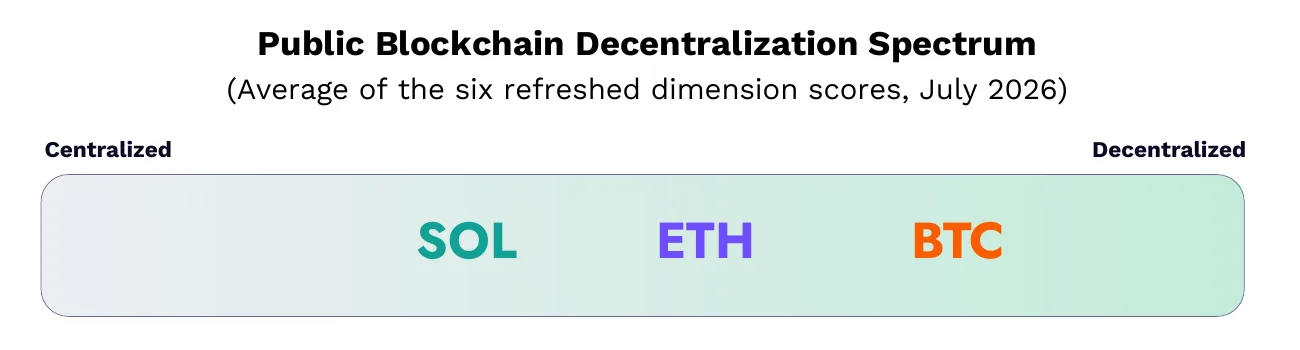
Blockchain decentralization is not a simple split between centralized and decentralized systems. Network design places each chain at a different point across auditability, security, governance and ownership.
In its “Ark Invest + Glassnode: The Decentralization Spectrum” report published on Sept. 1, 2026, Glassnode said Bitcoin, Ethereum and Solana showed different decentralization profiles across four design features and six measurable dimensions. The report compared the three networks by auditability, security, governance and ownership structure.
The report said design choices such as block size and staking models determine where a network sits on the spectrum. In a fully auditable network, anyone can run a full node and verify the ledger directly. Distributed consensus raises the coordination cost an attacker must bear, community-led governance makes unilateral upgrades harder, and widely dispersed ownership limits control by any insider group.
For security, the core question is how many independent parties would have to collude to alter the ledger. Glassnode analyzed hash rate and stake concentration, the capital required to acquire 1% of each network, exit fluidity and client diversity.
The analysis found that Bitcoin and Ethereum each reach their critical control threshold with three entities. Solana requires 19. Glassnode said mining pools and delegation structures make the actual control picture more complex.
Exit fluidity also differed sharply. A Bitcoin miner can leave a 1% position in roughly 30 seconds by switching off hardware. On Ethereum, unstaking an equivalent position can take weeks under stress.
Where infrastructure is physically located also affects network resilience. High dependence on a specific region or provider can increase vulnerability to coordinated pressure. The report analyzed regional distribution, hosting environments and provider concentration across the three networks.
Bitcoin had the most evenly distributed node footprint. Some 63% of its nodes operated behind Tor. Ethereum relied more heavily on cloud providers, with AWS alone hosting roughly 20% of nodes. Solana runs essentially all of its infrastructure in data centers by design.
The report’s quantitative analysis used six dimensions: ownership distribution, exit fluidity, network verification overhead, critical resilience threshold, blockchain reconstruction overhead, and geographic and provider resilience. No network led on every measure.
Bitcoin scored strongest on auditability, ownership distribution and geographic resilience. Ethereum occupied a middle ground. Solana was assessed as trading some decentralization for performance and coordination speed. The report’s appendix set out the calculations used for each score.
Different use cases can tolerate different risk profiles. A high-throughput payment network and a settlement layer for high-value institutional assets may sit at different points on the spectrum by design. The report also covered node economics, governance cases from Bitcoin’s SegWit to Solana’s SIMD-228, and supply distribution data for all three networks.
John Kim
John Kim reports on the digital-asset business for TokenPost. Send corrections or tips to info@tokenpost.com.