
 Add as a preferred source on Google
What justifies an AI app’s premium? Better results than building in-house
Andreessen Horowitz argues that AI apps must outperform credible in-house alternatives to sustain premium prices, combining reliable workflows, trusted context and measurable value.

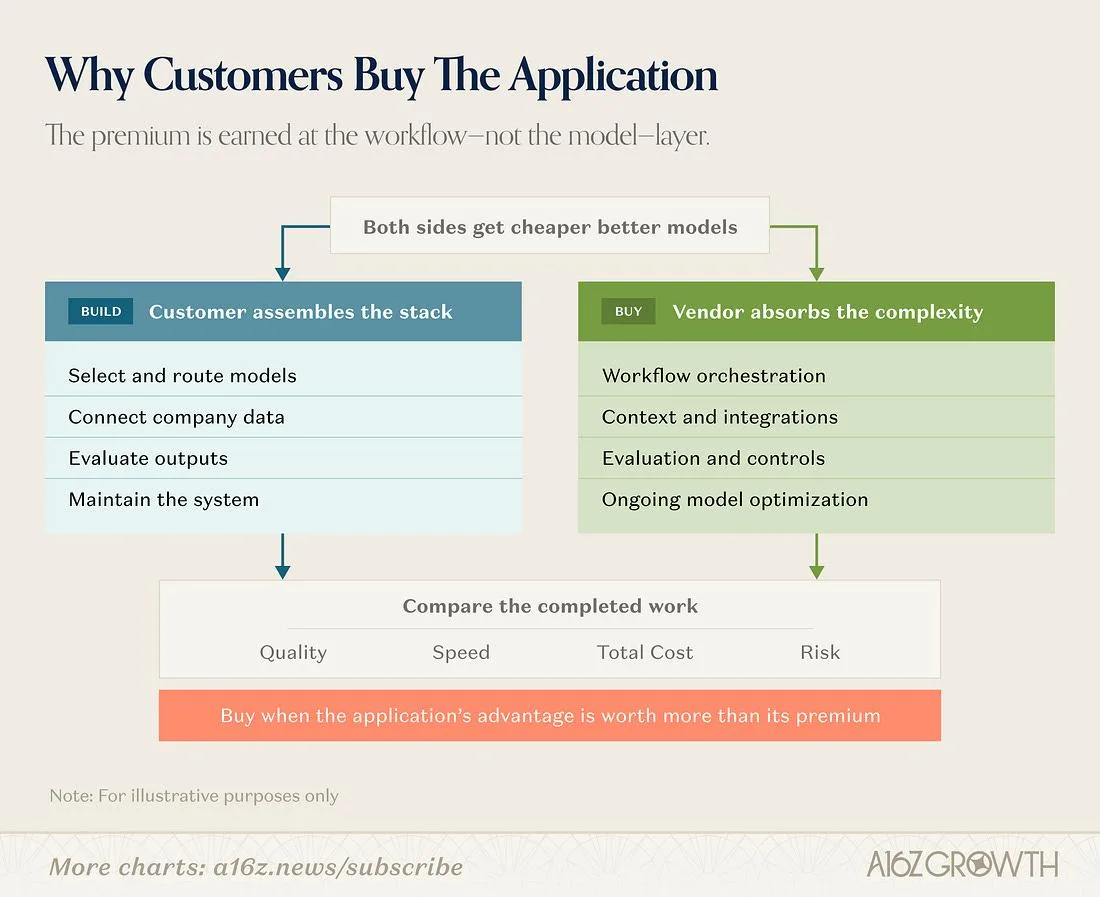
AI applications can sustain premium prices when buying them delivers more value than customers can achieve by building their own alternatives. As models improve and development becomes easier, vendors face a tougher test of what customers will keep paying for.
In its “How AI Applications Earn Their Premium” report published on November 2, 2026, Andreessen Horowitz said domain expertise, deep integrations, dependable execution and hard-to-access context underpin that value. Cheaper inference can lift application margins, but stronger models and better development tools also make individual features easier to replace. The commercial challenge is to preserve a reason to buy as customers’ alternatives improve.
The report said exposure depends on how easily customers can reproduce an application’s core output with a general-purpose model and maintain it with little effort. Fast growth can lead AI companies to postpone difficult pricing decisions, even as those decisions become more consequential. Vendors need to establish which advantages customers value before deciding how to charge for them.
Repsol tested that proposition within its legal team. A blind comparison placed Harvey ahead of Microsoft Copilot and Repsol’s internal AI prototype, Lexia, on output quality. An eight-week pilot involving 50 lawyers across 12 jurisdictions then found Harvey superior on accuracy and time savings, according to the report.
Repsol subsequently rolled out Harvey across the department. Harvey reports weekly savings of four to six hours per lawyer and adoption of 96%. The legal team also used past agreements to identify recurring objections and add fallback language to contract templates. Andreessen Horowitz presented the case as evidence that execution, measurable savings and reusable institutional knowledge can support a premium over credible alternatives.
The report organized its argument around three principles: deliver workflows better than customers can operate them, make reliable context less expensive to obtain than to reconstruct, and establish value before setting prices that capture part of it.
Outperform the customer across the workflow
A customer need not replace an entire application to put pressure on its price, Andreessen Horowitz said. Bringing a frequently performed task in-house, or developing a credible substitute, may be enough. A buyer at a global professional-services firm told the researchers that a vendor’s platform premium was difficult to justify when a direct prompt to a frontier model produced better work.
That firm had also developed an internal AI platform for sensitive projects, allowing models to run locally or on premises when clients prohibited third-party products. It was testing open-source code and other substitutes for commercial applications.
The report argued that a specialist vendor must therefore compete on the complete workflow. For contract review, that includes applying the customer’s legal standards, maintaining consistent edits throughout a document and retaining context as negotiations progress. Access to a capable model alone does not resolve those requirements.
Harvey’s Playbook Review illustrates the operational work involved. A lead agent assigns tasks to specialized agents, resolves conflicting changes and checks the finished document. Harvey uses legal evaluation criteria and chooses models according to task-specific quality, speed and cost. It also retains review context for follow-up requests. Harvey identifies learning from lawyers’ acceptance, revision or rejection of proposed edits as a further opportunity to reduce the guidance future reviews require.
Andreessen Horowitz said completed workflows can improve evaluations, test the validity of context and build customer-specific knowledge. That learning can reinforce an application’s advantage if it improves subsequent results. The report called for measuring changes in quality, reliability and delivery costs, and comparing vulnerable workflows with customers’ strongest credible alternatives. Such comparisons need to account for implementation, human review, failures and maintenance.
Make reliable context cheaper to obtain than to rebuild
Context can support premium pricing through exclusive access, preparation for practical use, or both, the report said. Information unavailable elsewhere has value through scarcity. Where customers already have access, the commercial advantage lies in the effort needed to keep it accurate, current and usable.
One industry-specific software company interviewed for the report had accumulated proprietary pricing benchmarks covering roughly 3,000 companies over several years. It was exploring a Model Context Protocol (MCP) server that would allow AI systems to query the information directly. Collecting, organizing, validating and maintaining the resource once would allow the vendor to spread those costs across customers, each paying less than an equivalent independent effort would require.
The report said eliminating duplicated work can produce a margin for the vendor while lowering customers’ total costs. The same economics can apply to information customers already own, including policies, customer relationship management records, contracts and workflow history. Making those resources dependable for AI requires permissions, normalization, retrieval and continuing validation. Applications can charge for managing that process and improving it through feedback.
Pricing analysis should distinguish between the value of access and the value of preparation, Andreessen Horowitz said. At comparable quality, the relevant benchmark is the engineering, validation and maintenance burden the application removes.
Demonstrate the value of completed work, then price it
Better execution and trusted context create room for a premium, but spending growth increases the need for evidence. In an August 2026 survey of 100 enterprise large language model (LLM) decision-makers, the report’s authors found that 94% expected total LLM spending to rise and 37% expected it to at least double over the following year. Buyers need to understand the volume and quality of work delivered, alongside its total cost relative to alternatives.
The report proposed measuring recognizable units of completed work: a reviewed contract, resolved support conversation, finished research task or enriched record. Delivery costs include retrieval, model calls, tools, retries, evaluation and human review. Failed attempts also belong in the calculation of cost per successful completion.
Evidence of value then requires a broader comparison. Application fees, implementation, continuing oversight and remaining human work must be assessed against the cost and quality of the process being replaced. Where internal development is a credible option, its development and maintenance costs also matter.
Andreessen Horowitz cited Decagon’s Notion case study as an example of that comparison informing a purchase. Notion considered building internally but selected an external provider to keep its teams focused on the core platform. It chose Decagon after assessing quality, integrations, security and partnership. The published case reports an improvement of up to 34% in ticket resolution time, connecting the buying decision to a measurable operational result.
Once completed work has a demonstrable value, the report said pricing can capture a share of the time saved and quality delivered while allowing profitable delivery. It also cited an earlier argument co-authored with Sarah Wang in “You Are Not a Model. Don't Price per Token”: applications should charge at the highest level of value they can reliably measure, attribute and defend.
Recognizable outputs such as research briefs, contract reviews and support interactions can carry direct prices or be packaged through credits. The report distinguished credits as a payment currency rather than a measure of value. To support customer planning, they need a clear relationship to tasks or understandable levels of effort.
Predictable pricing must also accommodate differences in workload costs. According to Clay’s pricing memo, fixed AI charges made simple workloads too expensive while leaving complex ones unprofitable. Clay separated Data Credits from Actions used for orchestration, retained fixed credit prices for more bounded AI workloads and passed through actual token costs without a markup for more variable reasoning models. The arrangement separated payment for orchestration from volatile model input costs.
The column’s analysis also describes how that separation can accommodate falling delivery costs. With prices attached to recognizable work, vendors can improve margins through model routing, caching and better models. They can also reduce prices or include more work for the same fee, allowing customers to share efficiency gains without tracking every change in the underlying model mix. The overall offer must remain attractive against available alternatives.
The resulting pricing assessment combines full delivery costs with evidence of value and billing units buyers can anticipate. It also requires separate margin calculations for typical and expensive workloads. Those measures inform how efficiency gains can be shared while preserving the appeal of the service.
Keep renewing the case for a premium
The final test is whether purchasing the application offers a better combination of total cost, quality, speed and risk than the customer’s strongest credible alternative. That comparison extends beyond subscription or usage fees to the effort required to implement, operate and maintain each option.
Andreessen Horowitz’s argument brings execution, context, evidence and pricing into the same commercial calculation. Reliable workflows and trusted information establish an advantage; measurable results make it visible; and pricing determines how customers and vendors share the gains. As improving models strengthen customers’ alternatives, sustaining a premium requires the application’s advantage to keep expanding.
John Kim
John Kim reports on the digital-asset business for TokenPost. Send corrections or tips to info@tokenpost.com.