

 News
News  Coin Information
  About us
  Customer Service


 Add as a preferred source on Google
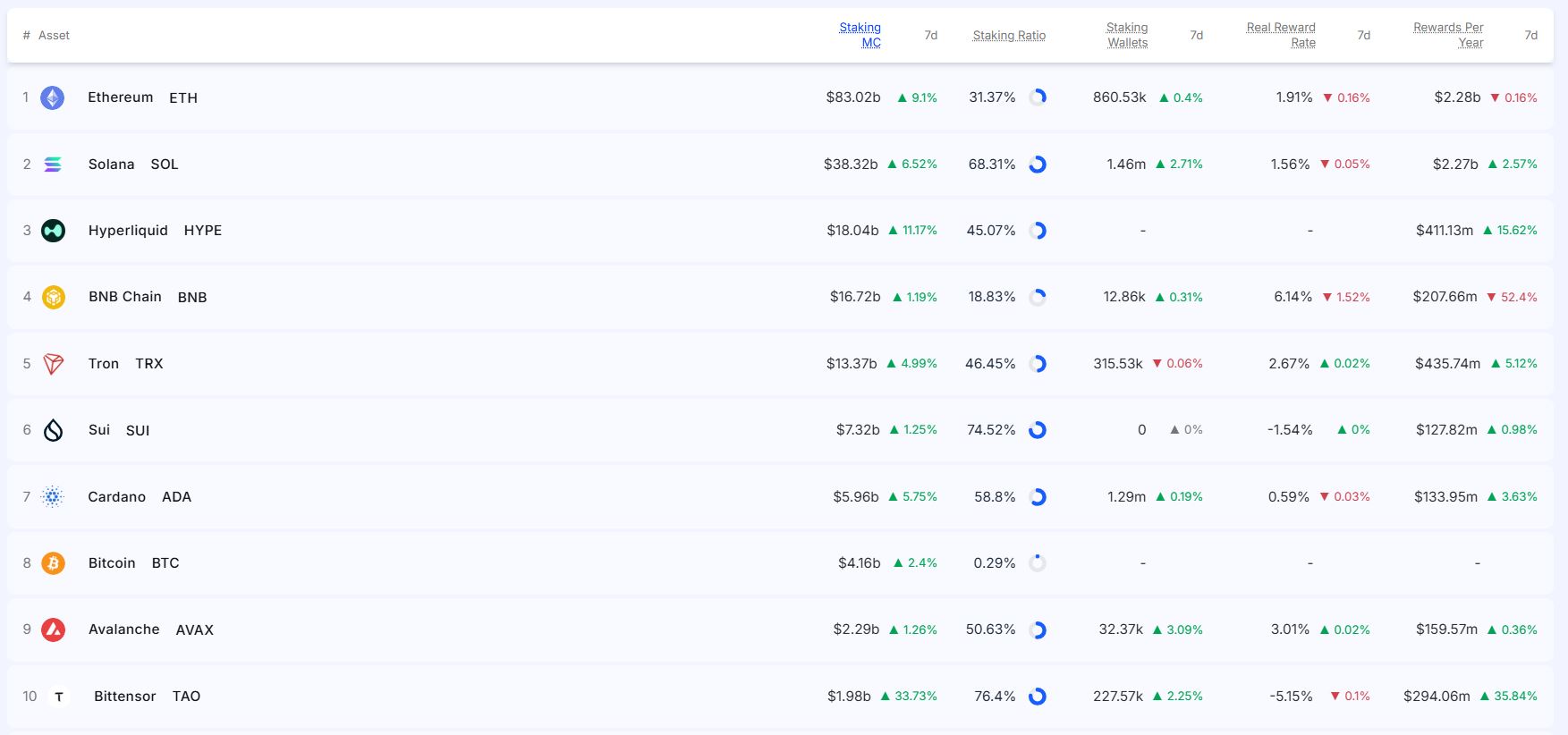
The crypto staking market widened its footprint over the past week, with every top asset by staked value posting gains—yet the strongest momentum clustered in a handful of altcoins, led by Bittensor (TAO) and Hyperliquid (HYPE).
Data compiled by StakingRewards on Wednesday UTC showed Ethereum (ETH) retaining the top spot in 'staking market cap'—the value of tokens currently locked in staking—at $83.02 billion, up 9% over the last seven days. Solana (SOL) held second place at $38.32 billion, rising 6.5% over the same period.
The biggest reshuffle came in the race for third: Hyperliquid (HYPE) climbed to No. 3 with a staked value of $18.04 billion after a weekly surge of 11%, overtaking BNB Chain (BNB). The move underscores how quickly capital can rotate within staking-heavy ecosystems when yields, incentives, or network activity shift even modestly.
Across the top 10, staked value increased for all tracked assets, signaling a broader risk-on tone in staking participation. Bittensor (TAO) posted the steepest weekly expansion at 33%, followed by Hyperliquid (HYPE) at 11% and Ethereum (ETH) at 9%. By contrast, BNB Chain (BNB), Sui (SUI), and Avalanche (AVAX) recorded the smallest weekly increases, each in the 1% range.
Participation metrics painted a more nuanced picture of where staking is most entrenched. By share of circulating supply staked, Bittensor (TAO) topped the list at 76.4%, with Sui (SUI) close behind at 74.52% and Solana (SOL) at 68.31%. High staking ratios can indicate strong token-holder commitment, though they can also reflect limited liquid float and greater sensitivity to unlock-driven volatility.
In terms of breadth of participation, Solana (SOL) led by number of staking wallets at roughly 1.46 million, followed by Cardano (ADA) at about 1.29 million and Ethereum (ETH) at around 860,000. Wallet growth over the past week was strongest on Avalanche (AVAX) at 3.1%, with Solana (SOL) up 2.7% and Bittensor (TAO) up 2.3%, suggesting incremental onboarding rather than a single-network surge.
Yield dynamics, however, were less uniform. On realized reward rates, BNB Chain (BNB) posted the highest figure at 6.14%, though the metric was about 1.5 percentage points lower than the previous week—an indicator that net rewards can compress quickly as participation rises or incentive schedules change. Avalanche (AVAX) followed at 3.01% and TRON (TRX) at 2.67%.
Notably, Bittensor (TAO) and Sui (SUI) remained in negative territory on realized returns, at -5.15% and -1.54% respectively, highlighting that 'staking yield' is not always synonymous with positive performance once token price movements and reward mechanics are accounted for.
Estimated annualized reward volume continued to be dominated by the largest networks. Ethereum (ETH) led at approximately $2.28 billion, while Solana (SOL) followed at roughly $2.27 billion, narrowing the gap between the two. TRON (TRX) and Hyperliquid (HYPE) each posted estimates in the $400 million range, reinforcing their growing relevance in the reward economy despite smaller market footprints than the top two.
On a seven-day basis, estimated annual reward volume rose most for Bittensor (TAO), up 35.84%, and Hyperliquid (HYPE), up 15.62%. BNB Chain (BNB) swung the other way, dropping 52.4%—the sharpest decline among the assets tracked—while TRON (TRX), Cardano (ADA), and Solana (SOL) posted moderate increases of 5.12%, 3.63%, and 2.57% respectively. Ethereum (ETH) slipped 0.16%, signaling a marginal cooling in rewards growth even as its overall staked value expanded.
The week’s data suggests staking is entering a broader expansion phase, but the outsized gains in TAO and HYPE point to selective 'liquidity inflow' rather than uniform growth. If the trend persists, analysts will likely watch whether wallet participation and reward stability can keep pace with rapid increases in staked value—especially for newer ecosystems where incentives can shift quickly.
🔎 Market Interpretation
{
"trend": [
{
"headline": "Staking market expanded broadly, but gains concentrated in select altcoins",
"detail": "All top-10 assets by staked value rose over the week, indicating a risk-on shift toward yield-bearing participation. However, momentum was uneven—Bittensor (TAO) and Hyperliquid (HYPE) captured the strongest inflows, signaling selective capital rotation rather than uniform ecosystem growth."
},
{
"headline": "Ethereum remains dominant; Hyperliquid reshuffles the top ranks",
"detail": "ETH stayed No. 1 in staking market cap at $83.02B (+9% WoW). SOL held No. 2 at $38.32B (+6.5%). The key change was HYPE rising to No. 3 with $18.04B staked (+11%), overtaking BNB—evidence that staking leaderboard positions can change quickly when incentives and activity shift."
},
{
"headline": "Participation depth differs by metric (stake ratio vs wallet count)",
"detail": "TAO led in % of supply staked (76.4%), followed by SUI (74.52%) and SOL (68.31%), implying strong holder commitment but also potentially tighter liquid float. By wallet count, SOL led (~1.46M), ahead of ADA (~1.29M) and ETH (~860k), suggesting Solana has the broadest staking base among major networks."
},
{
"headline": "Yield is not uniformly positive; reward rates and price effects diverge",
"detail": "BNB showed the highest realized reward rate (6.14%) but fell ~1.5pp from last week, illustrating how yields can compress as staking participation rises or incentives change. TAO (-5.15%) and SUI (-1.54%) were negative on realized returns, emphasizing that token price movement and reward mechanics can outweigh nominal staking rewards."
},
{
"headline": "Reward economy remains led by ETH/SOL, while HYPE/TRX gain relevance",
"detail": "Estimated annualized reward volume was highest for ETH (~$2.28B) and SOL (~$2.27B). TRX and HYPE were each in the ~$400M range, indicating growing reward significance despite smaller staked bases than the top two."
}
],
"notable_movers": {
"staked_value_weekly_change": {
"TAO": "+33% (largest increase)",
"HYPE": "+11%",
"ETH": "+9%",
"BNB/SUI/AVAX": "+~1% (smallest increases)"
},
"estimated_annual_reward_volume_change_7d": {
"TAO": "+35.84%",
"HYPE": "+15.62%",
"BNB": "-52.4% (sharpest decline)",
"TRX": "+5.12%",
"ADA": "+3.63%",
"SOL": "+2.57%",
"ETH": "-0.16%"
},
"wallet_growth_weekly": {
"AVAX": "+3.1%",
"SOL": "+2.7%",
"TAO": "+2.3%"
}
}
}
💡 Strategic Points
{
"investor_takeaways": [
{
"point": "Differentiate between staked value growth and sustainable participation",
"why_it_matters": "Rapid increases in staked value (e.g., TAO, HYPE) can be driven by incentives or short-term rotations. Confirm durability by tracking wallet growth, validator distribution, and whether yields remain stable as the staking base expands."
},
{
"point": "Treat high % supply staked as a double-edged signal",
"why_it_matters": "High staking ratios (TAO, SUI) can reflect strong commitment, but can also imply reduced liquid float and potential for sharper price moves if unlocks occur or staking sentiment reverses. Risk management should consider unlock schedules and unstaking conditions."
},
{
"point": "Use realized returns, not headline APR, to judge outcomes",
"why_it_matters": "BNB’s realized reward rate remained highest, yet fell notably WoW; TAO and SUI had negative realized returns. This highlights that token price performance and reward emissions/dilution can dominate the actual investor result."
},
{
"point": "Watch for incentive-driven regime shifts in newer ecosystems",
"why_it_matters": "HYPE’s jump to No. 3 suggests staking capital can rotate quickly when yields/incentives change. For newer ecosystems, changes in reward schedules can rapidly alter both staked value and risk (including liquidity/exit dynamics)."
},
{
"point": "Large networks still anchor the reward economy",
"why_it_matters": "ETH and SOL together dominate annualized reward volume (~$2.28B and ~$2.27B). Even if smaller networks show faster growth, the deepest liquidity and most established staking infrastructure remains concentrated in the top two—relevant for allocators prioritizing scale and market depth."
}
],
"what_to_monitor_next": [
{
"metric": "Wallet participation vs staked value",
"signal": "If staked value rises faster than wallet count, growth may be concentrated among fewer large stakers (higher concentration risk)."
},
{
"metric": "Reward volume trend vs realized yield trend",
"signal": "Divergence (e.g., staked value up, reward growth flat/down) can imply yield compression."
},
{
"metric": "BNB reward volume drop (-52.4%)",
"signal": "May indicate changing incentives, emissions, or participation mix; could affect relative attractiveness vs peers."
},
{
"metric": "Negative realized returns (TAO, SUI)",
"signal": "Assess whether negativity stems from token drawdowns, dilution, or reward mechanics; persistent negatives can reduce staking appetite despite high stake ratios."
}
]
}
📘 Glossary
{
"terms": [
{
"term": "Staking market cap (staked value)",
"definition": "The total value of tokens currently locked/staked in a network; often used to gauge staking participation and capital allocation."
},
{
"term": "Circulating supply staked (%)",
"definition": "The share of a token’s circulating supply that is staked. Higher values can indicate commitment but may reduce tradable float and increase sensitivity to unlock or unstake events."
},
{
"term": "Realized reward rate (realized yield)",
"definition": "A yield measure reflecting actual outcomes over a period, often incorporating reward distribution effects and token price changes—can differ materially from advertised/nominal APR."
},
{
"term": "Annualized reward volume",
"definition": "An estimate of the total dollar value of staking rewards paid over a year based on current conditions; useful for comparing the scale of reward economies across networks."
},
{
"term": "Yield compression",
"definition": "A decline in effective yields that can occur when more tokens are staked (rewards spread across more participants) or when incentive schedules/emissions are reduced."
},
{
"term": "Liquidity inflow / capital rotation",
"definition": "Movement of capital from one token/ecosystem to another, often in response to changes in yields, incentives, or network activity; can rapidly reshuffle staking rankings."
},
{
"term": "Liquid float",
"definition": "The portion of supply readily available for trading (not locked or staked). Lower liquid float can amplify price volatility."
}
]
}




















Comment 0