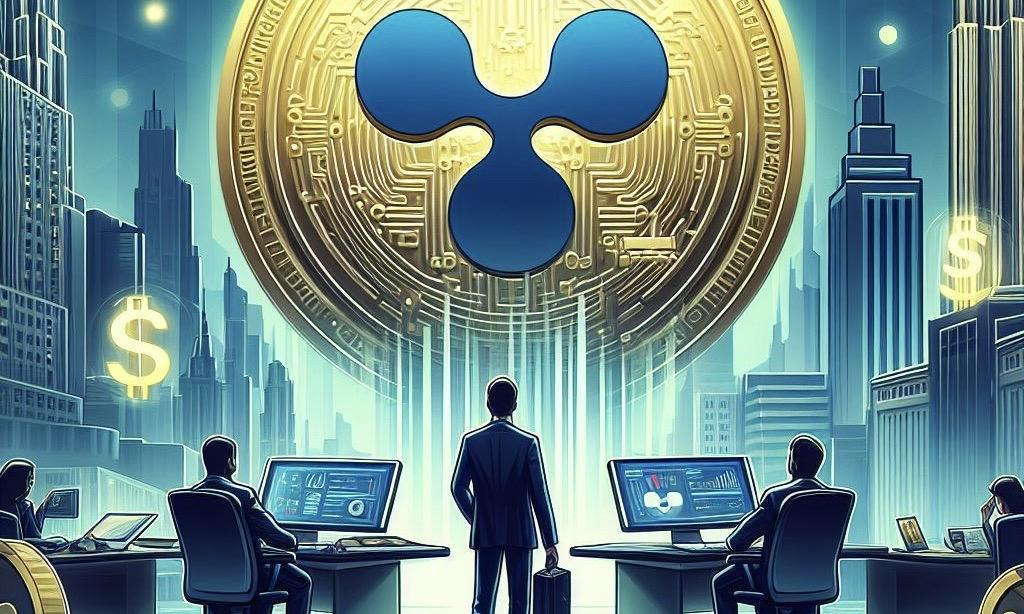
XRP Stalls Below $1.50 as Breakout Hinges on Policy, ETF Catalysts
XRP remains range-bound below $1.50 as traders weigh breakout potential amid ETF expansion, legislative developments, and mixed market signals.



Ripple’s XRP is struggling to break out of a tight trading range that has persisted for more than two months, with market participants increasingly focused on whether the token can reclaim the psychologically important $1.50 level. The move matters because a clean breakout could validate a bullish chart structure and coincide with several policy and product catalysts that may reshape XRP’s near-term demand profile.
As of May 8, 2026 (UTC), XRP was trading at $1.3837, down 2.06% over the past 24 hours. The token’s market capitalization stood at roughly $85.5 billion, maintaining its position as the fifth-largest cryptocurrency by market value, according to CoinMarketCap data cited in the report.
Technically, XRP has spent around 70 days oscillating within a narrow band—roughly $1.35 to $1.45—showing little sustained directional conviction. On the daily chart, traders are watching $1.50 as a key ‘neckline’ level associated with a potential ‘cup-and-handle’ setup, a pattern that typically signals continuation if resistance is cleared with conviction.
Indicators are mixed. While the MACD is described as flashing a buy signal, the RSI and Bull Bear Power readings remain near neutral, suggesting momentum has not decisively shifted. Crypto analyst Ali Martinez said a daily close above $1.45 could “open the path” toward $1.80, framing $1.45–$1.50 as the immediate battleground for bulls.
Price expectations for May remain constrained by that same ceiling. Several analysts cited in the report projected a month-long range of $1.35 to $1.55, with the market’s main question being whether XRP can secure a sustained move above ‘$1.50’. Analyst EGRAG CRYPTO argued that a strong break above that level could trigger a short-term surge toward $2.20.
Institutional and derivatives-linked forecasting signals, however, point to rising caution. India-based exchange CoinDCX projected a May target of $1.55 and a year-end level near $2.01, but odds on decentralized prediction platform Polymarket for XRP reaching $1.60 this month were put at 28%, down sharply from 41% at the start of May—an indication that traders have been repricing the probability of an upside breakout.
Beyond charts, three external catalysts are converging around XRP: U.S. legislation, new ETF access, and broader exchange adoption. In Washington, attention is on the Senate Banking Committee’s timeline ahead of the May 21 congressional recess, with expectations that it must set a markup schedule for the ‘CLARITY’ bill. If passed, the legislation could classify XRP as a ‘digital commodity’, potentially reducing a key overhang—regulatory uncertainty—that has historically weighed on the asset’s institutional narrative.
Meanwhile, GraniteShares (GraniteShares) listed a 3x leveraged XRP ETF on Nasdaq on May 7, according to the report, expanding regulated market access for retail participants seeking leveraged exposure. Separately, Russia’s largest securities exchange is expected to list an XRP index product on May 13, a development that could add another channel for institutional-style participation outside the traditional spot market.
Ripple (Ripple) is also pushing further into financial-market infrastructure initiatives, with the report citing its participation in a tokenized securities pilot led by DTCC, the U.S. post-trade clearing and settlement giant. The pilot is described as beginning in July, with a broader launch targeted for October. Additional pilot transaction partnerships involving JPMorgan (JPM) and Mastercard (MA) were also referenced, adding to speculation that XRP-linked rails could see increased real-world testing in legacy financial environments.
On-chain and market structure data provide a more restrained counterpoint. XRP’s circulating supply was cited at about 61.8 billion tokens—roughly 61.8% of the 100 billion maximum—while the fully diluted valuation (FDV) was estimated at around $138.3 billion versus a circulating market cap of about $85.5 billion, underscoring potential ‘dilution risk’ over time as additional supply enters the market.
Short-term activity has also cooled. XRP’s 24-hour trading volume totaled about $1.92 billion on May 8 (UTC), down 34.4% from the previous day. Centralized exchanges accounted for virtually all of that flow, while decentralized exchange volume was negligible by comparison—an imbalance that suggests most demand is still concentrated in traditional crypto trading venues rather than migrating on-chain.
For now, XRP’s next decisive move appears tied to whether buyers can regain control above ‘$1.50’. A breakout could amplify the impact of legislative progress, new exchange-traded products, and infrastructure pilots arriving in close succession. Failure to clear that level, however, risks extending the same range-bound conditions that have defined XRP trading for the past 70 days, keeping the market in a prolonged wait-and-see mode.
Article Summary by TokenPost.ai
🔎 Market Interpretation
Range-bound price action: XRP has traded in a tight $1.35–$1.45 band for ~70 days, signaling indecision and suppressing trend-following participation.
Key inflection zone: $1.45–$1.50 is framed as the near-term “battlefield.” A sustained reclaim of $1.50 is treated as the psychological and technical trigger for a regime shift.
Chart setup focus: Traders are monitoring a potential cup-and-handle structure, with $1.50 acting as the “neckline” resistance that would validate continuation if broken with volume/conviction.
Mixed momentum signals: MACD is described as bullish (buy signal), while RSI and Bull Bear Power hover near neutral—suggesting upside attempts may lack follow-through without a catalyst.
Consensus expectations remain capped: Several projections keep May mostly constrained to $1.35–$1.55 unless $1.50 is decisively cleared.
Upside targets if breakout occurs: Commentary cited points to $1.80 (after a daily close above $1.45) and a more aggressive scenario toward $2.20 if $1.50 breaks strongly.
Market is repricing breakout odds: Polymarket odds for XRP reaching $1.60 this month fell to 28% (from 41% at May start), indicating growing caution despite bullish narratives.
Liquidity/attention cooling: 24h volume fell to $1.92B (−34.4% day-over-day), aligning with the idea of “wait-and-see” positioning until a clear level breaks.
💡 Strategic Points
Define the decision level: Treat $1.50 as the confirmation threshold; repeated failures below it favor continued range strategies, while a clean breakout favors trend re-engagement.
Watch confirmation, not just wicks: The article emphasizes “daily close” logic (e.g., above $1.45) to reduce the risk of false breakouts common in tight ranges.
Catalyst clustering may matter: Potential demand tailwinds are arriving close together—U.S. legislative steps (CLARITY bill), new ETF access, and infrastructure pilots—raising the chance of a volatility expansion if price confirms.
Regulatory narrative sensitivity: If the CLARITY bill progresses and helps frame XRP as a digital commodity, that could reduce the longstanding “regulatory overhang” for institutions—an important narrative shift even before fundamentals change.
Access expansion is two-track:
Retail leverage: A 3x leveraged XRP ETF on Nasdaq can amplify short-term flows and volatility (both up and down).
Broader market plumbing: A Russia-listed XRP index product and DTCC tokenized-securities pilot participation suggest growing experimentation with XRP-adjacent exposure and settlement infrastructure.
Supply/dilution awareness: With ~61.8B circulating out of 100B max and FDV (~$138.3B) well above circulating market cap (~$85.5B), incremental supply over time may act as a structural headwind that investors should factor into long-horizon theses.
Market structure note: Volume is overwhelmingly on centralized exchanges while DEX activity is negligible, implying XRP’s liquidity and price discovery remain primarily CEX-driven (sensitive to exchange flows, derivatives, and headline catalysts).
Scenario map (from the article’s levels):
Bull case: Hold $1.35 support → reclaim/close above $1.45 → challenge and break $1.50 → potential extensions toward $1.80 then $2.20 if momentum sustains.
Base case: Continued $1.35–$1.55 consolidation through May while catalysts develop.
Stall risk: Failure to clear $1.50 keeps XRP trapped in the same range, with declining volume increasing whipsaw risk.
📘 Glossary
Psychological level: A round-number price (e.g., $1.50) that draws heightened trader attention and can concentrate orders.
Trading range: Sideways movement between support and resistance where breakouts often require a catalyst or volume expansion.
Neckline: A key resistance/support line that, if broken, confirms certain chart patterns and can trigger momentum buying/selling.
Cup-and-handle: A bullish continuation pattern; confirmation typically requires a breakout above the prior resistance (“rim/neckline”).
MACD: Moving Average Convergence Divergence—momentum indicator used to identify trend shifts and potential buy/sell signals.
RSI: Relative Strength Index—measures recent price momentum; near-neutral readings imply no strong trend bias.
Bull Bear Power: Indicator comparing buying vs. selling pressure; near neutral suggests balanced forces.
FDV (Fully Diluted Valuation): Market cap assuming the maximum token supply is in circulation; highlights potential dilution effects over time.
Dilution risk: The possibility that additional token supply enters the market, potentially pressuring price if demand doesn’t rise proportionally.
Polymarket odds: Market-implied probability from a prediction market, reflecting how traders are pricing an outcome (e.g., XRP hitting $1.60 in May).
Leveraged ETF (3x): An exchange-traded product targeting multiples of daily returns; can magnify gains and losses and increase volatility.
Digital commodity: A regulatory classification that may reduce uncertainty about oversight and improve institutional comfort, depending on jurisdiction and final rules.