
Ethereum Options Skew Bullish as Call Interest Tops 60% With $6.9B OI
Ethereum options markets show bullish positioning as call contracts exceed 60% of $6.92 billion open interest, signaling sustained upside expectations despite active hedging.


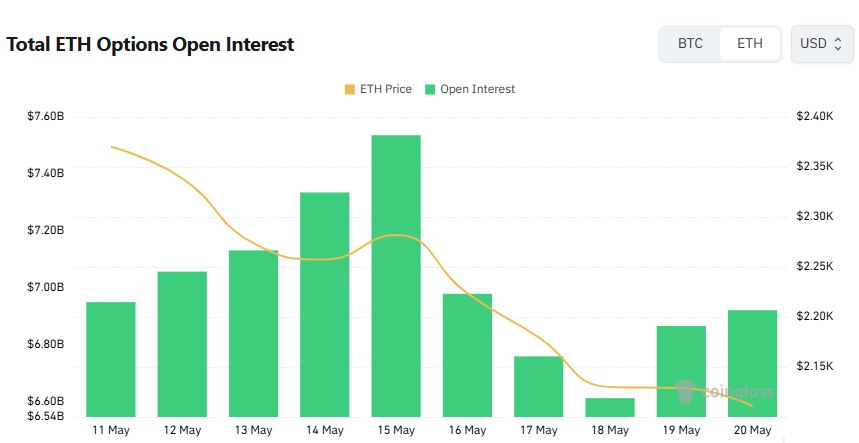
Ethereum (ETH) options positioning continued to lean bullish on Tuesday ET, with call options making up more than 60% of outstanding contracts as open interest edged higher. The skew suggests traders are still pricing in upside scenarios, even as near-dated flow concentrates around a handful of strike prices.
According to CoinGlass data as of May 20, total Ethereum options open interest (OI) stood at $6.92 billion, up about 0.73% from $6.87 billion a day earlier. In the OI breakdown, calls accounted for 60.54% versus 39.46% for puts, reinforcing a market structure tilted toward 'upside exposure' in aggregate positioning.
Options trading volume over the past 24 hours reached roughly $936 million. By venue, Deribit led with about $271 million, followed by CME at around $5 million, OKX at $125 million, Binance at $199 million, and Bybit at $336 million—highlighting the continued dominance of offshore crypto-native exchanges in day-to-day ETH options activity, while regulated U.S. futures-linked options on CME remain comparatively smaller.
Despite the call-heavy open interest, the 24-hour volume split showed a slightly more balanced tone: calls represented 56.94% of traded volume, while puts accounted for 43.06%. That gap can matter for interpretation—open interest tends to reflect accumulated medium-term positioning, while daily volume often captures shorter-term tactical trades, including hedging demand around key price levels.
The largest concentrations of open interest were found in the $2,100 put expiring May 29 on Deribit, the $3,200 call expiring Dec. 25 on Deribit, and the $2,500 call expiring June 26 on Deribit. In contrast, the most actively traded contracts over the last 24 hours centered on shorter-dated calls: the $2,500 call expiring May 22 on Bybit, the $2,150 call expiring May 20 on Bybit, and the $3,000 call expiring June 26 on Deribit.
Market watchers often use the combination of 'open interest' and volume to distinguish between longer-horizon conviction trades and near-term positioning. A rising OI figure typically indicates new exposure entering the market rather than contracts being closed out, which can signal growing appetite to express a forward view on ETH’s price. At the same time, a meaningful share of put volume alongside call-dominant open interest can point to concurrent demand for downside protection or volatility-driven trades, even within an overall optimistic backdrop.
In the near term, the clustering of flow around the $2,500 and $2,150 call strikes suggests traders are focusing on clearly defined upside targets, while the heavy open interest in the $2,100 put underscores that protection remains in place below spot—an indication that sentiment is constructive, but not complacent.
Article Summary by TokenPost.ai
🔎 Market Interpretation
Options positioning remains bullish: ETH options open interest (OI) rose to $6.92B (+0.73% day/day), with calls = 60.54% vs puts = 39.46%, indicating aggregate exposure is still skewed toward upside scenarios.
Volume is less one-sided than OI: Past-24h options volume totaled ~$936M, split 56.94% calls and 43.06% puts. This suggests that while longer-held positioning is call-heavy, short-term flows include notable hedging or tactical put activity.
Exchange mix highlights offshore dominance: Deribit (~$271M), Bybit (~$336M), and Binance (~$199M) drove most activity, while CME (~$5M) remained comparatively small—implying crypto-native venues continue to shape day-to-day ETH options pricing dynamics.
Key strikes define market “map”: Heavy OI at $2,100 put (May 29) implies meaningful downside protection below spot, while call interest at $2,500 (Jun 26) and $3,200 (Dec 25) reflects upside targets across both nearer and longer horizons.
Sentiment constructive, not complacent: Concentrated call flow around $2,150 and $2,500 suggests traders are leaning into upside, but the prominent $2,100 put position signals protection remains a priority.
💡 Strategic Points
Separate “conviction” from “tactics”: Use rising OI as a proxy for new exposure/medium-term conviction, while 24h volume can reflect short-dated positioning, gamma trades, or hedges around nearby strikes.
Watch the $2,100 put as a downside reference: Large OI there may act as a sentiment/hedging anchor; increased trading activity in that line can signal growing caution or demand for protection.
Monitor $2,150 and $2,500 calls for near-term “upside focus”: Persistent volume concentration can indicate traders are targeting those levels, potentially amplifying price sensitivity near these strikes into expiries.
Interpret call-heavy OI with put volume carefully: A meaningful put share in daily volume alongside call-dominant OI can imply risk-managed bullishness (upside exposure paired with protection) rather than outright one-way optimism.
Venue signals matter: If activity continues to migrate toward Deribit/Bybit for short-dated calls, near-term pricing may be more influenced by offshore flows; any sudden CME pickup could indicate greater institutional participation via regulated products.
📘 Glossary
Options Open Interest (OI): The total number of outstanding option contracts that remain open (not closed/settled). Rising OI often suggests new positions are being added.
Call Option: A contract that benefits if the underlying price rises above the strike (right to buy at the strike).
Put Option: A contract that benefits if the underlying price falls below the strike (right to sell at the strike); commonly used for downside hedging.
Strike Price: The price level at which the option can be exercised; concentrations can reveal where traders expect or hedge future price moves.
Expiration: The date the option contract ends (e.g., May 22, May 29, Jun 26, Dec 25); shorter expiries tend to reflect tactical trades, longer expiries reflect longer-horizon views.
Skew (Positioning Skew): In this context, the imbalance between call and put interest/volume, used to infer whether traders prefer upside or downside exposure.
Hedging: Using options (often puts) to reduce risk from adverse price moves rather than to express a directional bet.