
Ethereum ETFs See Ninth Straight Outflow as $32.6 Million Exits Signal Caution
US spot Ethereum ETFs recorded a ninth consecutive day of outflows led by BlackRock’s ETHA, signaling continued institutional caution despite strong total assets.


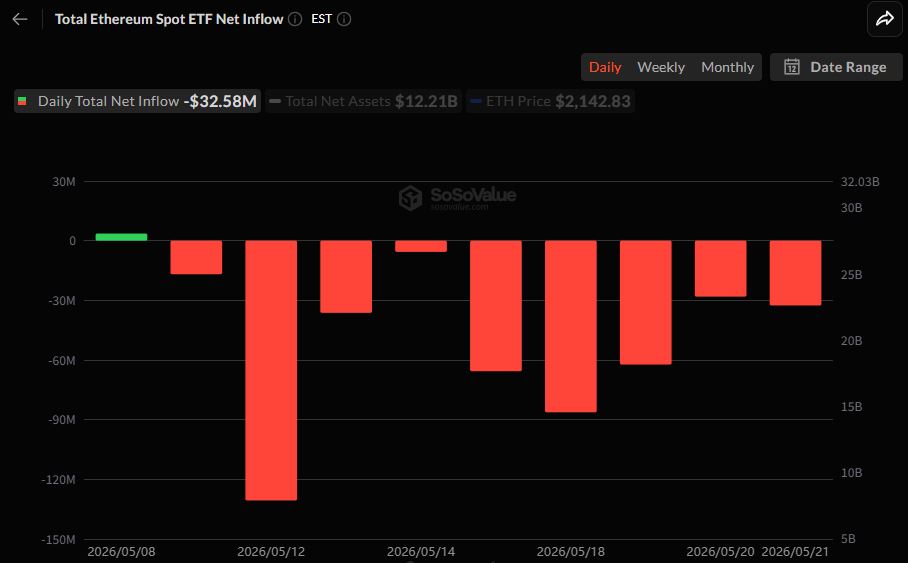
US spot Ethereum (ETH) exchange-traded funds extended their slide on May 21, logging a ninth consecutive trading day of net outflows—an indication that near-term institutional appetite for ETH exposure remains cautious even as overall assets in the category stay substantial.
According to data compiled by SoSoValue, the US spot Ethereum ETF cohort posted $32.58 million in net redemptions on May 21 (US Eastern Time). The latest session continued a persistent withdrawal streak that began on May 11, underscoring a sustained shift toward de-risking or profit-taking among some allocators rather than broad-based accumulation.
Flows were heavily concentrated in a single product. BlackRock’s iShares Ethereum Trust (ETHA) recorded $38.01 million in net outflows, more than offsetting modest inflows elsewhere. By contrast, inflows were reported in BlackRock’s Ethereum-focused staking-themed product (ETHB), which added $3.29 million, and Bitwise’s Ethereum ETF (ETHW), which took in $2.14 million. The remaining spot Ethereum ETFs were effectively flat on the day.
Despite the negative flow picture, trading activity remained active. Total turnover across the 10 ETFs reached $416.16 million. ETHA led volumes with $312.89 million, followed by Grayscale’s Ethereum Mini Trust (ETH) at $33.40 million and Grayscale Ethereum Trust (ETHE) at $25.44 million—suggesting that more of the day’s activity was driven by rebalancing and liquidity management than by fresh net buying.
Overall, the group’s total net assets stood at $12.21 billion, representing about 4.73% of Ethereum’s total market capitalization. By fund size, ETHA remained the dominant vehicle with $6.43 billion in net assets, followed by Grayscale’s ETH at $1.93 billion and ETHE at $1.73 billion.
While cumulative net inflows since launch were still reported at $11.62 billion, the prolonged outflow streak highlights the sensitivity of ETH-related products to short-term macro sentiment, positioning, and product-level rotations. The divergence between ETHA’s redemptions and smaller inflows into other funds also points to 'issuer-specific' reallocations rather than a uniform retreat from Ethereum exposure. For the broader market, continued net outflows could weigh on marginal demand, even if the category’s asset base remains large enough to keep liquidity conditions relatively stable.
Article Summary by TokenPost.ai
🔎 Market Interpretation
Persistent risk-off signal: US spot Ethereum ETFs recorded a 9th straight day of net outflows (May 21), indicating near-term institutional demand for ETH exposure remains cautious.
Net flow snapshot: The cohort saw $32.58M in net redemptions (SoSoValue), extending the outflow streak that began May 11—consistent with de-risking, rebalancing, or profit-taking behavior.
Outflows are concentrated, not uniform: BlackRock’s ETHA drove the day’s net outflows (-$38.01M), while smaller inflows into other products suggest rotation across issuers rather than a broad exit from ETH exposure.
Liquidity remains healthy despite redemptions: Total daily turnover across the 10 ETFs was $416.16M, implying active trading and liquidity management even as net buying was negative.
Category still sizable: Total net assets were $12.21B (~4.73% of ETH market cap). Large AUM can help stabilize trading conditions even when marginal demand softens.
💡 Strategic Points
Watch ETHA as the key marginal driver: With $6.43B in net assets and the largest daily volume ($312.89M), ETHA’s creations/redemptions may disproportionately influence short-term ETF-linked demand dynamics.
Differentiate “headline outflows” vs “issuer rotation”: Small inflows into ETHB (+$3.29M) and ETHW (+$2.14M) alongside ETHA redemptions point to allocator preferences (fees, structure, liquidity) rather than a single directional ETH view.
Expect sensitivity to macro/positioning: The prolonged outflow streak suggests ETH ETF flows are currently reactive to short-term sentiment, positioning, and allocation shifts.
Monitor flow streaks for demand confirmation: Continued net outflows can pressure marginal demand; stabilization or reversal (multiple inflow days) would be a clearer signal of renewed institutional accumulation.
AUM concentration matters for market impact: The largest funds (ETHA, Grayscale’s ETH, ETHE) dominate assets and volume; flow changes in these products are more likely to translate into noticeable market effects than moves in smaller ETFs.
📘 Glossary
Spot Ethereum ETF: An exchange-traded fund designed to track Ethereum’s spot price, typically by holding ETH directly (as opposed to futures exposure).
Net inflows / net outflows: The net amount of capital entering or leaving an ETF in a day; outflows occur when redemptions exceed creations.
Redemptions: Shares of an ETF being exchanged for the underlying assets (or cash), reducing the ETF’s assets under management.
Turnover (trading volume): The dollar value of ETF shares traded during a session; high volume can reflect active repositioning even if net flows are negative.
Total net assets (AUM): The total value of assets held by the ETFs; indicates the category’s size and capacity to provide liquidity.
Issuer-specific rotation: Reallocation from one provider’s ETF to another’s due to differences in fees, liquidity, reputation, features, or portfolio constraints.
Marginal demand: The incremental buy/sell pressure that can move prices at the margin—often influenced by new inflows or outflows.