

 News
News  Coin Information
  About us
  Customer Service


 Add as a preferred source on Google
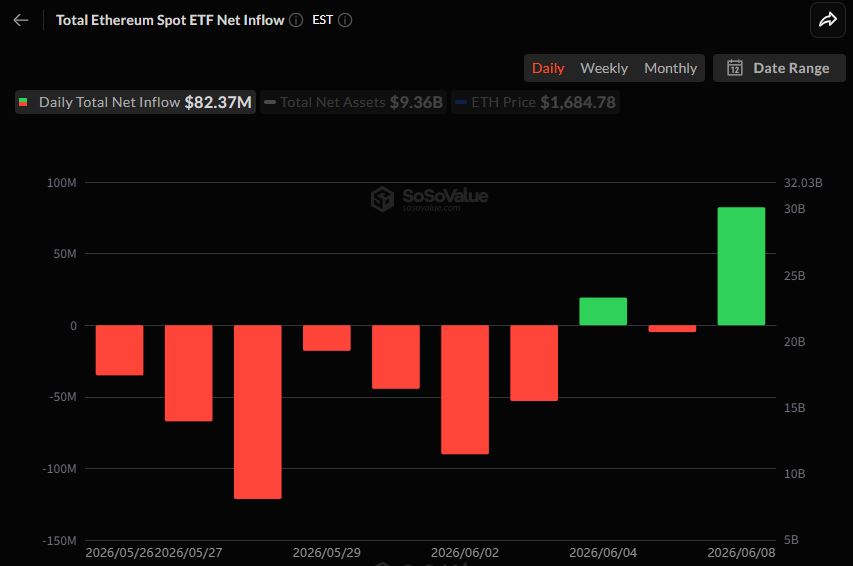
U.S. spot Ethereum (ETH) ETFs swung back to positive territory on Sunday, drawing $82.37 million in net inflows as demand concentrated in Fidelity and BlackRock products—an early sign that institutional appetite remains resilient after a brief pullback.
Data compiled by SoSoValue showed the spot Ethereum ETF complex posting the $82.37 million daily net inflow on June 8 (UTC), reversing the prior session’s $4.83 million net outflow recorded on June 5 (UTC). Cumulative net inflows across the market reached $11.28 billion, underscoring the category’s growing role as a regulated entry point for ETH exposure.
Of the 10 listed spot ETH ETFs, seven recorded net creations. Fidelity’s Fidelity Ethereum Fund ($FETH) led with $28.57 million in inflows, followed by BlackRock’s iShares Ethereum Trust ($ETHB) at $26.90 million and BlackRock’s iShares Ethereum Trust ($ETHA) at $17.82 million. Grayscale Ethereum Trust ($ETH) added $8.00 million, while Bitwise Ethereum ETF ($ETHW) brought in $3.02 million. Smaller inflows were also seen in 21Shares Core Ethereum ETF ($TETH) with $1.26 million and Invesco Galaxy Ethereum ETF ($QETH) with $0.50 million.
Outflows were limited. VanEck Ethereum ETF ($ETHV) saw $3.70 million in redemptions, while Grayscale Ethereum Trust ($ETHE) and Franklin Ethereum ETF ($EZET) were flat on the day.
Trading activity remained elevated, with total turnover across spot ETH ETFs reaching $580.19 million. BlackRock’s $ETHA dominated volumes at $428.18 million, followed by Grayscale’s $ETH at $47.79 million and Fidelity’s $FETH at $34.83 million—an indication that liquidity continues to cluster in the largest issuers even as the market broadens.
Total net assets across the spot Ethereum ETF suite stood at $9.36 billion, equivalent to roughly 4.59% of Ethereum’s total market capitalization. By assets under management, BlackRock’s $ETHA led the group at $4.83 billion, followed by Grayscale’s $ETH at $1.49 billion and Grayscale’s $ETHE at $1.33 billion.
The rapid return to net inflows suggests that, despite day-to-day volatility, spot ETH ETFs are increasingly being used as a 'liquidity on-ramp' for investors seeking regulated exposure—while the concentration of both inflows and trading in a handful of funds highlights the market’s preference for scale, tighter spreads, and established distribution.
🔎 Market Interpretation
{
"flow_reversal": {
"what_happened": "U.S. spot Ethereum ETFs flipped back to net inflows (+$82.37M on June 8 UTC) after a small outflow (-$4.83M on June 5 UTC).",
"what_it_signals": "Institutional demand appears intact; the pullback looked more like a pause than a trend change.",
"context": {
"cumulative_net_inflows": "$11.28B",
"total_net_assets": "$9.36B (~4.59% of ETH market cap)"
}
},
"concentration_dynamics": {
"inflows_concentrated_in": [
"Fidelity $FETH (+$28.57M)",
"BlackRock $ETHB (+$26.90M)",
"BlackRock $ETHA (+$17.82M)"
],
"volume_concentrated_in": {
"total_turnover": "$580.19M",
"dominant_fund": "BlackRock $ETHA ($428.18M)",
"implication": "Liquidity clusters in the largest issuers, reinforcing a ‘winner-takes-most’ liquidity profile (tighter spreads, deeper markets)."
}
},
"risk_tone": {
"outflows_limited": "Only VanEck $ETHV saw notable redemptions (-$3.70M); $ETHE and $EZET were flat.",
"interpretation": "Selling pressure was contained, suggesting rebalancing rather than broad risk-off behavior in ETH ETF allocations."
}
}
💡 Strategic Points
{
"investor_takeaways": [
{
"point": "Track flow leaders as ‘sentiment proxies’",
"why_it_matters": "Repeated inflow leadership by Fidelity/BlackRock may act as an early gauge of institutional positioning and risk appetite.",
"how_to_use": "Monitor daily creations/redemptions alongside ETH price and futures basis for confirmation or divergence signals."
},
{
"point": "Liquidity preference can shape execution quality",
"why_it_matters": "High turnover in $ETHA implies better depth and potentially tighter spreads than smaller funds.",
"how_to_use": "For larger orders, prioritize funds with consistently high volume to reduce slippage; consider smaller funds only if fee/structure advantages outweigh liquidity costs."
},
{
"point": "ETF flows may function as a regulated ‘on-ramp’",
"why_it_matters": "The quick return to inflows supports the idea that investors increasingly use spot ETH ETFs to gain/adjust exposure without direct custody.",
"how_to_use": "Watch whether inflows persist during volatility; sustained inflows during drawdowns can indicate structural demand rather than momentum chasing."
},
{
"point": "AUM share offers a macro adoption metric",
"why_it_matters": "Net assets at ~$9.36B (~4.59% of ETH market cap) indicate meaningful—but not saturated—penetration.",
"how_to_use": "Use the % of market cap held via ETFs as a longer-term indicator of traditional-market adoption and potential incremental demand."
}
],
"key_numbers_to_watch_next": [
"Daily net flows (especially whether inflows remain broad-based across issuers)",
"Turnover concentration (does $ETHA remain dominant or does liquidity disperse?)",
"Net assets as % of ETH market cap (trend of ETF penetration)",
"AUM ranks (does leadership by $ETHA widen or narrow?)"
]
}
📘 Glossary
{
"Spot Ethereum ETF": "An exchange-traded fund designed to track ETH’s price by holding (or economically referencing) spot ETH, offering regulated exposure via brokerage accounts.",
"Net inflow / net outflow": "The net dollar value of creations (new shares issued) minus redemptions (shares removed) in a given period.",
"Creation / redemption": "The mechanism where authorized participants add or remove ETF shares, typically in exchange for cash or underlying assets—driving reported flows.",
"Cumulative net inflows": "Total net capital added to the ETF category over time; a measure of aggregate demand since launch.",
"Turnover (trading volume)": "Total dollar value traded over a period; often used as a proxy for liquidity and execution efficiency.",
"Net assets (AUM)": "Total value of assets held by the fund(s); indicates size and often correlates with market liquidity.",
"Redemptions": "Withdrawals from an ETF via the removal of shares, usually reflected as net outflows.",
"Liquidity on-ramp": "A channel that allows investors to enter/exit exposure efficiently and within a regulated wrapper, without handling direct custody.",
"Market capitalization": "Total value of an asset (price × circulating supply); used to contextualize ETF holdings relative to the broader ETH market.",
"Spread": "The bid-ask difference; typically tighter in more liquid funds, affecting trading costs.",
"Issuer": "The firm sponsoring the ETF (e.g., BlackRock, Fidelity), often influencing distribution reach and liquidity.",
"Broad-based vs. concentrated flows": "Whether inflows are distributed across many funds or focused in a few large products—important for understanding market structure and competition."
}























Comment 0