

 News
News  Coin Information
  About us
  Customer Service


 Add as a preferred source on Google
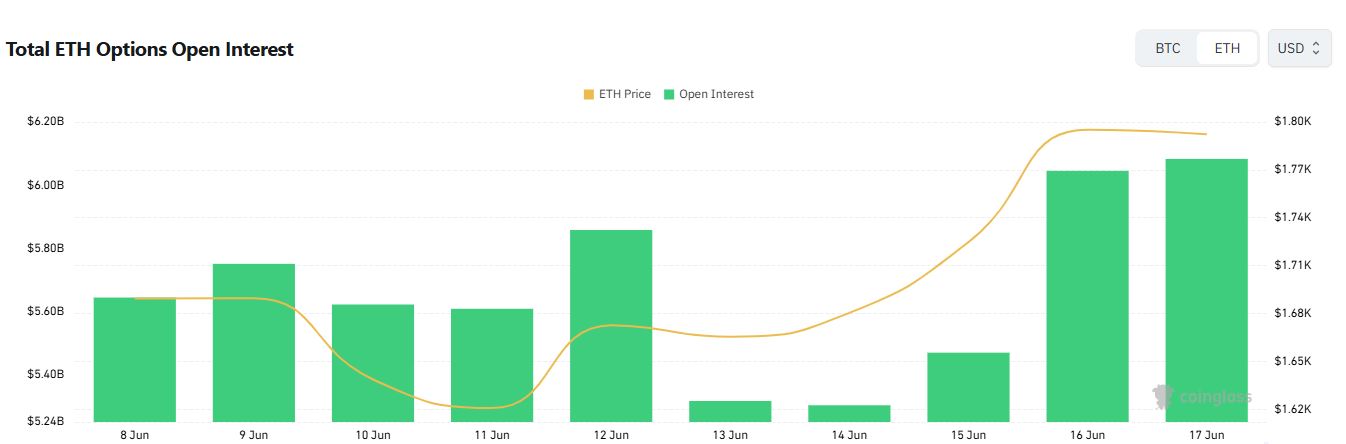
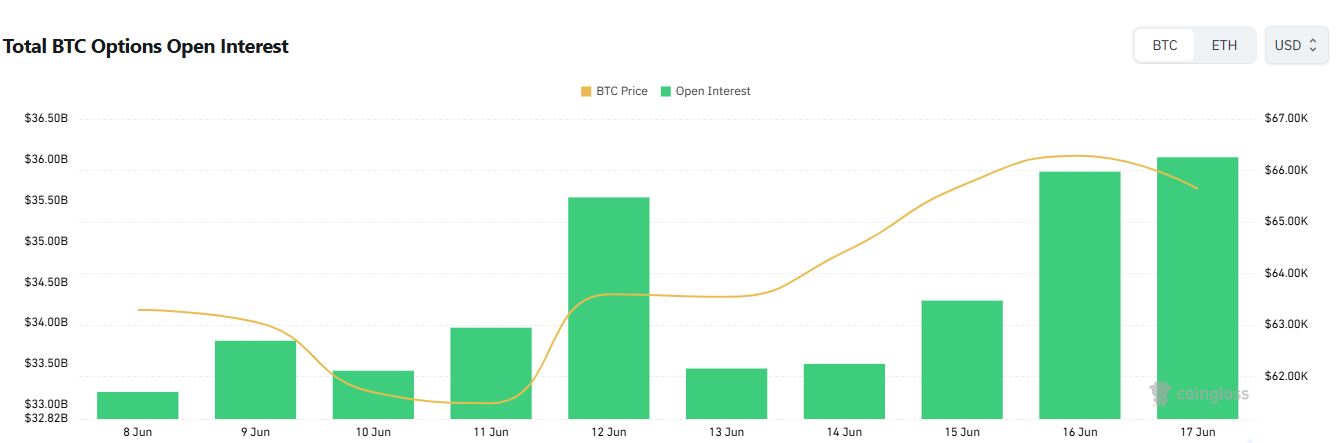
Ethereum’s (ETH) options market continued to show a bias toward bullish positioning, with call contracts still dominating open interest. However, traders have been increasingly active in near-dated downside protection—most notably through heavy flow into the $1,200 put—highlighting renewed sensitivity to short-term drawdown risk.
As of Tuesday 13:00 UTC, data compiled by Coinglass showed total Ethereum options 'open interest' (OI) at $6.08 billion, up about 0.5% from $6.05 billion a day earlier. Calls accounted for 59.90% of outstanding contracts, while puts made up 40.10%, indicating that longer-lived positioning remains skewed toward upside exposure despite heightened hedging activity.
Total options trading volume over the latest 24-hour period reached roughly $1.068 billion. By venue, Bybit led activity with about $520 million in volume, followed by Binance with approximately $204 million, Deribit with $187 million, OKX with $150 million, and CME with about $7 million. In directional terms, 24-hour volume was relatively balanced: calls represented 52.37% and puts 47.63%, underscoring that short-term trades have been more two-sided than the open-interest split suggests.
In the OI rankings, the largest concentrations were clustered in higher-strike call contracts on Deribit—$2,000 calls expiring June 26, $2,500 calls expiring June 26, and $3,200 calls expiring Dec. 25—pointing to maintained expectations for a recovery into later summer and year-end timelines. By contrast, the highest-volume contracts over the past day reflected a more defensive near-term posture: the $1,200 put expiring June 19 on Bybit ranked first, followed by the $2,400 call expiring June 19 and the $1,825 call expiring June 17, both also on Bybit.
Market participants often interpret this divergence—call-heavy OI alongside an uptick in put-driven turnover—as a sign that traders are simultaneously holding medium-term upside positions while actively hedging near-term volatility. 'Open interest' measures the total number of outstanding derivatives contracts and typically rises when new positions are added, rather than merely rotated intraday. When OI increases while put volume remains elevated, it can signal that fresh risk is entering the market even as participants pay up for protection against abrupt price swings.
The latest distribution suggests Ethereum options traders are keeping a constructive bias in their broader positioning, but are not dismissing the possibility of short-term turbulence—an outlook consistent with a market that is willing to express upside views while remaining alert to downside tails.



















Comment 0