
Ethereum Options Turn Defensive as Short-Term Put Volume Outpaces Calls
Ethereum options data shows put trading volume slightly գերpassing calls as traders increase short-term hedging while maintaining longer-term bullish positioning.


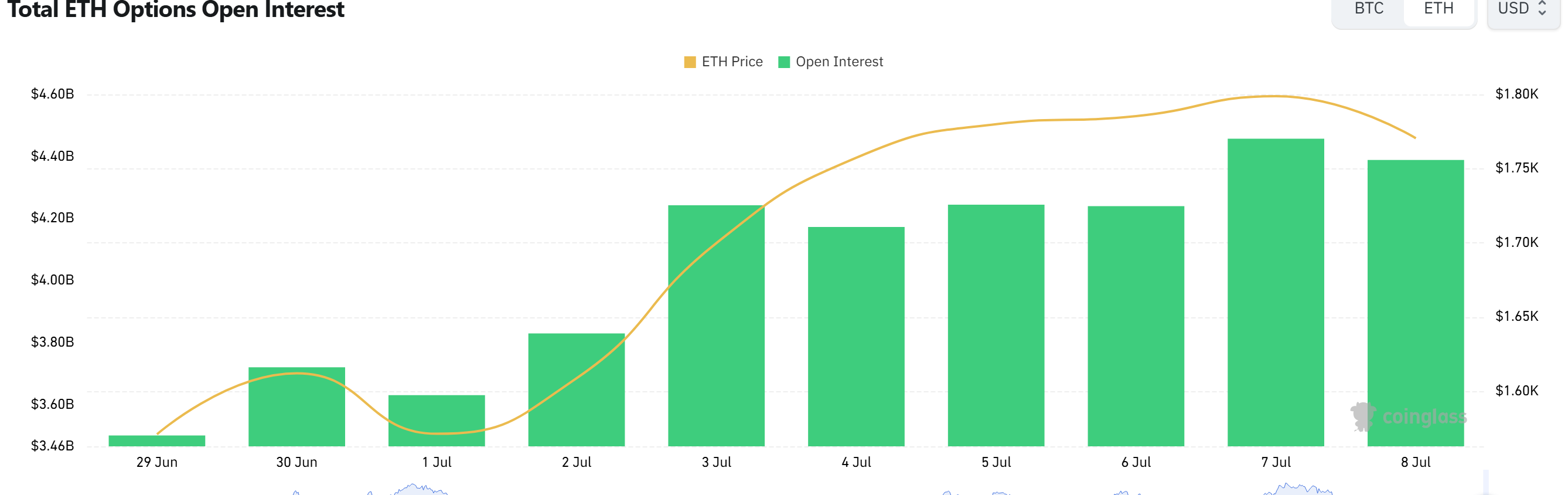
Ethereum (ETH) options positioning showed a modest pullback in outstanding exposure on Tuesday, even as short-dated trading activity skewed toward downside protection—highlighted by heavy turnover in a $1,775 put contract on Bybit.
Data compiled by CoinGlass as of 12:50 a.m. ET on July 8 put total Ethereum options open interest (OI) at $4.318 billion, down 0.23% from the prior day’s $4.328 billion. Over the past 24 hours, total options volume was about $831.2 million, indicating active near-term repositioning despite the slight decline in cumulative outstanding contracts.
The mix of positions remained tilted toward bullish exposure when viewed through open interest: calls accounted for 57.41% of OI versus 42.59% for puts. However, the flow picture looked more defensive. By 24-hour volume, puts narrowly led at 51.05%, compared with calls at 48.95%—suggesting traders were more aggressively transacting hedges or short-term bearish bets even as the broader inventory of longer-dated positions stayed call-heavy.
In practice, this divergence often reflects two different time horizons in the same market. A call-dominant OI base can signal that medium-term positioning is still oriented toward upside scenarios, while a put-leaning volume profile can indicate demand for immediate protection against drawdowns and volatility spikes, particularly around key levels in spot and perpetual markets.
On the open-interest leaderboard, the largest concentrations were in Deribit-listed December 25 expiries: the $3,200 call, the $2,200 call, and the $3,500 call. These strikes, sitting well above prevailing spot levels, point to continued interest in higher-end year-end outcomes and structured upside exposure.
By contrast, the most actively traded contracts over the past 24 hours were concentrated in ultra-short-dated Bybit options expiring July 8. The top contract by volume was the $1,775 put, followed by the $1,800 call and the $1,775 call. Such clustering around nearby strikes is typically associated with tactical hedging, intraday leverage, and delta adjustments as traders manage risk into short expiry windows.
Options are derivatives that allow investors to express leveraged views on an underlying asset or hedge existing exposure. A 'call option' grants the right to buy at a predetermined price, generally used for bullish positioning, while a 'put option' grants the right to sell, commonly used to position for declines or to protect against downside. Open interest represents the total number of outstanding contracts and is widely monitored as a gauge of accumulated positioning.
Overall, Tuesday’s data suggest Ethereum options traders are maintaining a structurally call-heavy book in longer-dated contracts while simultaneously rotating into short-term 'defensive' activity—an alignment consistent with markets that remain open to upside but are increasingly attentive to near-term volatility and potential pullbacks.
Article Summary by TokenPost.ai
🔎 Market Interpretation
Open interest dipped slightly: ETH options OI fell to $4.318B (-0.23% day/day), signaling a modest reduction in total outstanding positioning even as traders remained active.
Near-term trading turned defensive: 24h options volume was $831.2M, and puts led volume (51.05%) despite calls dominating OI (57.41%)—a classic split between longer-dated bullish inventory and short-dated hedging demand.
Short-dated protection centered near spot: Heavy turnover in Bybit July 8 expiry—especially the $1,775 put—suggests traders actively managed downside risk into an imminent expiration window.
Longer-dated upside still anchored: Biggest OI concentrations sat in Deribit Dec 25 calls at $2,200 / $3,200 / $3,500, indicating persistent interest in higher year-end outcomes.
Interpretation of the divergence: The market appears to be pricing a scenario where participants remain structurally optimistic over the medium term, while paying up (or positioning) for near-term volatility/pullback risk around key levels.
💡 Strategic Points
Two-horizon positioning is evident: Maintain awareness that OI reflects accumulated positioning (often longer-dated), while volume reflects current urgency (often short-dated hedges/speculation).
Watch the $1,775–$1,800 zone: Concentrated trading in these strikes near expiry can amplify pinning effects, rapid delta hedging flows, and sharp spot reactions around that range.
Risk signal: put-heavy flow: When puts lead volume while calls lead OI, it often implies traders are protecting existing long exposure rather than fully flipping bearish—still, it can precede higher realized volatility.
Follow strike clusters on Dec 25: Large OI at $3,200–$3,500 may act as a reference for market narratives (upside targets) and potential dealer hedging sensitivity if spot trends upward.
Practical takeaway for positioning: Traders may be expressing “bullish longer-term, cautious now” via combinations such as holding calls longer-dated while buying short-dated puts for drawdown coverage.
📘 Glossary
Option: A derivative contract giving the right (not obligation) to transact the underlying at a set price by a set date.
Call option: Right to buy at the strike price; typically used to express bullish exposure.
Put option: Right to sell at the strike price; used for bearish positioning or downside hedging.
Strike price: The predetermined price at which the option can be exercised (e.g., $1,775).
Expiry (expiration): The date the option contract ends (e.g., July 8 for ultra-short-dated contracts).
Open interest (OI): Total number of outstanding option contracts; a proxy for accumulated positioning.
Options volume: Contracts traded over a period; a proxy for current activity/flow.
Hedging: Taking positions (often puts) to reduce losses from adverse price moves in the underlying.
Delta adjustments: Changes in hedging due to the option’s sensitivity (delta) to underlying price moves, often intensifying near expiry.