
 Add as a preferred source on Google
Ethereum Options Open Interest Rises to $4.33 Billion as Calls Dominate $1,800 Strike
Ethereum options open interest climbed to $4.33 billion with call-heavy positioning around the $1,800 strike, signaling a modestly bullish market bias.


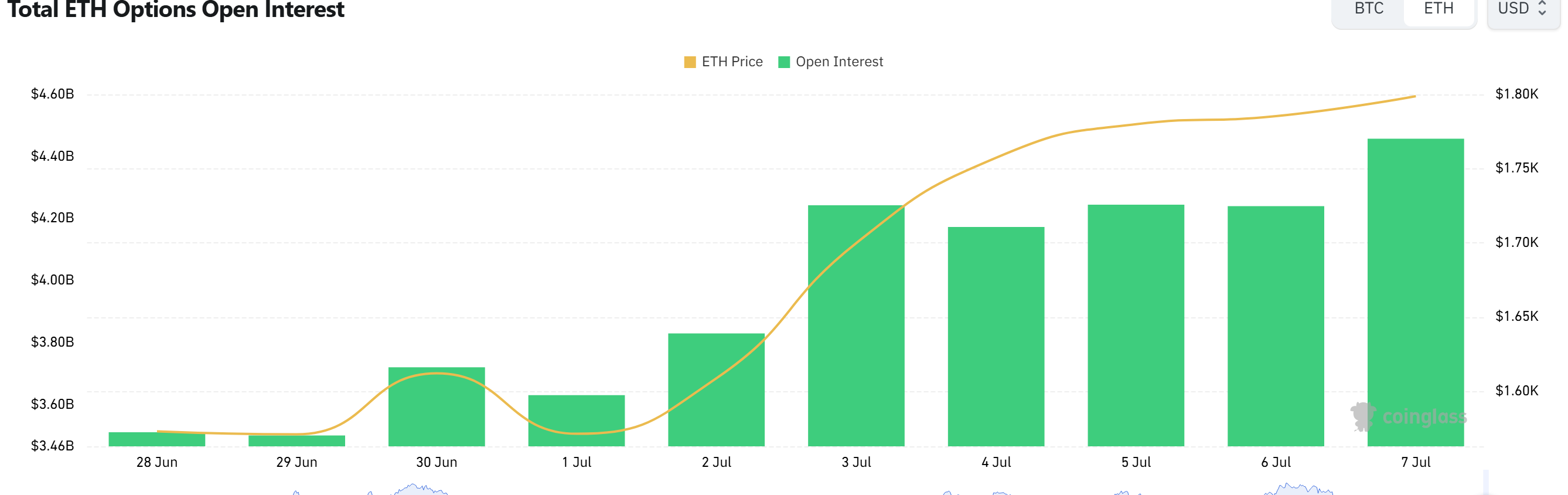
Ethereum (ETH) options positioning tilted more bullish on Monday, with total open interest rising and the most active flow over the past day clustering in short-dated call contracts around the $1,800 strike—an area traders often use to express near-term upside exposure or hedge spot and futures books.
Data compiled by CoinGlass as of July 7, 11:48 a.m. in Seoul (July 7, 02:48 UTC) showed total Ethereum options open interest (OI) at $4.33 billion, up 4.30% from $4.15 billion a day earlier. Notional options volume over the past 24 hours was about $1.21 billion, underscoring steady derivative activity alongside the latest price action in ETH.
By contract type, call options accounted for 57.36% of total OI versus 42.64% for puts, indicating that outstanding positions are skewed toward upside structures. The 24-hour volume split was narrower but still leaned to calls, with calls at 51.08% and puts at 48.92%. In practice, that combination—calls leading both in total positioning and daily turnover—suggests traders are maintaining net 'upside exposure' not only in longer-dated positioning but also through short-term trades.
In the longer-dated book, the largest concentrations of open interest were on Deribit, led by the $3,200 call expiring Dec. 25, followed by the $2,200 call and the $3,500 call with the same expiry. Heavy OI at these strikes often reflects a mix of outright directional bets and structured strategies such as call spreads, where traders cap upside in exchange for lower premium cost.
Near-term activity was dominated by Bybit contracts expiring July 7. The most traded contract over the past 24 hours was the $1,800 call, followed by the $1,825 call. The third-most active was a $1,750 put, highlighting that while traders were actively targeting upside strikes, there was also meaningful demand for downside protection or volatility hedges around nearby levels.
Options are derivatives that provide the right, but not the obligation, to buy (a 'call option') or sell (a 'put option') an underlying asset at a predetermined price by a specific date. Open interest tracks the number of outstanding contracts and is commonly used as a proxy for accumulated positioning; increases in OI typically signal new position formation rather than purely intraday churn.
For Ethereum, the latest rise in OI alongside call-heavy positioning points to expanding speculative and hedging activity with a modestly bullish bias, even as the presence of active put trading suggests some participants are still preparing for short-term pullbacks or heightened volatility. The balance between these flows is likely to remain sensitive to spot ETH moves and broader crypto market sentiment in the days ahead.
Article Summary by TokenPost.ai
🔎 Market Interpretation
{
"bias_signal": [
"ETH options positioning turned more bullish as total open interest rose to $4.33B (+4.30% day/day), suggesting fresh position-building rather than only short-term churn.",
"Calls dominate outstanding positions (57.36% of OI vs 42.64% puts) and also led 24h trading (51.08% calls vs 48.92% puts), indicating traders are expressing upside views both structurally (OI) and tactically (daily flow).",
"Short-dated flow clustered around the $1,800 call (most traded), implying traders are targeting near-term upside, potentially as a directional bet or as a hedge overlay on spot/futures exposure.",
"Meaningful activity in a near-term $1,750 put (3rd most traded) signals continued demand for downside protection/volatility hedging even while overall tone is call-leaning.",
"Longer-dated OI is concentrated in higher strikes (e.g., $3,200/$3,500 calls for Dec. 25), reflecting optimism for higher levels over time or structured positioning that benefits from upside scenarios."
],
"what_to_watch_next": [
"Whether rising OI continues while call share stays elevated—this would reinforce the 'bullish bias with new risk being added' narrative.",
"Spot ETH behavior around the $1,800 region: sustained strength may encourage more call demand; rejection could increase put hedging and volatility buying.",
"Changes in the call/put volume split: a turn toward put-heavy volume could indicate hedgers taking control or traders repositioning for pullbacks.",
"Implied volatility behavior into very short expiries (e.g., July 7): sharp IV moves can amplify gamma effects and accelerate spot swings near popular strikes."
]
}
💡 Strategic Points
{
"tactical_takeaways": [
"Near-term upside expression: Heavy trading in $1,800–$1,825 calls shows the market is paying for quick upside convexity; traders should monitor whether these strikes act as 'magnets' into expiry (pinning) or become breakout triggers.",
"Risk management remains priced in: The active $1,750 put suggests participants are not complacent; downside hedges may be used to protect leveraged longs or to run long-vol structures.",
"Long-dated positioning hints at higher-target narratives: Large OI in Dec. 25 calls ($3,200, $3,500) can reflect directional bets or call spreads—important because spreads can cap upside participation, affecting how 'bullish' the headline OI truly is.",
"Interpret OI carefully: Rising OI is typically new position formation, but it does not reveal whether traders are net long or short options; combining OI with volume and strike clustering provides a clearer read.",
"Scenario planning: If ETH rallies, short-dated call concentration can increase dealer hedging activity, potentially accelerating moves; if ETH sells off, the presence of put demand may cushion portfolios but can also raise volatility."
],
"practical_checks_for_readers": [
"Track daily changes in: (1) total OI, (2) call/put OI ratio, (3) top-traded strikes by expiry, and (4) whether volume follows price (momentum) or fades it (mean reversion).",
"Compare exchange-specific signals: Bybit dominated near-term flow (July 7 expiry), while Deribit showed the largest long-dated concentrations—differences can reflect distinct trader bases and hedging activity."
]
}
📘 Glossary
{
"terms": {
"Option": "A derivative giving the right, not the obligation, to buy or sell an asset at a set price before/at expiry.",
"Call option": "Right to buy the underlying at the strike price; typically benefits from price increases.",
"Put option": "Right to sell the underlying at the strike price; typically benefits from price decreases or is used for protection.",
"Strike price": "The predetermined price at which the option can be exercised.",
"Expiry (maturity)": "The date/time when the option contract ends.",
"Open interest (OI)": "Number (or notional value) of outstanding option contracts; rising OI often implies new positions being opened.",
"Notional volume": "The dollar value of options traded over a period; reflects turnover/activity.",
"Call/Put ratio": "A comparison of call vs put activity (in OI or volume) used to infer market bias.",
"Hedging": "Using derivatives to reduce risk in spot or futures positions.",
"Call spread": "A structured strategy buying one call and selling another at a higher strike to reduce premium cost while capping maximum upside.",
"Implied volatility (IV)": "Market-implied expectation of future price variability embedded in option prices.",
"Gamma (near expiry sensitivity)": "The rate at which an option’s delta changes; can intensify hedging flows and spot moves around popular strikes near expiration."
}
}