
 Add as a preferred source on Google
Futures top traders lift XRP coin-margin longs by 12 points as ETH trims both markets
XRP’s coin-margin long share rose 12 percentage points to 78.32%, while Ethereum’s long share fell in both USDT- and coin-margin positioning.








Major long positioning
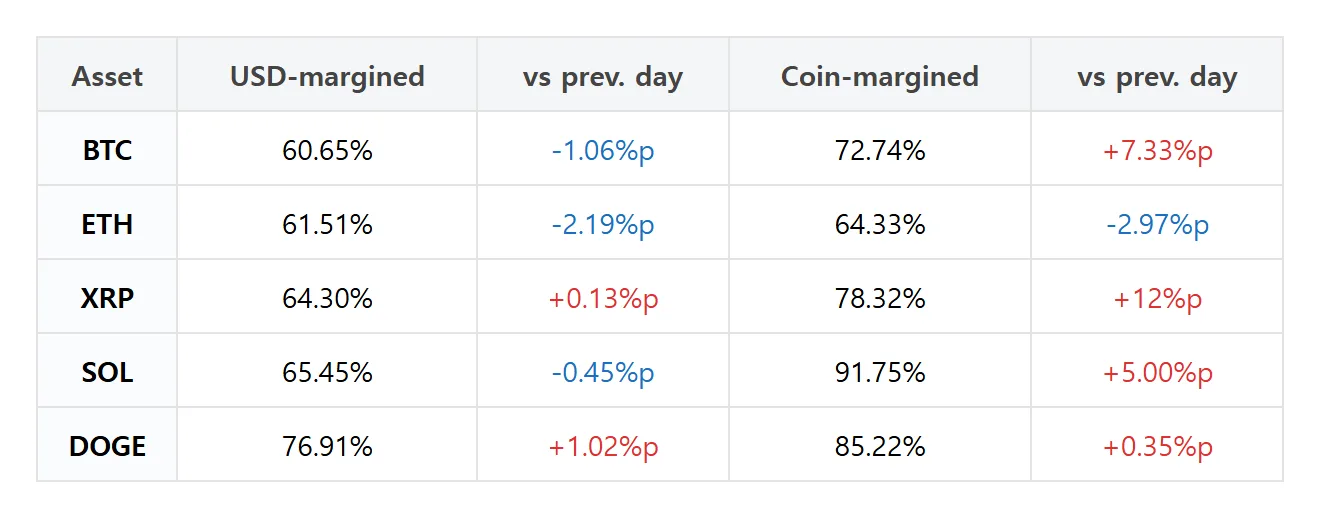
On Oct. 11, XRP’s coin-margin long share stood at 78.32%, up 12 percentage points from the previous day. Bitcoin rose 7.33 percentage points to 72.74%, while Solana widened 5.00 percentage points to 91.75%. Ethereum moved the other way, falling 2.97 percentage points to 64.33%.
In USDT-margin positioning, Ethereum showed the clearest decline, down 2.19 percentage points to 61.51%. Bitcoin slipped 1.06 percentage points to 60.65%, while Dogecoin edged up 1.02 percentage points to 76.91%. XRP was little changed at 64.30%, up 0.13 percentage point.
Long-position account share
On an account basis, USDT-margin changes were all limited to less than 1 percentage point from the previous day. Solana rose 0.53 percentage point to 72.69%, and XRP added 0.49 percentage point to 73.73%. Bitcoin and Ethereum were broadly steady at 60.63% and 68.10%, down 0.04 and 0.18 percentage point, respectively.
In coin-margin accounts, Bitcoin showed the most notable move, rising 2.33 percentage points to 81.08%. Solana increased 1.34 percentage points to 85.10%, while XRP gained 1.31 percentage points to 85.03%. Dogecoin stayed near flat at 83.71%, down 0.21 percentage point.
Strongest long-position names
By position share, the top USDT-margin names were EPIC at 89.06%, OG at 88.55% and FORM at 87.97%. In coin-margin positioning, BCH led at 97.62%, followed by AAVE at 94.23% and SOL at 91.75%.
By account share, the strongest USDT-margin names were ESPORTS at 88.48%, GUA at 87.87% and STAR at 87.44%. In coin-margin accounts, ETC ranked first at 90.06%, followed by XLM at 89.87% and AVAX at 89.83%.
The figures track long-position concentration among top cryptocurrency futures traders across USDT-margin and coin-margin markets. USDT-margin contracts use stablecoin collateral, while coin-margin contracts use cryptocurrency collateral, making shifts between the two useful for reading how positioning differs by collateral type.