

 News
News  Coin Information
  About us
  Customer Service


 Add as a preferred source on Google

The White House under President Trump signaled growing confidence that a Bitcoin (BTC)-related market structure bill will move forward within April, a message that traders and institutions are reading as a potential inflection point for U.S. crypto regulation. The comments, shared by journalist Pete Rizzo on X, framed the legislation as a near-term step toward long-awaited regulatory clarity for digital asset markets.
While the White House did not publish detailed legislative text alongside the remarks, the emphasis on market structure—typically covering definitions of digital assets, oversight boundaries between U.S. regulators, and rules for trading venues and custody—has become central to Washington’s effort to standardize how crypto is regulated. For market participants, clearer lines on issues such as exchange registration, token classification, and compliance obligations could influence liquidity conditions and the pace of institutional adoption.
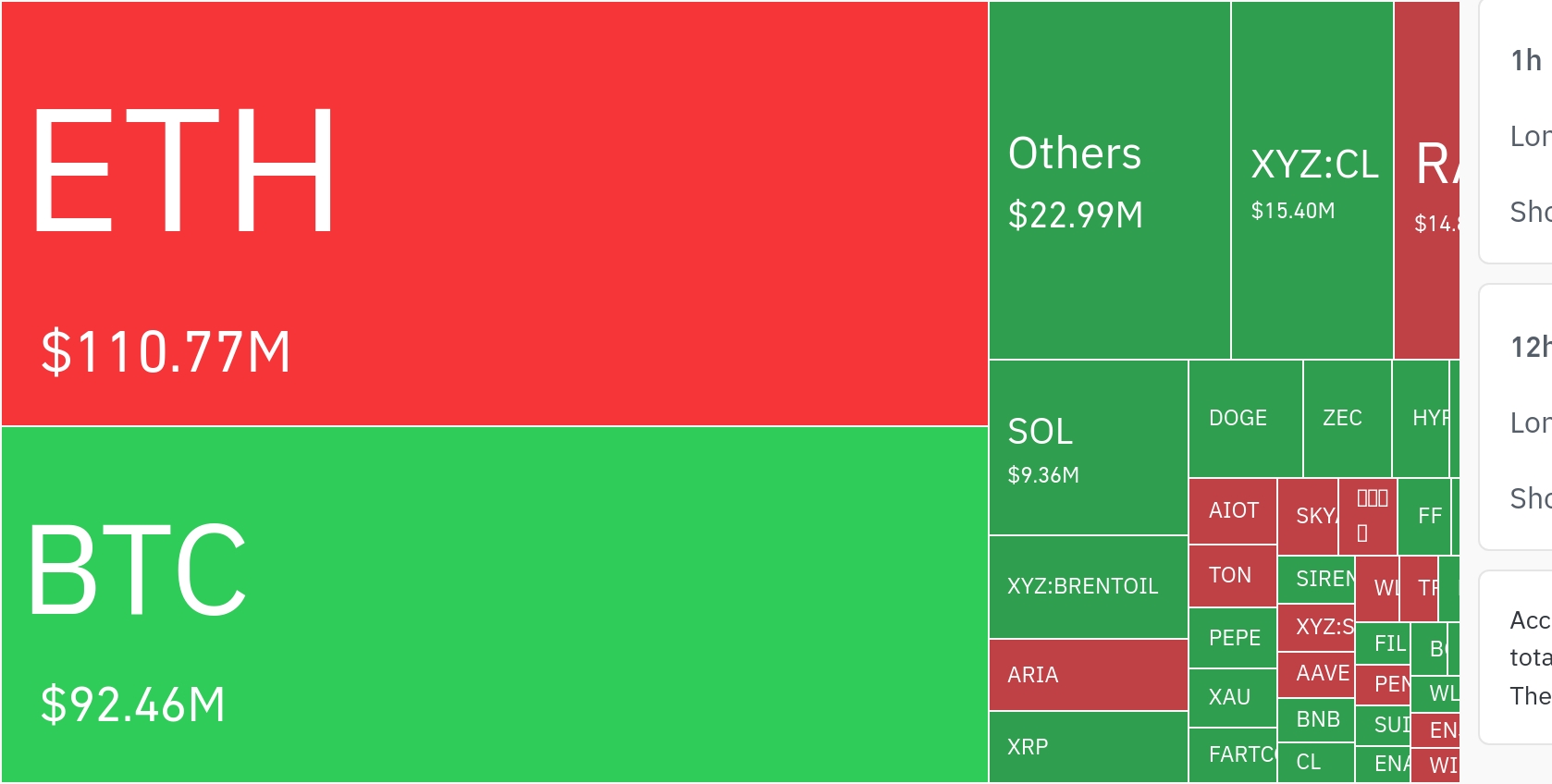
Macro headlines, however, continued to compete with policy optimism. On-chain analytics platform Onchain Lens said volatility rose after renewed U.S.-Iran talks failed to produce a breakthrough, keeping geopolitical risk elevated. A large whale address identified as ‘0x9e8’ reportedly reduced most of an existing 20x leveraged long position in silver and opened a new 20x leveraged long in crude oil futures (CL), totaling 95,577 contracts and roughly $9 million in notional exposure over a five-hour window—an example of how some large accounts are rotating into commodity-linked bets as conflict-related risks reprice.
The third round of U.S.-Iran talks ended without agreement on three core issues—control of the Strait of Hormuz, unfreezing overseas assets, and uranium enrichment—according to regional coverage cited by PANews. The meeting was reported to have taken place on April 12 in Islamabad (April 12 ET), with Iran describing the negotiations as a last opportunity to reach a basic framework. Separate reporting amplified the market’s focus on energy logistics, with Watcher.Guru stating on X that Saudi Arabia’s East–West pipeline has been fully restored, enabling up to 7 million barrels per day of crude transport that bypasses the Strait of Hormuz.
President Trump added to the risk backdrop with remarks indicating that a maritime blockade could be a ‘trump card’ if Iran does not back down, according to a post cited by Odaily from Trump’s Truth Social account. The statement reinforced perceptions that geopolitics could remain a swing factor for risk assets, including crypto, where liquidity conditions often tighten during volatility spikes tied to global headlines.
In the digital asset industry, Bitcoin mining companies are reportedly preparing for profitability pressure ahead of the network’s fifth halving expected in 2028. Coverage cited by PANews said miners are revisiting operating models by selling part of their Bitcoin treasuries, cutting costs, and expanding into adjacent businesses such as AI compute and power infrastructure—strategies aimed at diversifying revenue as block rewards trend lower over time.
Institutional product development also continued. Digital asset financial services firm Tok-Edge was reported by PANews, citing Benzinga, to have launched a dedicated crypto hedge fund for institutional investors, with plans to raise $100 million in an initial funding round by 2026. The launch underscores a broader trend: even as price cycles remain volatile, service providers are building vehicles designed to meet institutional expectations around risk management, custody, and reporting.
In spot markets, Ethereum (ETH) remained well below its peak, with Odaily estimating the asset is down about 55% from its all-time high. ETH was last quoted around $2,212 on OKX, reflecting the continued gap between the market’s large-cap leaders and prior cycle highs, even as attention shifts between regulatory developments, macro risks, and sector-specific fundamentals.
Notable positioning updates from prominent crypto figures highlighted the same macro sensitivity. Odaily reported that Rune Christensen, co-founder of Sky (formerly MakerDAO), closed a 7x leveraged short position on the Nasdaq 100 roughly 16 hours earlier and currently holds long exposure totaling about $518,000, including leveraged longs in WTI crude (CL) and Brent crude—another sign that some market participants are actively expressing views through cross-asset trades rather than crypto pairs alone.
Looking further out, Chainalysis projected in a new report that inflation-adjusted real-economy transaction volumes in stablecoins could rise from $28 trillion in 2025 to $719 trillion by 2035. The forecast, while highly sensitive to regulation and adoption assumptions, reinforces why U.S. market structure legislation is being closely watched: clearer rules around payments, reserves, and intermediaries could shape whether stablecoins become a mainstream settlement layer or remain constrained by regulatory fragmentation.
For now, the market is balancing two powerful narratives—near-term policy momentum in Washington and persistent geopolitical and macro volatility—both of which can quickly alter liquidity, leverage, and risk appetite across crypto assets.




















Comment 0