
US Senate Advances CLARITY Act as Korea Crypto Market Faces Transparency Gaps
The U.S. Senate Banking Committee advanced the CLARITY Act to define crypto oversight, as South Korea faces growing transparency and market structure concerns amid rising retail participation.

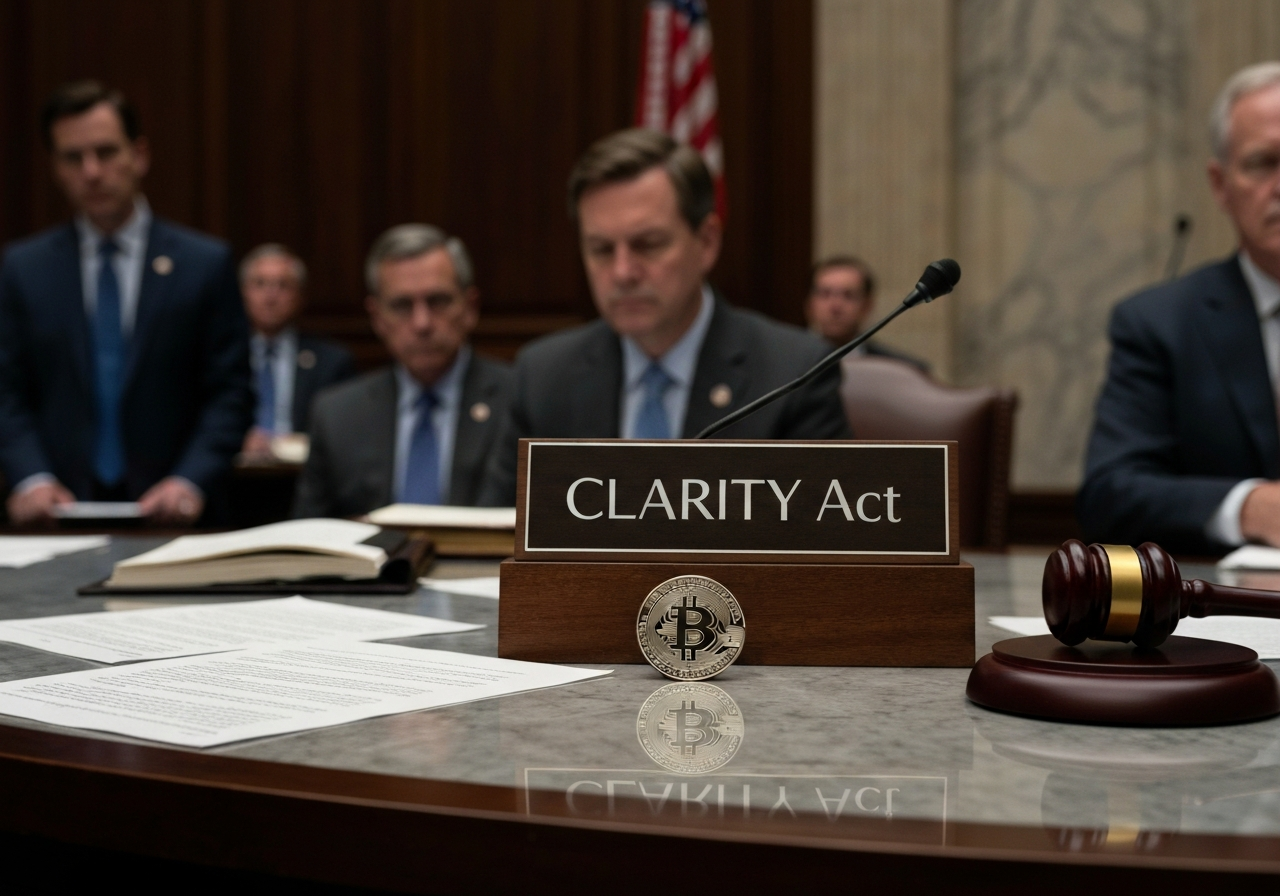
The U.S. Senate Banking Committee has advanced a sweeping digital asset market structure proposal—the CLARITY Act—signaling that America’s crypto regulatory debate is no longer rhetoric but legislation in motion. For South Korea, one of the world’s most active retail-driven crypto markets, the bill’s core message is not whether regulation is ‘pro-crypto’ or ‘anti-crypto,’ but whether it delivers ‘clarity’—and what happens when a market grows without it.
In a 15–9 vote, the committee approved the CLARITY Act with unified Republican support and backing from Democratic senators Ruben Gallego and Angela Alsobrooks, sending the measure toward the full Senate despite opposition from more hawkish lawmakers including Elizabeth Warren. The bill is designed to formalize how digital assets are classified—particularly the dividing line between ‘securities’ and ‘commodities’—and to define where the U.S. Securities and Exchange Commission and the Commodity Futures Trading Commission each hold authority. It also aims to set explicit responsibilities for exchanges, brokers, custodians, and parts of decentralized finance (DeFi), moving U.S. crypto oversight away from regulation-by-enforcement toward a statutory framework.
That distinction matters because ‘clarity’ is not a concession to the industry; it is the starting point for accountability. When projects sit outside enforceable rules, weak issuers, market manipulators, and cross-border illicit flows can exploit gray zones. When they are pulled inside a legal perimeter, they face concrete obligations—registration, disclosure, segregation of customer assets, and anti-money laundering compliance. The U.S. message, in effect, is pragmatic: if crypto cannot be eliminated, it must be governed.
South Korea has taken a first step, but the gap between market scale and market structure is widening. The Virtual Asset User Protection Act, implemented in July 2024, strengthened protections for client assets, banned unfair trading practices, and expanded supervisory authority for financial regulators. Yet the law largely focuses on reducing harm after trading occurs. It leaves major structural questions unresolved—issuance rules, listing standards, mandatory disclosures, circulating supply controls, foundation accountability, stablecoins, and DeFi.
That unresolved framework is increasingly difficult to justify in a country whose crypto participation rivals global hubs. According to a joint survey by the Financial Services Commission and the Financial Supervisory Service, South Korea had 11.13 million domestic exchange-eligible user accounts by the end of 2025, with approximately 8.1 trillion won in fiat deposits. Over the same period, average daily trading volume fell to around 5.4 trillion won, while exchange operating profit declined 38% to roughly 380.7 billion won. Total market capitalization stood near 87.2 trillion won. The headline takeaway is uncomfortable: user counts are rising, but market ‘stamina’—liquidity quality, profitability, and resilience—appears to be weakening.
The more alarming problem is transparency. TokenPost’s “TOKEN KOREA WATCH” initiative reviewed projects listed on South Korea’s five major won-based exchanges and found 637 listed tokens across the venues—yet only 32 were listed on all five. When researchers contacted projects through official websites, public channels, and email from the perspective of an ordinary investor, only 51 projects responded, about 8%. More than 140 projects reportedly did not even provide an email address.
This is not merely a marketing lapse. In traditional finance, a market where investors cannot reliably contact an issuer would be considered structurally broken. The implication is that a large share of listed tokens function in practice as ‘unreachable’ assets—trading instruments without accessible accountability. In such an environment, projects can disappear socially before they disappear legally, and investors tend to learn last.
The stakes are amplified by South Korea’s distinctive trading profile. TokenPost estimates the country’s weekly crypto trading volume at about $26 billion—roughly 30% of global volume—while domestic retail portfolios are overwhelmingly tilted toward altcoins. The report puts altcoin activity at 85% versus 9% for Bitcoin (BTC) and 6% for Ethereum (ETH), making South Korea one of the most aggressive altcoin trading markets globally. At the same time, around 40% of those altcoins are said to be trading near all-time lows, increasing delisting pressure and highlighting the downside of a market built on rapid rotation into higher-risk tokens.
Delistings are already accelerating. In the second half of 2025, won-market trading suspensions totaled 54 cases, up 50% from the previous half-year, with ‘project risk’ cited most frequently. That category includes business continuity concerns and situations where exchanges or stakeholders lose contact with a project’s foundation or core team. From that angle, widespread ‘no-response’ behavior is not incidental—it is often a precursor to removal.
The policy prescription now being urged by local commentators is a second-stage framework akin to a Korean digital asset ‘market structure law.’ The broad contours include codifying categories such as security-like tokens, payment-oriented tokens, commodity-like tokens, and utility tokens; imposing legally binding disclosures on issuers and foundations rather than relying on voluntary whitepapers; and requiring listed projects to maintain investor-accessible communication channels, provide Korean-language updates, and disclose data central to price integrity—circulating supply changes, lockup schedules, foundation holdings, key personnel, and jurisdictional footprint.
Responsibility would also fall more explicitly on exchanges. Listing is not merely a neutral act of intermediation; it is a commercial decision that signals credibility to retail investors. Critics argue that exchanges should not be able to monetize fees and volume during bullish periods only to retreat behind “we only brokered trades” when a project becomes unreachable. A stricter framework would formalize listing reviews, delisting standards, supply monitoring, and ongoing verification that a project remains contactable. Under that model, persistent ‘no-response’ projects would face warnings and, if silence continues, removal.
Stablecoins sit at the center of the sovereignty debate. Advocates of stronger rules argue that stablecoins are not simply speculative tokens but payment rails, and that allowing them to grow without standards for reserves, redemption rights, audits, banking connectivity, and foreign-exchange oversight could create a channel for financial instability. Yet blocking stablecoins without offering a compliant path risks ceding digital payment infrastructure to dollar-based stablecoins—turning a regulatory delay into a strategic disadvantage for the won in an increasingly tokenized payment environment.
DeFi regulation is also framed as a question of ‘control’ rather than code. The argument is that software developers should not automatically be treated as regulated entities, but actors who collect fees, retain operational authority, and effectively control user-asset flows should not be shielded indefinitely behind a decentralization narrative. Proponents say that this principle aligns with the CLARITY Act’s reported emphasis on oversight tied to effective control.
While lawmakers debate, private-sector initiatives are moving to fill the vacuum. TOKEN KOREA WATCH positions responsiveness itself as an investor-relevant signal—documenting whether teams exist, communicate, and maintain functioning official channels, while also recording silence as data. TokenPost and partners are also promoting a draft set of voluntary disclosure standards covering 12 categories, including token supply schedules, lockups, insider holdings, market-making arrangements, distribution structure, corporate or foundation jurisdiction, financial information, key personnel, and official communication channels.
Even supporters of self-regulation, however, describe its limitations as structural: voluntary standards primarily constrain the conscientious. Projects that intend to disappear, obscure supply changes, or liquidate insider allocations can ignore voluntary frameworks with few consequences. That is why many observers argue for a three-step model: private actors define baseline disclosure norms, exchanges embed them into listing and monitoring, and regulators convert core requirements into legal obligations.
The longer-term outcome, they warn, hinges on decisions made now. With clearer rules, South Korea could plausibly foster won-based stablecoins, tokenized securities, tokenization tied to K-content intellectual property, game and entertainment point economies, and AI agent payment infrastructure—all under domestic compliance. Without such rules, higher-quality projects may continue migrating to jurisdictions viewed as more predictable, including the U.S., Singapore, Hong Kong, and Japan, leaving South Korea with a churn-heavy market characterized by short-term trading, delisting anxiety, unreachable foundations, and repeated retail losses.
At the center of the debate is a simple contention: a market cannot demand trust without enforceable transparency. The CLARITY Act is an American bill, but the principle embedded in its name—‘clarity’ as the foundation of accountability—has become a growing refrain in Seoul as well. For a market where projects can be listed without even a working email address, the question is no longer whether new rules are desirable, but whether the system can remain credible without them.