
Stablecoins Framed as Core Financial Infrastructure as Volumes Surpass Card Networks
A new book by Jae-hyun Park and Ji-su Park argues stablecoins are emerging as core financial infrastructure as payment volumes surpass Visa and Mastercard, reshaping global finance and policy debates.

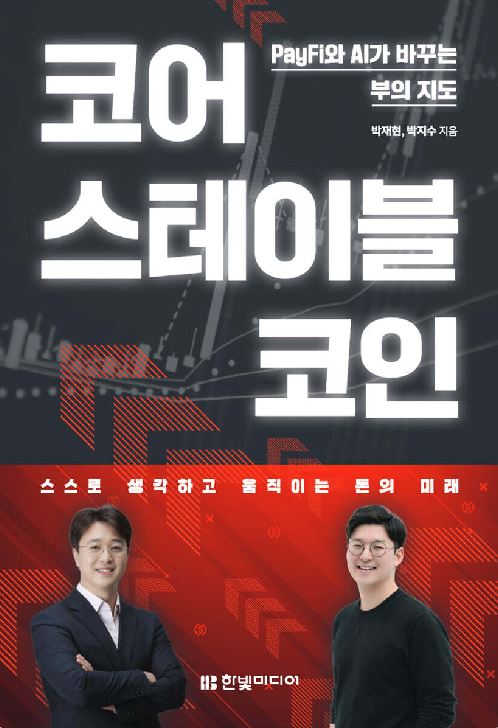
A new Korean-language book is arguing that stablecoins should be understood less as a subset of crypto assets and more as a foundational 'financial operating system'—a shift in framing that comes as global payment volumes routed through stablecoins surge past familiar card networks.
Core Stablecoin — The Wealth Map Changed by PayFi and AI, co-authored by Jae-hyun Park (a former Samsung Electronics executive who led key development for Samsung Pay) and Ji-su Park, CEO of Sooho.io (who participated in early development of Upbit), is scheduled for release in late May across major Korean retailers including Kyobo Book Centre, YES24, and Aladin. The authors position stablecoins not as speculative tokens but as a 'core layer' that unifies money, payments, settlement, and credit—an infrastructure thesis they say is already being validated by real-world throughput in 2026.
Using the claim that annual stablecoin payment processing has already exceeded Visa and Mastercard as a starting point, the book builds its analysis around four questions: why governments and central banks remain wary of stablecoins; whether banks will disappear or evolve; what a Korean won (KRW) stablecoin could structurally change in Korea’s financial system; and how an 'AI agent' economy could reshape monetary architecture. Rather than treating these as abstract debates, the authors argue they determine who controls the rails of digital commerce in the next cycle of financial modernization.
One of the book’s defining ambitions is to function as a 'blueprint' rather than an investing guide or a technical primer. It explicitly grounds its KRW stablecoin design discussion in Korea’s regulatory environment—citing constraints such as the Act on Reporting and Using Specified Financial Transaction Information (often referred to as the 'Specific Financial Information Act'), network separation requirements, and the realities of bank-linked payment structures. The book even includes Solidity example code and architecture considerations intended to be usable at the implementation stage, suggesting it targets builders and policymakers as much as it does crypto-native readers.
It also connects the emerging concept of PayFi—payments integrated directly into programmable finance—to autonomous payment flows run by AI agents, mapping how machine-driven commerce could require new approaches to identity, wallets, and liability. In that context, the authors introduce the idea of entities that possess wallets, capital allocation authority, and responsibility frameworks—what they describe as 'algorithmic corporations'—raising legal and institutional questions that policy circles are only beginning to confront.
From a markets perspective, the book places stablecoins within a broader convergence between traditional finance and blockchain-based settlement. It examines why heavyweights such as BlackRock ($BLK) and JPMorgan Chase ($JPM) have pursued tokenized U.S. Treasury initiatives and how incumbent institutions may absorb stablecoins into existing capital-market plumbing rather than be displaced by them. The underlying argument is that stablecoins are increasingly being pulled into the 'settlement layer' of finance—where control tends to translate into long-term competitive advantage.
The authors distill their thesis into five propositions: stablecoins are not 'coins' but a unified core layer for money, payments, settlement, and credit; banks will not vanish but will evolve from physical institutions into infrastructure defined by code and trust; a KRW stablecoin could pose an existential challenge to domestic exchanges while also offering Korea a rare chance to become part of global financial infrastructure; the AI-agent economy will create new forms of autonomous economic actors; and regulation is ultimately a matter of 'design' rather than blanket prohibition.
Jae-hyun Park describes stablecoins as “not an extension of crypto, but a redesign of financial infrastructure,” while Ji-su Park calls a KRW stablecoin “a rare opportunity for Korea to secure digital currency sovereignty.” Their backgrounds reflect the book’s attempt to bridge mainstream payments and crypto rails: Jae-hyun Park is known in Korea for authoring the long-running 'Core series' of programming books and previously founded blockchain company Lambda256 after stints at Samsung and SK Telecom; Ji-su Park founded security firm Sooho.io, worked on a Bank of Korea CBDC digital voucher platform project, and now leads 'Project Namsan,' a digital asset payment and settlement initiative.
The book’s intended readership underscores its policy and infrastructure tilt: legislative and regulatory stakeholders shaping digital asset rules; venture capital and strategic investors seeking a structural view of tokenization, AI, and PayFi; planners at banks, fintech firms, and exchanges evaluating stablecoin adoption; and Web3 and AI founders building compliance-oriented payment systems and agent-driven finance. With Korea’s debate over formalizing KRW stablecoins gaining momentum, the authors frame a stark choice: treat stablecoins primarily as a risk to be contained, or as infrastructure to be deliberately engineered.