

 News
News  Coin Information
  About us
  Customer Service


 Add as a preferred source on Google
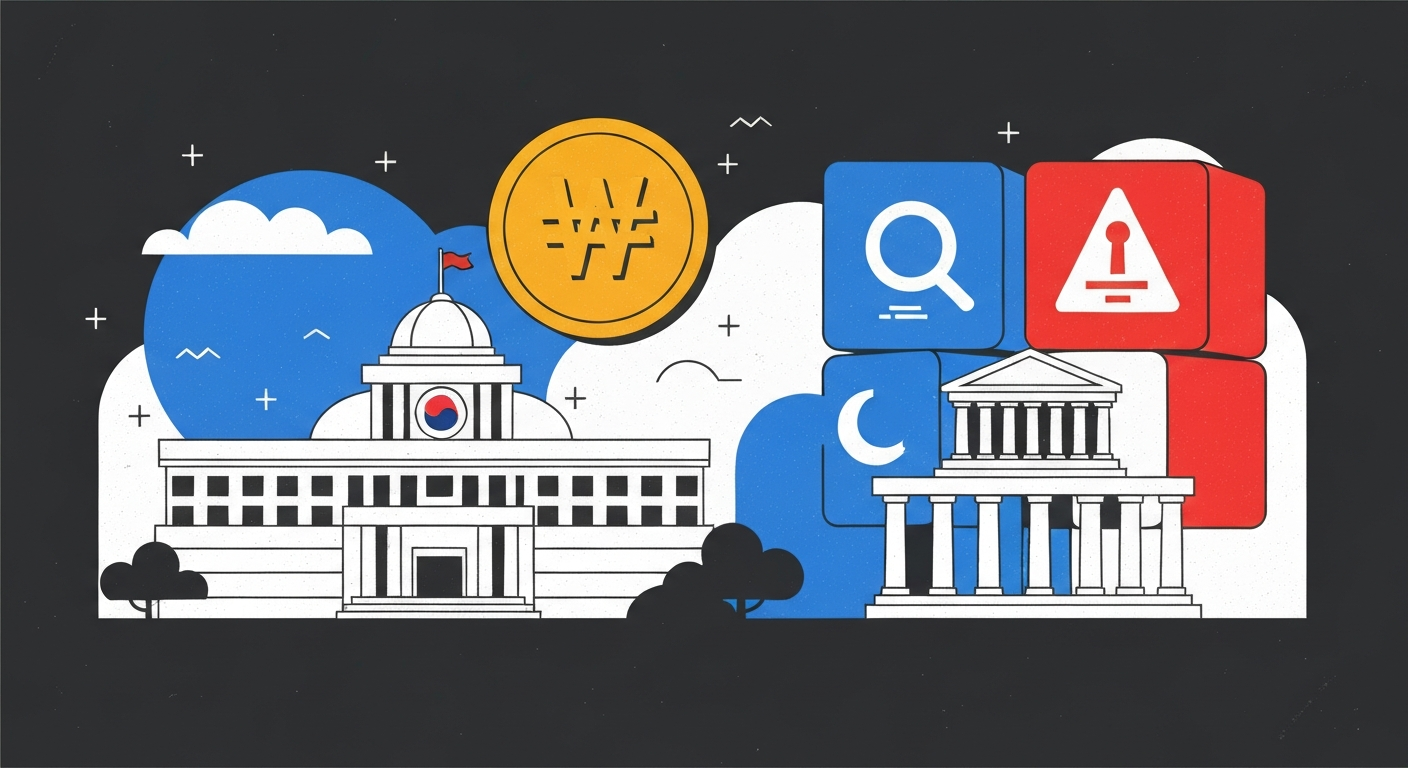
South Korea’s debate over a won-denominated stablecoin is increasingly converging on a less glamorous but more decisive question: not whether it can be issued, but whether it can be widely used. In a domestic crypto market where day-to-day on-chain settlement is already dominated by dollar-pegged tokens such as Tether (USDT) and USD Coin (USDC), the stakes are being framed less as a fintech experiment and more as a test of Korea’s 'monetary sovereignty' in the digital economy.
The won is the currency used daily by roughly 50 million people, yet the moment economic activity shifts onto blockchain rails, that familiarity fades. Even on Korean exchanges, stablecoin flows are overwhelmingly dollar-based, reflecting a global liquidity standard that has hardened over time: stablecoins have moved beyond speculative trading tools to become payment infrastructure for cross-border remittances, payroll processing, international commerce and on-chain markets’ 'cash bridge'. As capital increasingly travels through these rails, the currency denomination of settlement becomes a strategic variable. If the dollar becomes the default unit for digital transactions, Korea risks a scenario in which domestic digital commerce is settled in a foreign currency by default—an outcome with implications for policy autonomy, payment resilience and the structure of the financial system.
That has led to a straightforward-sounding prescription: issue a won stablecoin. But industry and policy discussions are increasingly acknowledging that issuance itself is rarely the hard part. The real challenge is distribution—getting consumers to hold the token, merchants to accept it, exchanges to list it with deep liquidity, and institutions to integrate it into treasury, settlement and collateral workflows. In practice, 'circulation' creates liquidity, and liquidity drives adoption; without that feedback loop, even well-capitalized stablecoin projects can fail to achieve meaningful usage.
Against that backdrop, lawmakers in Seoul are weighing a framework that would initially prioritize stablecoin issuance by consortia in which banks hold a controlling stake—often described as 50% plus one share. The approach is widely seen as an attempt to balance innovation with the Bank of Korea’s emphasis on stability, governance and risk controls. Yet the more consequential feature emerging from the debate is the composition of would-be issuers: the leading contenders are being designed not merely as minting entities, but as 'distribution alliances' that combine banking infrastructure with mass-market platforms and high-velocity crypto venues.
Several ecosystem-building efforts are already being discussed in the market. Hana Financial Group is associated with a broader integration narrative after its reported 1 trillion won stake purchase in Dunamu, the operator of Upbit—an axis that could, in theory, connect banking foreign-exchange rails, a top exchange and large-scale consumer services such as Naver Pay and commerce. Elsewhere, KB Financial Group has been linked to cooperation discussions involving Toss and Bithumb, while Shinhan is said to be exploring ties with Samsung’s financial affiliates. Woori and NongHyup have also been mentioned in connection with potential collaboration involving Kakao’s platforms. The logic is clear: banks bring deposits, compliance frameworks and payments/FX infrastructure; platforms and exchanges bring tens of millions of users and high-frequency transaction environments. If distribution is the core bottleneck, these alliances attempt to start with distribution already built in.
Still, two risks stand out. The first is time. Every month of legislative uncertainty and industry fragmentation gives dollar stablecoins more room to deepen their presence and network effects in Korea’s on-chain economy. Once a settlement standard becomes entrenched—especially in markets dependent on global liquidity—dislodging it can be expensive and slow. In that sense, the policy window for reinforcing won-based rails may be narrower than it appears.
The second is the possibility of a stablecoin that technically exists but is not meaningfully used. If banks focus primarily on risk containment and restrict circulation to narrow channels—effectively pushing deposits and withdrawals onto exchanges while keeping the token peripheral to mainstream payment apps and real-world commerce—accessibility could remain limited. In that scenario, a won stablecoin would function more like a ledger entry than a living medium of exchange, offering little practical defense of monetary autonomy. Critics also warn that if issuance eligibility is drawn too narrowly in the name of trust, it could choke off innovation and delay experimentation with new settlement models.
For policymakers, the implication is that legislation should be completed quickly—but designed around making the won stablecoin a 'usable currency', not simply an approved product. The strongest case for adoption lies in tangible use cases that outperform legacy rails: seconds-long cross-border settlement, 24/7 corporate cash management, and collateral transfers unconstrained by banking hours. Only if those functions work at scale—across consumer apps, merchant networks, trading venues and institutional workflows—can a won stablecoin credibly compete in the emerging on-chain currency order. Issuance without distribution, by contrast, would do little to change the reality that dollar stablecoins already underpin much of Korea’s digital transaction layer.










Comment 0