
 Add as a preferred source on Google
South Korea’s DAXA Warns of Phishing Sites Impersonating Crypto Exchanges
DAXA warned that phishing sites mimicking South Korean crypto exchanges are spreading via social media ads, urging users to avoid fake links and unauthorized software downloads.

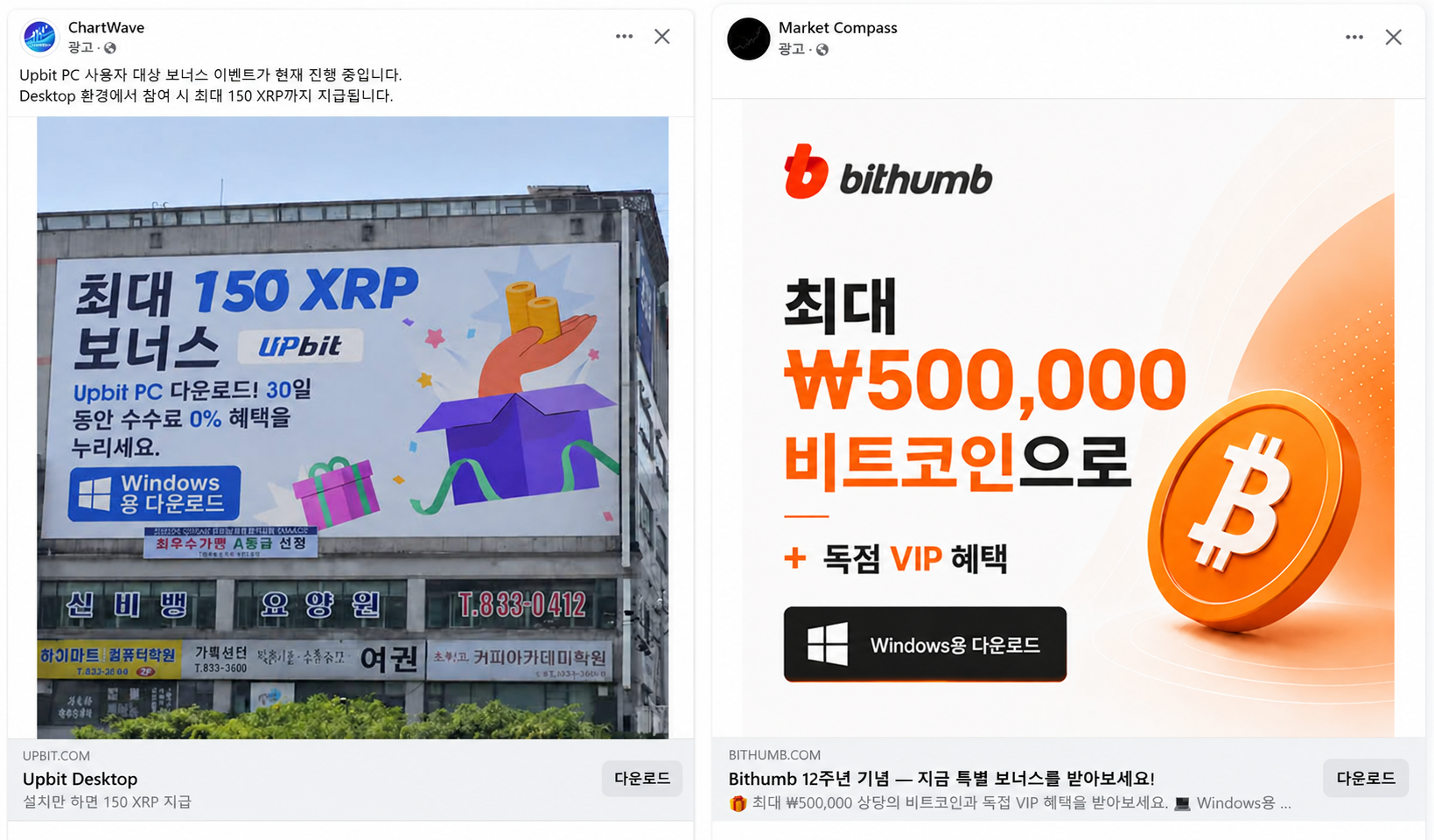
The Digital Asset eXchange Alliance (DAXA) warned on Wednesday ET that phishing sites impersonating South Korea’s won-based crypto exchanges are being circulated through social media ads, urging users to avoid clicking promotional links and to verify access points through official channels.
DAXA, an industry consultative body representing major domestic exchanges that support Korean won trading pairs, said it recently identified cases in which advertisements on platforms such as Facebook redirect users to websites designed to closely resemble legitimate exchange pages. The fake sites then attempt to lure visitors into installing a supposed “PC-only program,” promoting claims such as ‘zero trading fees’ or ‘special events’ available only through the dedicated desktop software.
The organization emphasized that South Korea’s won-based exchanges do not currently provide separate installable desktop trading applications. As a result, any prompt directing users to download a “desktop app” is highly likely to be a phishing attempt or a conduit for distributing malware, DAXA said.
According to DAXA, installing such software can expose users to theft of login credentials, personal data, and authentication information. In more severe scenarios, the malicious program may enable remote access features, potentially allowing attackers to drain ‘virtual assets’ and other financial holdings linked to compromised accounts.
DAXA urged users to follow several basic safeguards: access exchanges via their official websites rather than through social media ads; stop immediately if an installation is requested; be skeptical of promotions advertising unusually generous benefits such as ‘free trading fees’; avoid downloading files from unknown sources, including executable formats such as APK or EXE; and report suspected sites promptly to the relevant exchange’s customer service team or to appropriate authorities.
Kim Jae-jin, executive vice chairman of DAXA, said impersonation tactics are becoming more sophisticated. “The methods are becoming increasingly subtle and elaborate, meaning anyone can become a victim,” he said, adding that users should be especially vigilant when a site attempts to steer them toward installing a PC program.
DAXA said it will continue coordinating with member exchanges to monitor phishing sites and malware distribution aimed at crypto users, and plans to strengthen public guidance to reduce the risk of consumer losses as attackers increasingly rely on paid ads and polished interfaces to build credibility.
Article Summary by TokenPost.ai
🔎 Market Interpretation
Rising social-engineering risk in Korea’s crypto on-ramps: Phishing campaigns are targeting users of South Korea’s KRW-based exchanges via paid social ads, indicating attackers are prioritizing high-liquidity retail entry points.
Shift from crude scams to “ad-driven credibility”: Use of Facebook-style promotions and polished lookalike sites suggests a move toward more professionalized fraud funnels designed to bypass user skepticism.
Malware distribution disguised as trading tools: The “PC-only program” pitch is positioned as a conversion step to install malicious software, expanding the attack from credential theft to device-level compromise and broader financial loss.
Industry-led consumer protection signaling: DAXA’s public warning functions as a coordinated trust-and-safety response, aiming to reduce incident volume and reputational damage for member exchanges.
💡 Strategic Points
Golden rule for access: Enter exchanges through official URLs or bookmarked links—avoid clicking exchange links in social media ads or promotional posts.
Immediate red flag: KRW-based exchanges do not provide separate installable desktop trading apps; any page requesting a “desktop app/PC-only program” download is highly likely to be phishing or malware delivery.
Promotion skepticism checklist: Treat “zero trading fees,” “exclusive PC events,” or unusually generous benefits as high-risk bait—verify offers directly on the official site/app announcements.
File-type awareness: Do not download unknown executables (e.g., EXE) or app packages (e.g., APK) from promotional pages—these are common malware formats.
Account-compromise impact: Installed malware can steal IDs/passwords, personal data, and 2FA/authentication info; advanced variants may enable remote control and facilitate withdrawal of crypto and linked financial assets.
Incident response steps: Stop the process if an install prompt appears, close the page, run security scans, change passwords from a clean device, review withdrawal/API settings, and report the site to the exchange’s customer service and relevant authorities.
What to watch for next: Expect more paid-ad impersonation, domain lookalikes, and “download to continue” gates; users should anticipate tighter verification prompts and expanded public guidance from exchanges/DAXA.
📘 Glossary
DAXA (Digital Asset eXchange Alliance): A consultative industry body representing major South Korean crypto exchanges that support KRW trading pairs, coordinating standards and user protection efforts.
KRW-based (won-based) exchange: A crypto exchange offering trading and deposits/withdrawals in South Korean won (KRW), commonly used as the primary fiat on-ramp for local users.
Phishing site: A fake website designed to mimic a legitimate service to trick users into revealing credentials or sensitive information.
Impersonation (lookalike) website: A clone of an official exchange page using similar branding/UI and often similar domain names to appear authentic.
Malware: Malicious software installed to steal data, spy on activity, or gain unauthorized access to systems and accounts.
Social media ad redirect: A paid advertisement link that forwards users to an external site; attackers use this to funnel victims to phishing pages.
EXE / APK: Common executable file formats for Windows (EXE) and Android apps (APK); frequently abused to distribute malicious programs.
Remote access (RAT-like behavior): Functionality that lets an attacker control a victim’s device, potentially enabling withdrawals or theft of assets.