

 News
News  Coin Information
  About us
  Customer Service


 Add as a preferred source on Google
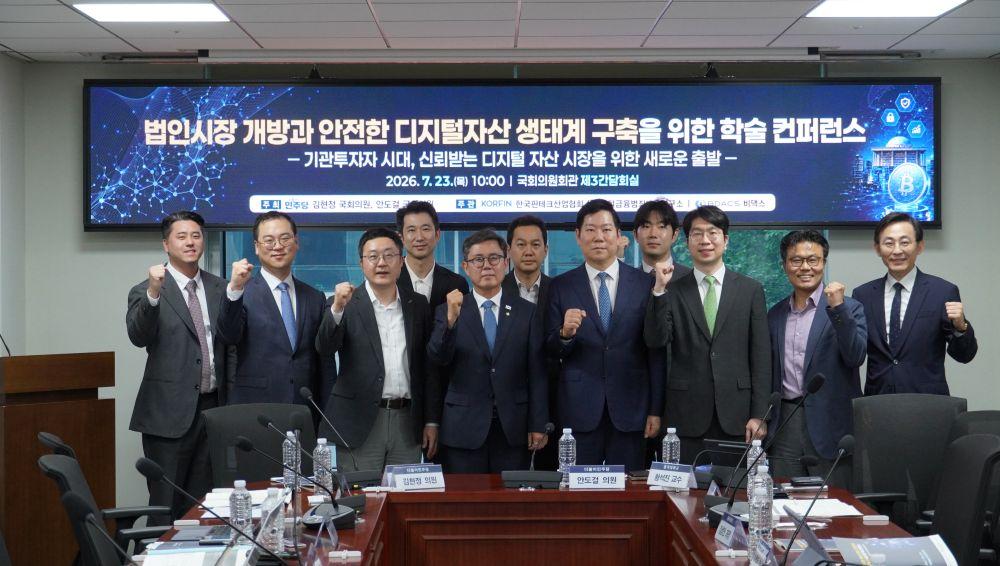
South Korea’s fintech industry and policymakers are accelerating efforts to prepare the country’s digital asset market for broader corporate participation, with a renewed focus on ‘custody infrastructure’ and strict internal controls as prerequisites for safer institutional adoption.
The Korea Fintech Industry Association (KORFIN, chaired by Jong-hyun Kim, CEO of KUKON) held a National Assembly seminar on Thursday, July 23 (ET) at the National Assembly Members’ Office Building in Seoul, under the theme “Opening the Corporate Market and Building a Safe Digital Asset Ecosystem.” The session was co-hosted by Democratic Party lawmakers Hyun-jung Kim and Do-geol Ahn, and co-organized by KORFIN, the Digital Finance Crime Response Research Institute, and BDACS.
The seminar comes as South Korea moves toward a phase in which companies and institutions are expected to take a larger role in crypto markets—an evolution that industry participants say could deepen liquidity while raising the bar for operational resilience. 참석자들은 금융당국, 금융권, 법조계, 학계, 업계 관계자들이 한자리에 모여, 법인 시장 개방의 의미와 함께 ‘어떻게 안전하게 열 것인가’라는 질문에 정책적·실무적 해법을 모색했다.
In opening remarks, Rep. Hyun-jung Kim argued that market access alone is insufficient without safeguards that meet global standards. “Now that corporate participation is becoming a reality, the key is how to open the market safely,” she said, pointing to recurring risks such as hacks and weak internal controls. She added that building internationally aligned custody systems is a necessary condition for credible market expansion and pledged support for swift progress on the second phase of legislation tied to South Korea’s broader digital asset framework, often discussed under the banner of a ‘Basic Digital Asset Act’ roadmap.
Rep. Do-geol Ahn underscored the potential macro benefits of bringing institutions and corporates into the market, suggesting their involvement could encourage longer-term and diversified allocations. He said improved transparency in managing reserve assets, robust security systems at international standards, and clear legal accountability would be critical for digital assets to emerge as a new growth engine for the country.
Jong-hyun Kim, chair of KORFIN, framed corporate participation as an opportunity for the financial sector and the domestic digital asset industry to grow in tandem. He said the association plans to promote collaboration across market participants and to strengthen policy communication to help South Korea’s digital asset industry build ‘global competitiveness.’
The event was structured into two sessions: “The significance of opening the corporate digital asset market and the role of custody,” and “Building trust infrastructure in the era of institutional investors.”
In the first session, BDACS CEO Hong-yeol Ryu described corporate entry into digital assets as a ‘turning point’ in market maturation, arguing that a credible, independent custody model should be foundational. Ryu pointed to high-profile global failures such as FTX and Mt. Gox, saying they exposed structural weaknesses when trading and asset safekeeping are not effectively separated. For institutionally scaled capital to enter more reliably, he said, the market needs trusted and independent custodians that can provide segregated storage, operational controls, and transparent risk management.
The second session featured Kyobo Securities executive director Hee-jin Shin, who presented a phased approach for institutional readiness in South Korea. Shin said the country is in a transition period toward an institutional-investor era and warned that simply allowing market access does not establish trust. Instead, she argued, the framework must cover the full lifecycle of participation—from investment decision processes and asset custody standards to incident response and clearly defined liability in the event of losses or operational failures.
A panel discussion, co-chaired by professor Seok-jin Hwang of Dongguk University and professor Jong-seob Lee of Seoul National University, brought together representatives from regulators, research institutions, legal firms, and industry. Panelists included Seong-jin Kim, director at the Financial Services Commission; Tae-ho Jeong, senior officer at the Korea Financial Intelligence Unit; Jeong-doo Lee, senior researcher at the Korea Institute of Finance; attorney Jae-bin Cho of Barun Law; attorney Sang-jin Cha of BECOM Law Office; Chun Ryu, vice president at Hectowalletone; and Myung-hoon Lee, CEO of Parataxis Ethereum. The discussion centered on what ‘trust infrastructure’ should look like in practice—spanning custody supervision, corporate governance requirements, compliance obligations, and a clearer allocation of responsibility among service providers and participants.
While participants broadly agreed that corporate participation could improve market liquidity and stability, the seminar’s key message was that those benefits depend on the quality of market plumbing. Across sessions, speakers converged on the need to strengthen ‘custody infrastructure,’ formalize corporate internal control systems, and establish unambiguous accountability structures to reduce operational and legal uncertainty.
KORFIN said it will continue discussions with the National Assembly, financial authorities, traditional financial institutions, and digital asset companies as South Korea shapes rules for a safer and more reliable digital asset ecosystem—an agenda likely to grow more pressing as domestic institutions seek compliant pathways into the market.
🔎 Market Interpretation
- South Korea is shifting from retail-led crypto activity toward an institution-ready market, emphasizing that corporate participation must be paired with globally aligned safeguards rather than simple market access.
- Custody is positioned as core market infrastructure (“market plumbing”): independent safekeeping, segregation of assets, and auditable controls are framed as prerequisites for credible inflows of institutional capital.
- Regulatory momentum is building via National Assembly engagement and references to a second-stage legislative roadmap often discussed under a “Basic Digital Asset Act,” signaling continued rulemaking for corporate entry.
- Systemic risk lessons from global failures (e.g., FTX, Mt. Gox) are being used to justify stricter governance, the separation of trading and custody, and clearer liability structures.
- Expected market impact: participants see corporate involvement as potentially improving liquidity and stability, but only if operational resilience and accountability reduce hacking/operational-loss concerns.
💡 Strategic Points
- Prioritize independent custody models: separate custody from exchange/broker functions; require segregated accounts, clear asset ownership records, and strong key-management practices.
- Implement institutional-grade internal controls for corporates entering digital assets: investment committee governance, authorization matrices, dual-control approvals, and operational risk policies.
- Define end-to-end participation standards: cover the full lifecycle—investment decisioning, onboarding/KYC/AML, custody standards, reporting, incident response, and post-incident remediation.
- Clarify legal accountability and liability allocation: specify responsibilities among custodians, exchanges, brokers, issuers, and corporate clients to reduce uncertainty during losses, hacks, or operational failures.
- Strengthen compliance and supervision: align with global expectations on audits, SOC/ISMS-style security assurance, travel rule/AML monitoring, and supervisory reporting for custody providers.
- Adopt phased rollout for institutional access: start with tightly governed products/participants, expand permissions as custody supervision, incident playbooks, and transparency benchmarks mature.
- Build trust infrastructure through multi-stakeholder coordination: ongoing dialogue among National Assembly, FSC/FIU, banks/securities firms, and digital-asset firms to prevent fragmented standards.
📘 Glossary
- Custody (Digital Asset Custody): The safekeeping and administration of clients’ digital assets, including private key management, withdrawal controls, and asset reporting.
- Independent Custodian: A custody provider structurally separated from trading venues to reduce conflicts of interest and commingling risk.
- Segregated Storage: Keeping each client’s assets separated (on-chain and/or in records) to improve ownership clarity and reduce loss/commingling risk.
- Internal Controls: Corporate governance and process safeguards (approvals, audits, access management) designed to prevent fraud, errors, and unauthorized transactions.
- Trust Infrastructure: The combined framework of custody, supervision, compliance, governance, audits, and legal accountability that enables institutions to participate safely.
- Incident Response: Procedures for detecting, containing, investigating, and reporting security events (e.g., hacks, key compromise) and restoring operations.
- Liability Allocation: Clear assignment of legal responsibility among parties (custodian, exchange, corporate client, service providers) when losses or failures occur.
- Basic Digital Asset Act (Roadmap): A commonly referenced term for Korea’s evolving legislative framework aiming to formalize digital asset rules in phases.













Comment 0