
Full U.S. Production of 10 Consumer Tech Categories Could Cost Up to $230 Billion
Domestic production across 10 technology categories could require 668,000 workers, 19.5 billion kilowatt-hours of annual electricity and raise average retail prices by up to 55%.

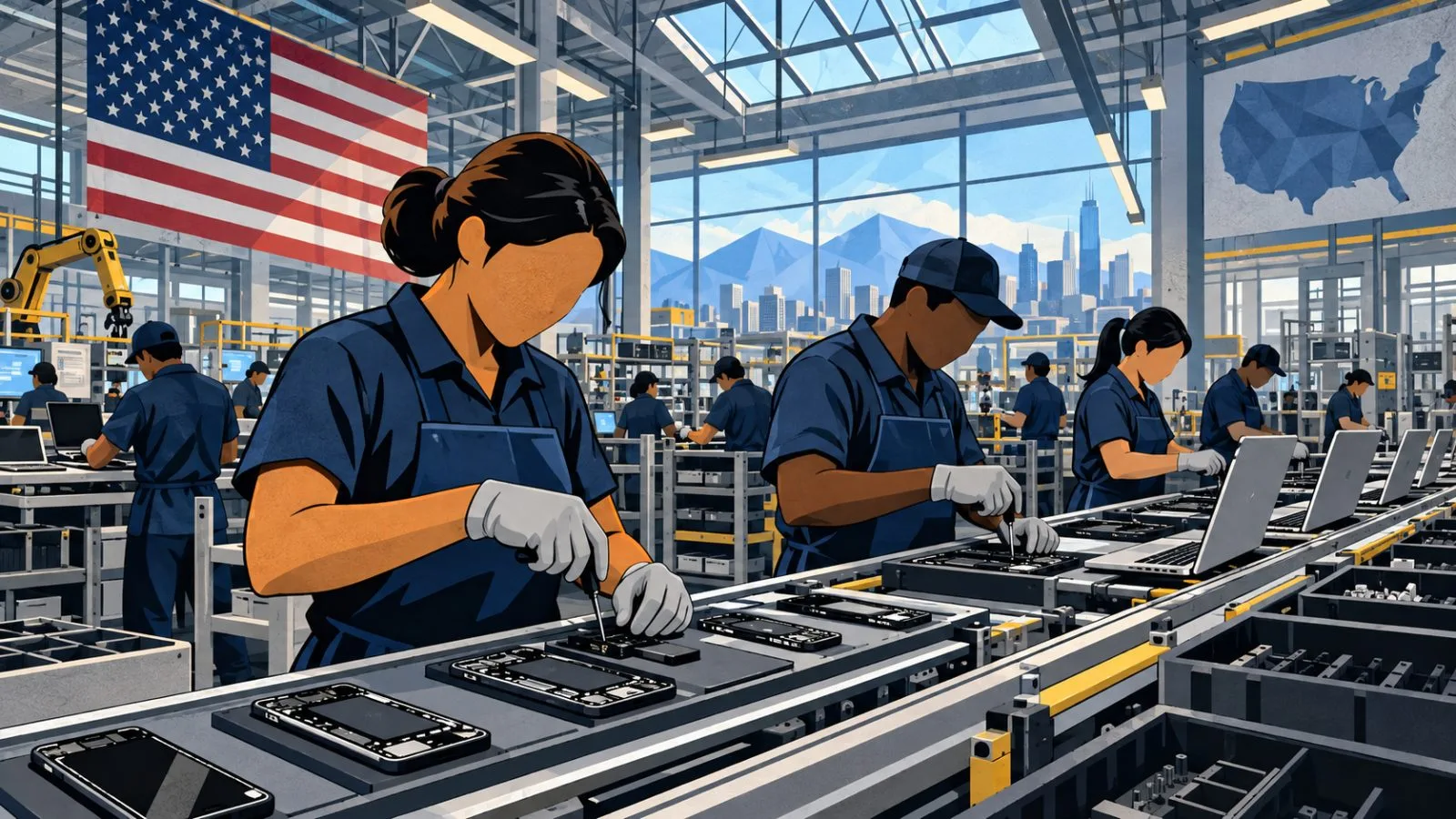
Fully domestic production across 10 consumer technology categories could require up to $230 billion and 668,000 workers while producing an average retail-price increase of as much as 55% across the categories.
The full-production scenario would require $185 billion to $230 billion in capital spending, 555,000 to 668,000 additional full-time workers and 19.1 billion to 19.5 billion kilowatt-hours of electricity annually.
The categories include computer monitors, laptops, robotic vacuums, smart speakers, smartphones, smartwatches, televisions, video game consoles, wireless earbuds and wireless headphones. Full domestic production means assembling the products in the United States with components sourced entirely within the country.
Under the model, manufacturing costs would rise 41% to 152%. Smartphones would face the largest increase at 152%, followed by smartwatches at 97%, laptops at 93%, video game consoles at 58%, robotic vacuums at 52% and televisions at 41%.
The model assumes companies would pass 25% to 50% of those higher costs to consumers. That would produce an average retail-price increase of 27% to 55% across the 10 categories.
A narrower final-assembly approach would require $16 billion to $19 billion in capital spending, 61,000 to 73,000 workers and 1.4 billion to 1.8 billion kilowatt-hours of electricity annually. It would continue to depend on foreign-made components.
Under that scenario, modeled retail-price increases would range from 17% to 33% for smartphones, 12% to 25% for laptops, 7% to 14% for smartwatches, 7% to 15% for video game consoles, 1% to 2% for robotic vacuums and 2% to 3% for televisions.
The analysis concludes that full reshoring is neither economically attractive nor readily feasible, while selective domestic assembly is a more viable path. It identifies reducing or eliminating tariffs on component parts from partners and allies as the measure most likely to make domestic assembly cost-effective.
“As policymakers across the political spectrum push for more U.S. manufacturing, this study provides new data on what it would cost to actually produce popular technology products in the United States,” Gary Shapiro, executive board chair of the Consumer Technology Association, said.
The figures are engineering-based modeled estimates rather than observed production costs or announced consumer prices. The analysis applies tariff measures in effect as of September 2026.
President Donald J. Trump’s Genesis Mission executive order, signed Nov. 24, 2025, identifies advanced manufacturing, critical materials, nuclear energy, quantum information science and semiconductors and microelectronics as priority areas. The order does not require consumer technology products to be made entirely in the United States.
Riza Dagoc
Riza Dagoc reports on regulation, investing and the digital-asset business for TokenPost. Send corrections or tips to info@tokenpost.com.