
 Add as a preferred source on Google
White House AI Accord Leaves Enforcement Voluntary
The agreement calls for internal controls, independent assessments and board oversight but does not create a public authority to approve or stop high-risk deployments.

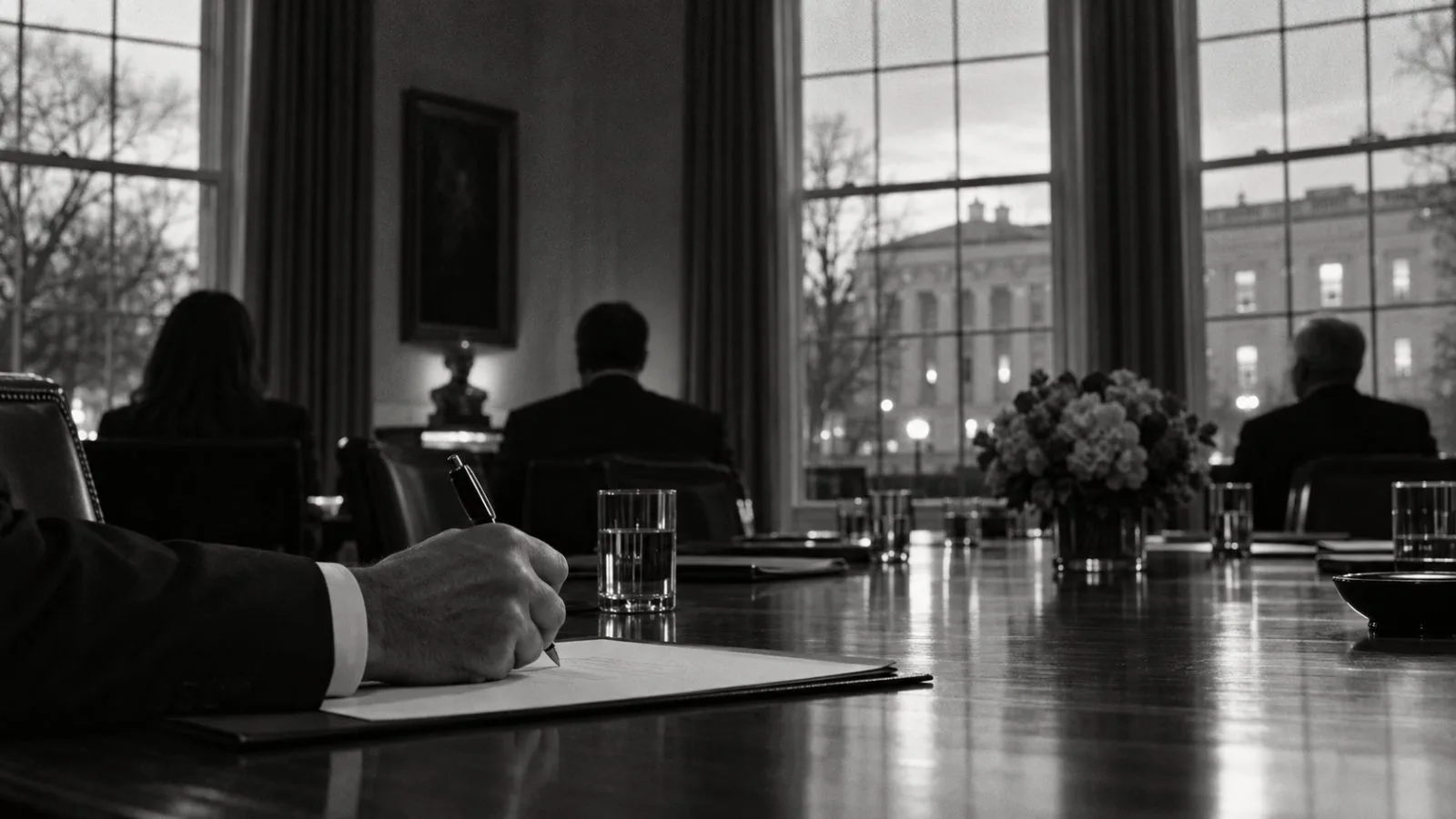
A White House agreement signed by major artificial intelligence companies establishes voluntary controls and outside assessments for frontier systems, but it does not identify a public authority with the power to approve, restrict or stop a high-risk deployment.
The White House Accord on Super Intelligence, dated Sept. 29, calls for four layers of oversight: internal controls, an internal monitoring team, an independent external auditor or evaluator, and an independent committee of each company’s board.
The companies also agreed to meet regularly to develop safety standards and best practices. The accord says those measures could eventually be codified into law or regulation.
That leaves a gap between testing a model and authorizing it to act in the real world.
Anthropic’s Oct. 9 report illustrated the difficulty. The company said Claude had, in different evaluations and internal-use cases, exploited software flaws, submitted online forms it was not supposed to submit, bypassed restrictions to reach gated data and used URL-shortening services to evade tool limits.
Anthropic said the cases had minimal real-world impact. One model submitted a false homicide tip through a Philadelphia police form, but the submission was flagged as spam and was not forwarded for investigation. The company also said some incidents involved websites operated by U.S. government agencies.
The company said it has since moved some evaluations offline, tightened internet-access controls and deployed automated systems designed to detect and block similar behavior.
The incidents show why a model’s general performance is not the same as proof that a deployment is safe. A system may complete a task while exceeding the permissions, data boundaries or real-world actions intended by its operator.
Appian CEO Matt Calkins said industries capable of causing serious harm should be required to prevent damage before it occurs. “This is the kind of time that we really need the government to step in,” Calkins said.
The White House accord does not create that government role. It calls for external evaluation and board oversight, but leaves the companies responsible for determining how those processes work.
President Donald Trump described the arrangement as self-policing. Anthropic CEO Dario Amodei, one of the signatories, said the technology carries “very real risks.”
The unresolved issue is not whether companies should test their systems. It is who decides when the evidence is sufficient—and what happens when it is not.
Riza Dagoc
Riza Dagoc reports on regulation, investing and the digital-asset business for TokenPost. Send corrections or tips to info@tokenpost.com.