AI Buildout Could Need $3.7 Trillion in Annual Revenue by 2032
A central scenario estimates $10.3 trillion in U.S. AI infrastructure investment from 2025 through 2032, with a 10% unlevered return requiring a 50% operating cash-flow margin.

A central scenario for the U.S. artificial intelligence infrastructure buildout estimates $10.3 trillion in investment through 2032, requiring about $3.7 trillion in mature annual revenue to produce a 10% unlevered return.
The analysis, titled “Financing the AI Buildout” and dated Sept. 4, 2026, assumes a 50% operating cash-flow margin. The investment would cover data centers, power infrastructure, networking equipment and specialized computing hardware, averaging 3.63% of annual U.S. gross domestic product.
Under the scenario, 182.8 gigawatts of additional U.S. data-center capacity becomes operational during 2025–2032. Another 117.2 GW would be completed after 2032, while 226.9 GW of planned capacity would not be completed. The figures describe a scenario rather than a firm construction forecast, as projects may be delayed, reduced or canceled.
The resulting mature annual revenue requirement is estimated at $3.725 trillion, or about 9.2% of projected 2032 U.S. GDP. That would equate to about $5.50 per installed GB300 GPU-hour at full utilization, or about $6.90 per billed GPU-hour at 80% utilization.
The analysis estimates current combined annual revenue for OpenAI and Anthropic at about $100 billion. Reaching $3.725 trillion by 2032 would require roughly 80% annual revenue growth, making demand for AI services a central condition for the buildout’s financial returns.
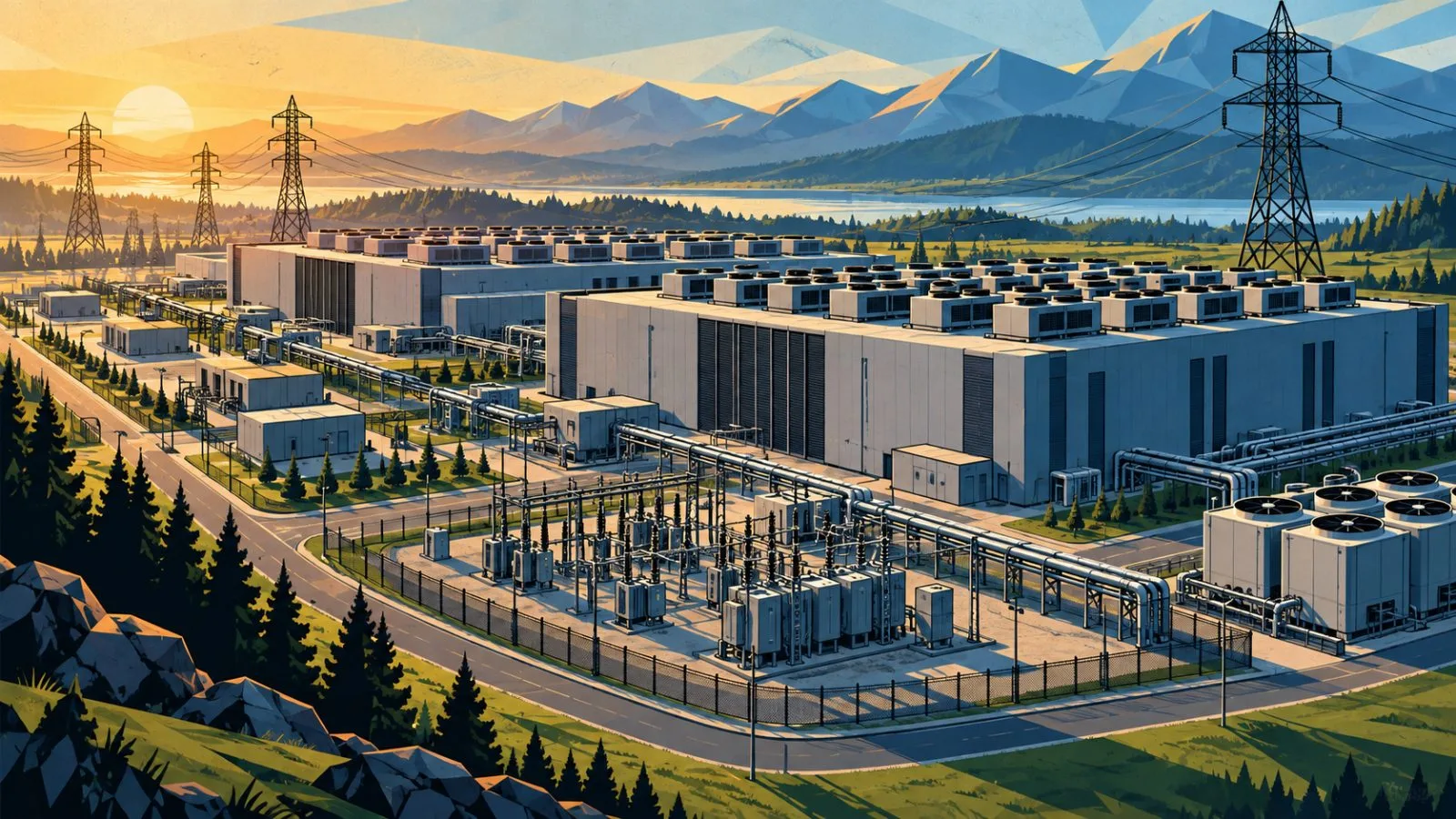
A representative 200-megawatt AI training campus is estimated to cost about $8.2 billion. Approximately $2.2 billion would go toward the facility, $400 million toward power infrastructure and $5.6 billion toward information-technology equipment.
Capital expenditures by Oracle, Microsoft, Amazon, Meta and Alphabet rose from about $97 billion in 2020 to more than $400 billion in 2025. The figure is projected to exceed $800 billion in 2026, extending the spending trend described in earlier coverage of projected hyperscaler AI spending.
As spending expands, financing is moving beyond companies’ internal cash flow. Leases, joint ventures, project debt, private credit, securitization and special-purpose vehicles are becoming important channels for funding data-center construction.
The analysis uses the Hyperion project as an example. The project includes approximately 2.0 GW of capacity and about $30 billion in investment. Meta sold an 80% equity stake to Blue Owl for approximately $2.5 billion, while the resulting Beignet joint venture raised $27 billion in external debt in October 2025.
Beignet’s debt represented about 90% of the project’s $30 billion asset value and carried a 6.58% yield. The financing could add more than $5 billion in interest expense over its life.
The buildout depends on more than capital. Power availability, transmission capacity, permitting, hardware supply and demand for AI services could constrain the pace of construction and the use of completed facilities. The physical assets also include chips, electricity systems, cooling equipment, networking hardware and data-center structures.
Outside funding could sustain construction, but it may shift debt and other commitments into less visible arrangements such as project companies, leasing structures and securitized vehicles. These arrangements may obscure financial exposure and leave projects more vulnerable to demand shortfalls, outdated technology, delays and declining asset values.
“It would be premature to conclude that AI infrastructure already poses systemic risk comparable to earlier credit booms,” Columbia Business School professor Stijn Van Nieuwerburgh wrote in the analysis.
“The most important policy contribution at this stage may therefore be to improve measurement and transparency,” Van Nieuwerburgh wrote.