
 Add as a preferred source on Google
AI Power Bottlenecks Could Shift Risk Across the Chip Supply Chain
U.S. electricity demand is rising as data-center projects face constraints involving power, grid connections, land, permits and completed facilities.

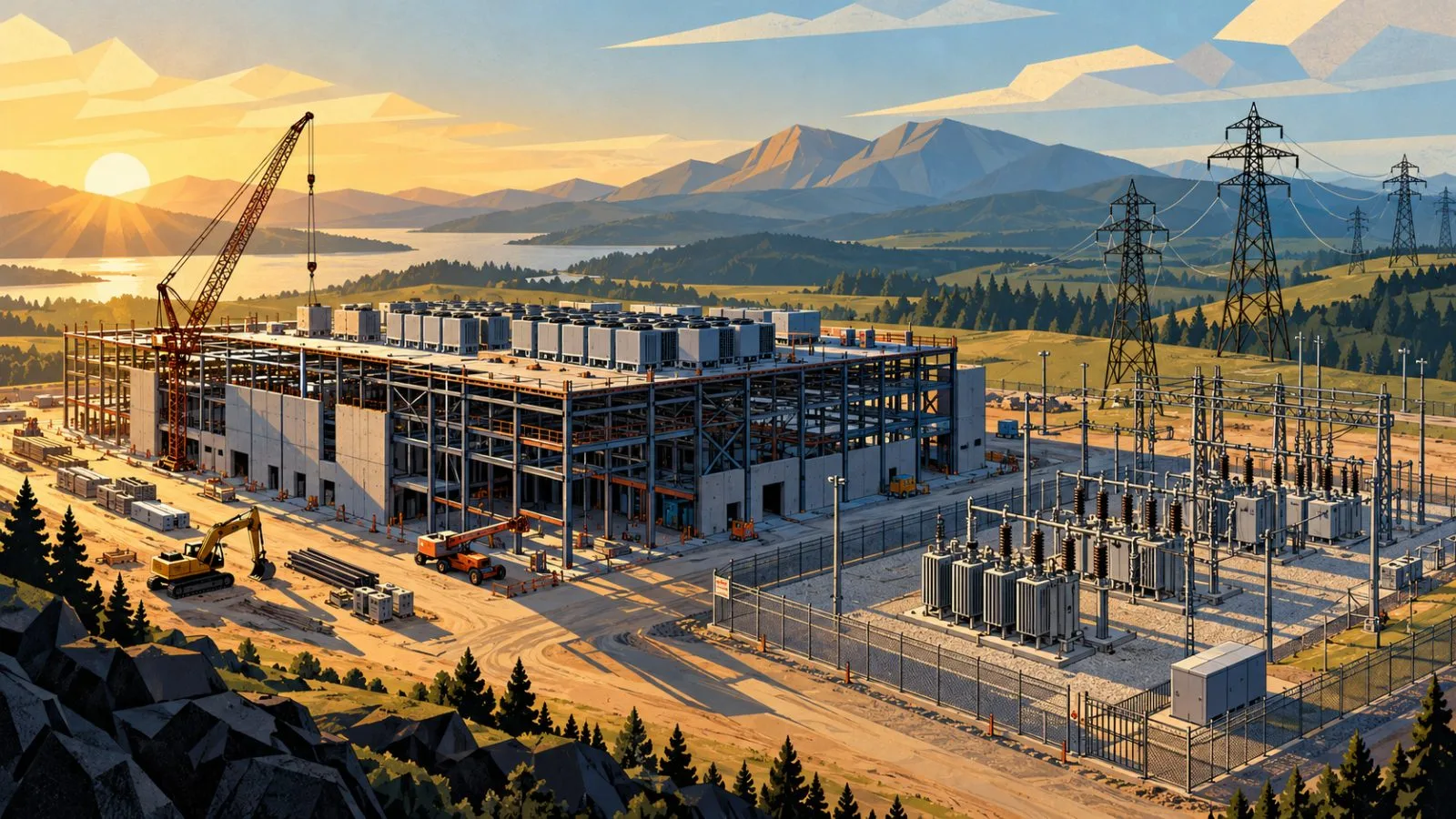
U.S. data-center expansion is facing rising power and infrastructure constraints that could change how AI-related hardware demand reaches suppliers, even as major technology companies continue to post strong results.
U.S. electricity sales are forecast to reach 4,135 billion kilowatt-hours in 2026 and 4,211 billion kilowatt-hours in 2027. Commercial consumption is expected to account for 63% of total sales growth in 2026 and 56% in 2027, with large computing facilities among the main sources of rising demand.
The pressure extends beyond electricity generation. Projects also need transmission connections, substations, transformers, permits, land and completed data-center buildings before computing equipment can operate.
About 2,061 gigawatts of generation and storage capacity were actively seeking transmission-grid interconnection at the end of 2025. That included approximately 1,312 gigawatts of generation and 749 gigawatts of storage across about 8,200 projects.
The queue is an indicator of grid pressure, not a direct measure of electricity available for data centers. It excludes behind-the-meter projects and requests to connect electricity loads, including the separate demand created by large computing facilities.
A gigawatt measures power capacity. An IT gigawatt refers to electricity delivered to information-technology equipment, while total generation requirements can be higher because of cooling, transmission and other infrastructure. NVIDIA’s Ohio PORTS-Pike project is planned to secure an initial 4.25 IT-GW, with an option for another 3.75 IT-GW.
The timing of facility completion may become increasingly important across the AI hardware market. GPU and custom-accelerator suppliers can potentially direct shipments toward projects that already have power and buildings available. Memory, optical-component, power-management and server suppliers are more closely tied to the point at which a complete facility is ready to operate. This is an analysis of the deployment sequence, not a confirmed ranking of companies by revenue risk.
Current results show that AI demand remains strong. NVIDIA posted fiscal second-quarter 2027 revenue of $96.2 billion for the quarter ended July 26, up 106% from a year earlier. Data-center revenue reached $89 billion, up 117%.
“AI has reached its inflection point. It’s doing useful work. Its tokens are productive and profitable. Now, compute is revenue,” NVIDIA founder and CEO Jensen Huang said.
NVIDIA also warned that shortages of land, power, shell capacity and capital could affect future revenue and financial performance. The company plans to invest $1.5 billion in SB Energy, while SB Energy and SoftBank plan at least 10 gigawatts of new generation and at least $4.2 billion in regional grid infrastructure.
Broadcom posted fiscal third-quarter 2026 revenue of $29.6 billion for the quarter ended Aug. 2, 2026, up 86% year over year. AI-semiconductor revenue rose 221% to $16.7 billion, and fourth-quarter AI-semiconductor revenue is forecast at $21.7 billion.
“Demand for our custom AI accelerators and networking continues to be very strong,” Broadcom President and CEO Hock Tan said.
Other parts of the buildout are also showing strong activity. Dell booked $60.9 billion in AI-server orders, recognized $16.4 billion in AI-server revenue and ended its fiscal second-quarter 2027 with a $95 billion AI-server backlog. Micron posted fiscal fourth-quarter 2026 revenue of $54.23 billion for the quarter ended Sept. 3, 2026, compared with $11.32 billion a year earlier.
Infrastructure suppliers are seeing similar demand. Eaton’s total Electrical-sector backlog increased 43% year over year. Vertiv posted second-quarter 2026 sales of $3.274 billion and forecast full-year sales of $13.8 billion to $14.2 billion. GE Vernova recorded $24.2 billion in second-quarter orders, while data-center-related orders exceeded $5 billion year to date.
The market’s exposure therefore depends partly on where a company sits in the deployment chain. Strong chip orders do not by themselves show that future revenue will be unaffected by delays in power delivery or facility completion. The distinction is especially relevant as investors assess companies connected to AI infrastructure bottlenecks.
NVIDIA’s Ohio project is expected to come online in phases beginning in 2028. The AI buildout will therefore face two linked tests: whether demand for computing hardware remains strong and whether the power system can deliver the facilities needed to turn those orders into operating capacity.
Simon Yoon
ReporterSimon Yoon reports on blockchain technology for TokenPost. Send corrections or tips to info@tokenpost.com.