
 Add as a preferred source on Google
Battery Rooms Draw New Fire-Safety Scrutiny at Data Centers
A South Korean data-center fire led to inspections of 178 facilities, while an Oregon incident began inside a UPS cabinet and was not caused by lithium-ion batteries.

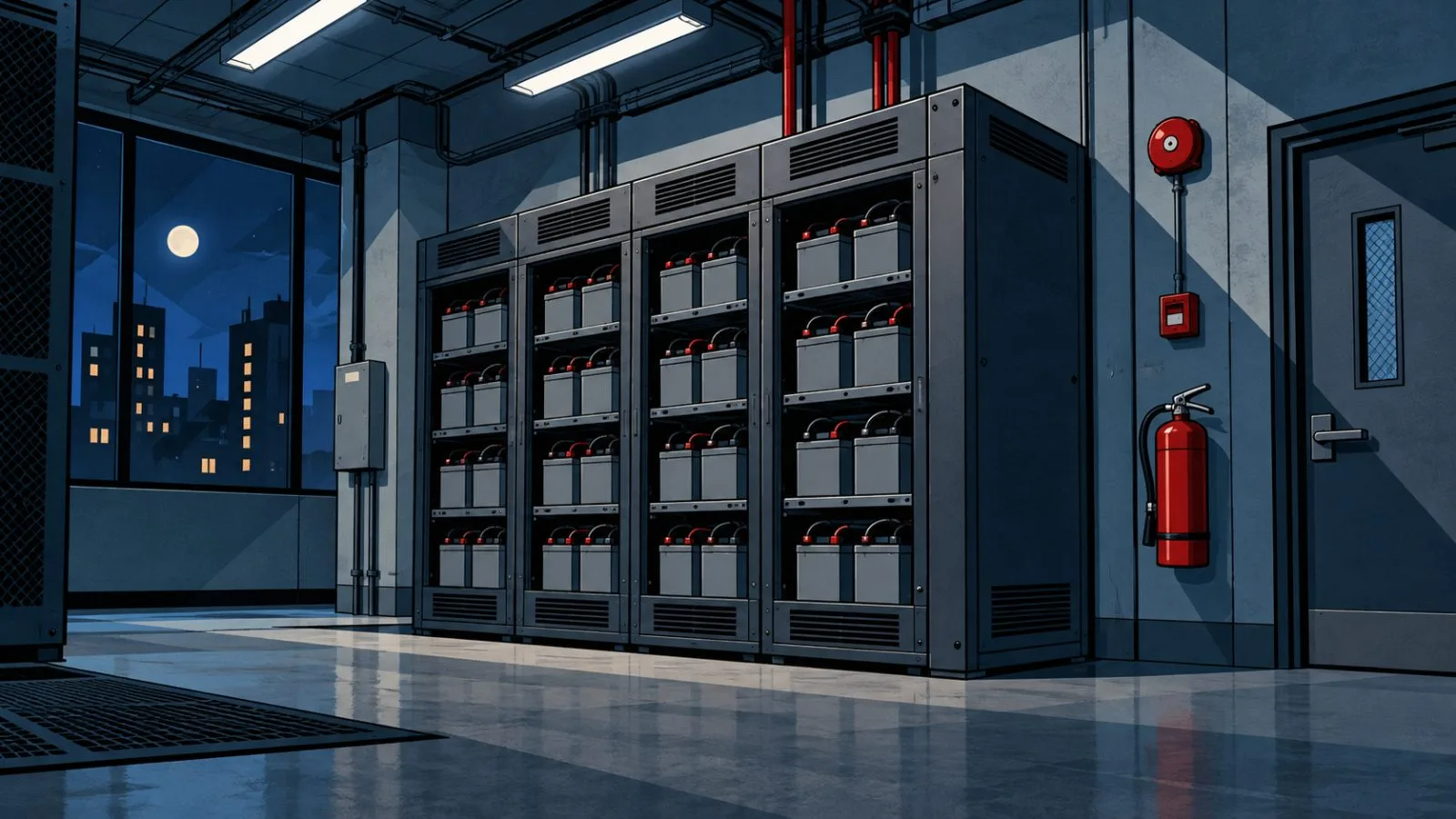
Data-center battery rooms are facing closer fire-safety attention after a South Korean incident prompted inspections of 178 facilities, while a separate Oregon fire highlighted the risks around uninterruptible power supply equipment.
Uninterruptible power supplies (UPS) and battery-energy-storage systems help maintain electricity during grid disruptions. Lithium-ion batteries offer high energy density in compact spaces, but damaged, overcharged or internally shorted cells can enter thermal runaway.
Thermal runaway can generate extreme heat, release gases and ignite nearby cells. Temperatures can exceed 1,000 F (538 C) during the process, although that figure is not tied to a specific incident.
A fire began in one UPS battery during relocation work at South Korea’s National Information Resources Service in Daejeon at about 7:15 a.m. ET (11:15 a.m. UTC) on Sept. 26, 2025. The incident shut down 647 systems. About 70 were initially affected directly, while the remaining systems were taken offline after cooling systems stopped working.
The fire was extinguished at about 5:30 p.m. ET (9:30 p.m. UTC) on Sept. 26. The battery type and precise cause had not been established at the time of the briefing, so the incident does not establish that lithium-ion batteries caused the fire.
Inspections covering 178 South Korean data centers took place from Oct. 21 through Oct. 31, 2025. The checks included batteries, electrical equipment, battery-management systems, fire-protection equipment and separation between server rooms and UPS battery rooms.
A separate fire at a Digital Realty data center in Hillsboro, Oregon, began at about 1:20 p.m. ET (5:20 p.m. UTC) on May 22, 2025. Firefighters contained it to one room. No injuries were reported, and estimated losses totaled $260,000.
The fire originated in a Schneider Electric Galaxy VX UPS cabinet. Investigators could not determine whether ignition resulted from an electrical or mechanical failure. William Reynolds, a Digital Realty spokesperson, said the fire was electrical in nature and was not caused by lithium-ion batteries.
“A UPS houses large battery packs which, much like electric-vehicle batteries, can be susceptible to fires caused by electrical failures or temporary high loads,” said Shaolei Ren, an electrical and computer engineer at the University of California, Riverside.
Safety standards address conditions that can allow battery failures to spread. NFPA 855 covers stationary energy-storage-system installation, while UL 9540A evaluates battery behavior during thermal runaway at the cell, module, unit and installation levels. The testing includes gas release, ignition, deflagration and fire spread.
Hydrogen can be an early measurable gas during some lithium-ion failures, raising the possibility that off-gas detection could provide warning before visible smoke or flames. Hydrogen was not established as a factor in either incident.
The South Korean inspection program places battery-room layout, cooling, fire separation, detection and UPS maintenance among the data-center resilience issues under review.
Simon Yoon
ReporterSimon Yoon reports on blockchain technology for TokenPost. Send corrections or tips to info@tokenpost.com.