
 Add as a preferred source on Google
U.S. 1-Gigawatt AI Data Centers Can Cost $38 Billion
AI hardware accounts for most of the upfront bill, while construction, land and electricity prices create major differences across U.S. markets.

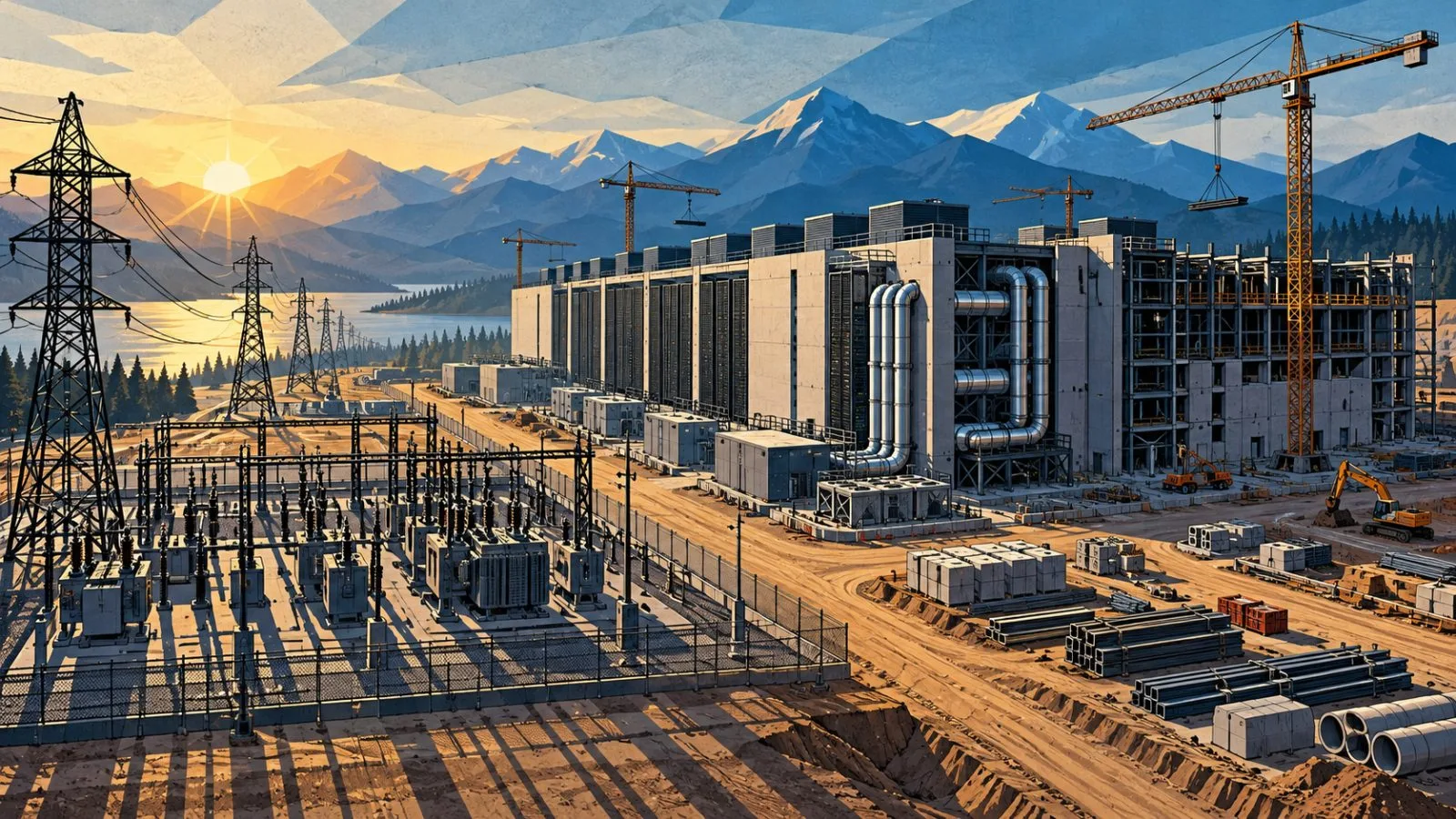
A 1-gigawatt artificial intelligence data center can require about $38 billion in upfront capital when AI chips are included, making hardware, construction, land and power access key factors in where new U.S. capacity is built.
A comparable facility without the chips averages about $17.6 billion. A gigawatt represents 1,000 megawatts of power-demand or supply capacity for the facility, rather than the amount of electricity it necessarily consumes at every moment.
A cost model for a 1-gigawatt facility using NVIDIA GB200 NVL72 racks estimates total capital spending at $37.88 billion. Servers account for $21.19 billion and networking equipment for $4.93 billion, together making up nearly 70% of the total.
Buildings and mechanical, electrical and plumbing systems account for $11.43 billion, or about 30%. Land costs $172 million, while substations, fiber and other utility infrastructure add $164 million. Removing the servers and networking equipment leaves about $11.8 billion for construction, land and utilities.
Location creates another major difference. Traditional air-cooled construction costs $13.31 per watt in Silicon Valley, compared with $10.92 in Northern Virginia, $9.54 in Dallas and $9.50 in Charlotte.
At 1 gigawatt, those figures translate to roughly $13.3 billion in construction costs in Silicon Valley and $9.5 billion in Dallas, a gap of about $3.8 billion. The comparison excludes land and chips. High-density U.S. AI facilities using liquid cooling cost 7% to 10% more than traditional air-cooled facilities.
Land prices are also rising, especially for sites with power already connected to the grid. A 97-acre parcel in Loudoun County, Virginia, changed hands for $615 million in November 2025, or about $6.3 million per acre. That was roughly 50 times the county’s median land price cited for 2025, although the properties had different conditions.
Along Texas’ Highway 67 corridor, land that sold for $20,000 to $40,000 per acre several years ago exceeded $350,000 per acre in some areas in 2026.
Electrified land in major U.S. markets averaged $584,000 per megawatt in 2026 to date, up 35% from the five-year average and 51% from a year earlier. At that rate, land for a 1-gigawatt facility would cost about $584 million, less than 2% of a $38 billion project.
Electricity can have a larger long-term effect because it is an ongoing operating expense. The U.S. industrial average was 9.77 cents per kilowatt-hour in July 2026. California averaged 25.11 cents, Virginia 10.07 cents and Texas 7.07 cents.
Construction costs have also risen. Average cost per megawatt increased 21% in less than two years as supply chains tightened, skilled-trade wages rose and key components became more expensive. Wages for mechanical, electrical and plumbing workers increased an average of 5% annually from 2021 through 2024.
Developers are increasingly seeking locations with available land, electricity and more flexible regulations. Capital spending in emerging markets outside traditional data-center hubs is expected to reach $631 billion, or 6.9 times current levels.
The shift comes as global data-center power-demand capacity is projected to reach 161 gigawatts in 2026. That measure includes the power capacity required by servers and supporting systems, including cooling and other non-IT infrastructure.
Simon Yoon
ReporterSimon Yoon reports on blockchain technology for TokenPost. Send corrections or tips to info@tokenpost.com.