
 Add as a preferred source on Google
Robotics Firms Expand Data Collection for Physical AI Training
Dyna Robotics is using more than 1 million hours of human video, while Innodata and Scale AI are expanding motion-capture and robot demonstration programs.

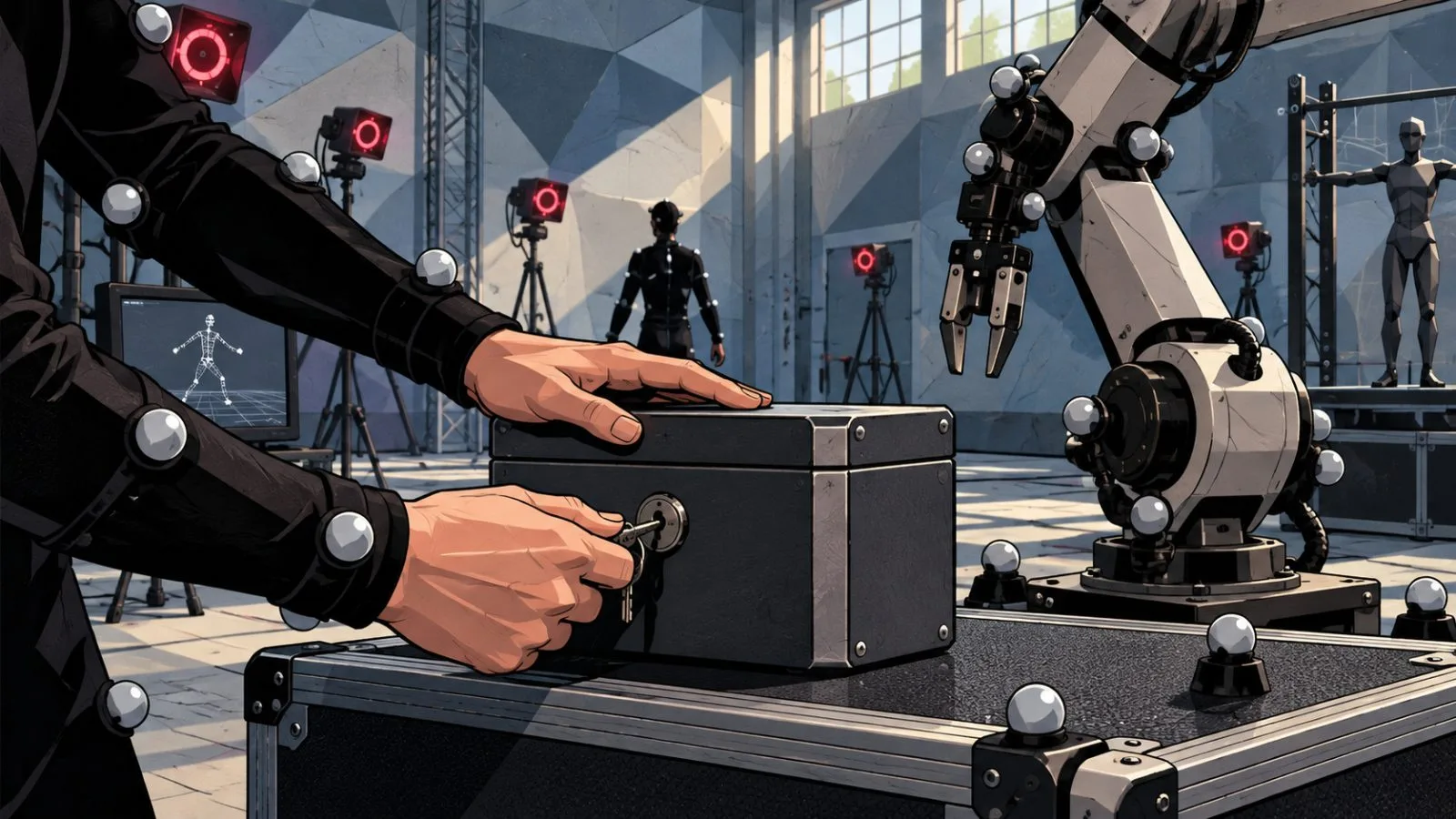
Robotics companies are expanding the use of human video, motion-capture data and robot demonstrations to train physical-AI models for tasks involving movement and manipulation.
Dyna Robotics says its Dyna-2 model was pretrained on more than 1 million hours of egocentric human video, or footage recorded from the performer’s viewpoint. The company equates that volume to about 170 years of continuous waking experience.
Dyna says expanding the pretraining dataset from 1,000 to 1 million hours improved the average normalized score across 14 tasks to 53% from 20%.
Dyna reports that the model reached a 90% success rate on a lockbox key-turning task after training at the 1-million-hour level. The company says models trained on up to 100,000 hours did not turn the key. Dyna says the models used only human video during pretraining and received a few hours of robot data during post-training.
The results indicate that human activity footage can be used to help train systems for robot tasks that were not part of their pretraining. Dyna’s figures are benchmark results from the company’s evaluation and do not establish readiness for broad household or factory deployment.
Innodata announced a motion-capture research and development lab in New Jersey on Sept. 30, 2026. The facility uses Vicon infrared optical cameras capable of measuring movement to the sub-millimeter level.
Innodata says the lab records three-dimensional movement directly from people, robots and objects, rather than estimating movement from ordinary two-dimensional video. The system is designed to capture humans and machines moving in the same space.
“There’s just no substitute for direct 3D motion capture,” said Frank Tanner, vice president of robotics and physical AI at Innodata. Tanner added that readings for a humanoid weighing almost 200 pounds must be precise rather than approximate.
Scale AI is adding demonstrations from real-world environments through data factories, residential collection and commercial or industrial deployments. The company says more than 1,000 hours of demonstration data are collected and uploaded to its platform each day.
Scale AI announced a partnership with Universal Robots on March 16, 2026, to collect visual and force-feedback data directly from production robots. Scale says Universal Robots hardware is used in more than 100,000 industrial deployments.
“Scale shares our belief that the future of robotics AI will be shaped as much by data quality as by model architecture,” said James Davidson, chief AI officer of Teradyne Robotics.
Simon Yoon
ReporterSimon Yoon reports on blockchain technology for TokenPost. Send corrections or tips to info@tokenpost.com.